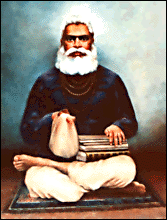
Srila Bhaktivinoda Thakura's
Sri Tattva-sutra - The Truth
To Read the text below easily you will need the Balaram FONT
Table of Contents:Chapter One
Tattva-prakarana - The TruthChapter Two
Cit-padartha-prakarana - SpiritChapter Three
Acit-padartha-prakarana - MatterChapter Four
Sambandha-prakarana - The Relationship of the Supreme Personality of Godhead and the Individual Spirit SoulsChapter Five
Siddhanta-prakarana - The Final Conclusion
Chapter OneTattva-prakarana
The TruthIntroduction by Srila Bhaktivinoda Thakura
All glories to Madana-mohana, who is eternal and full of knowledge and bliss. He is dear to the saintly devotees, and He is an ocean of mercy for the fallen souls.
I, who thirst to taste a drop of Lord Madana-mohana's mercy, shall now write these sutras describing the eternal truths of spiritual life. As far as I understand, so I shall write.
Bowing down before Lord Sri Krsna Caitanya, the eternal maintainer of all the worlds, I shall now write this Tattva-sutra and a commentary upon it.
In Srimad Bhagavatam (1.2.11) Suta Gosvami explains:
"Learned transcendentalists who know the Absolute Truth call the non-dual substance Brahman, Paramatma or Bhagavan."*
In the Yajur Veda, Vajasaneya-samhita, seventh mantra, it is said:
"One who always sees all living entities as spiritual sparks, in quality on with the Lord, becomes a true knower of things. What, then can be illusion or anxiety for him?"*
In the Bhagavad-gita (7.7.), the Supreme Personality of Godhead Himself declares:
"O conqueror of wealth, there is no truth superior to Me. Everything rests on Me, as pearls are strung on a thread."*
In the mangalacarana of the Narada-pancaratra, the author of that book declares:
"One should meditate on the Supreme Truth, who is known as Brahman, Paramatma, and Isvara. His activities are never material. He is never touched by matter. He is never touched by the modes of material nature. He is beyond the world of matter. He is the master of all. He is everything. He is the cause of all causes. He is the eternal truth, the ancient and imperishable Supreme Person."
In the Markandeya Purana, Fourth Chapter, it is said:
"Nothing is smaller than He. Nothing is greater than He. He is the unborn creator of the universes. He is present everywhere."
Here someone may protest: Is it not so that Sri Vyasadeva and other authors of sutras must always begin their sutra books with the word "atha" (now)? The sutras "athato brahma-jijnasa" and "athato dharma-jijnasa" are examples of this. This must be done both to bring auspiciousness and to state the topic one wishes to understand. Thus when one writes a book about Brahman or about dharma one must begin with an introduction describing the topic to be discussed in the book. Why has the author of Tattva-sutra not done this?
If this protest is spoken, I give the following reply: This protest is not correct. because in the first sutra of this book the supremely auspicious Supreme Personality of Godhead is described, there is no need for a separate mangalacarana to invoke auspiciousness. Also, the subject matter of this book is self-evident, and so it needs no introduction. Therefore, without any introduction, the first sutra declares:Sutra 1
The Supreme is one. He has no rival.
Commentary by Srila Bhaktivinoda Thakura
The Sruti-sastra declares:
"There is one Supreme God. He has no rival. There are not many Gods."
Here someone may protest: If it were so that there is only one Supreme God and no other Gods, then that one God would have to perform by Himself all the many duties involved in creating, maintaining, and destroying the universes. He would have to perform them all without any help from anyone else.
To refute this protest, the author of the sutras speaks the following words:
Sutra 2
Because He is limitless, He has all powers, even though He remains beyond the touch of the modes of material nature.
This sutra means that the Supreme Personality of Godhead is beyond the modes of nature and He has all powers. This is so because He is limitless, which is to say that He cannot be measured or understood by direct perception of the material senses or by any other material means. This is described in the following words of Svetasvatara Upanisad (3.19):
"His potencies are multifarious, and thus His deeds are automatically performed as a natural sequence."*
In Srimad Bhagavatam (2.2.35) Srila Sukadeva Gosvami explains:
"The Personality of Godhead Lord Sri Krsna is in every living being alone with the individual soul. And this fact is perceived and hypothesized in our acts of seeing and taking help from the intelligence."*
In Srimad Bhagavatam (4.20.7) it is also said:
"The individual soul is one, pure, non material, and self effulgent. He is the reservoir of all good qualities, and He is all-pervading. He is without material covering, and He is the witness of all activities. He is completely distinguished from other living entities, and He is transcendental to all embodied souls."*
In Srimad Bhagavatam (11.7.23) it is also said:
"Although I, the Supreme Lord, can never be captured by ordinary sense perception, those situated in human life may use their intelligence and other faculties of perception to directly search for Me through apparent and indirectly ascertained symptoms."***
In the Narada-pancaratra it is said:
"The Supreme Personality of Godhead, who is beyond the world of matter, who is the supreme object of worship, whose desires are all fulfilled, and whom all living entities yearn to attain, is described in the Pancaratras."
Here someone may protest: You consider the Supreme both beyond the modes of material nature and the master of all potencies. How is it possible to ascribe these two mutually contradictory natures to the Lord?
In the following words the author of the sutras refutes this protest:
Sutra 3
No one should be surprised that the Supreme possesses mutually contradictory natures.
Commentary by Srila Bhaktivinoda Thakura.
That the Supreme Personality of Godhead possesses mutually contradictory natures should not be a source of wonder. In the Svetasvatara Upanisad (3.19) it is said:
"Although the Supreme Lord is described as having no hands or legs, He nonetheless accepts all sacrificial offerings and moves very quickly. He has no material eyes, yet He sees everything. He has no material ears, yet He hears everything."*
In Bhagavad-gita (4.39-40), the Lord declares:
"A faithful man who is dedicated to transcendental knowledge and who subdues his senses is eligible to achieve such knowledge, and having achieved it he quickly attains the supreme spiritual peace.*
"But ignorant and faithless persons who doubt the revealed scriptures do not attain God consciousness. They fall down. For the doubting soul there is happiness neither in this world nor in the next."*
Here someone may ask: How can one understand the truth of this Supreme who has many mutually contradictory natures?
To answer this question the author of the sutras speaks the following words:
Sutra 4
He is eternal and full of knowledge and bliss. He cannot be known by ordinary knowledge, for He is known only by devotional service.
Commentary by Srila Bhaktivinoda Thakura
The Supreme Personality of Godhead is eternal and full of knowledge and bliss. He cannot be known by the material mind or described by material words. He is known only by devotional service. The Sruti-sastra declares:
"The material mind cannot understand the Supreme. Material words cannot describe Him."
In Srimad Bhagavatam (11.12.21), the Supreme Lord Himself declares:
"I am understood only by devotional service."
In the Sruti-sastra it is said:
"The Supreme is eternal and full of knowledge and bliss."
In the Brahma-samhita (5.1) it is said:
"Krsna, who is known as Govinda, is the supreme controller. He has an eternal, blissful, spiritual body. He is the origin of all. He has no other origin, for He is the prime cause of all causes."*
In the Visnu Purana is the following explanation of the word sac-cid-ananda:
"O Lord, You are the support of everything. The three attributes hladini, sandhini, and samvit exist in You as one spiritual energy. But the material modes, which cause happiness, misery, and mixtures of the two, do not exist in You, for You have no material qualities."*
A commentary on this verse follows:
The verse means, "O Supreme Personality of Godhead, in You, who are the Supreme Personality of Godhead, the supreme controller, and the shelter of all, exists one inconceivable potency, which is manifested in three as hladini, sandhini, and samvit." That is the meaning. The question may be asked, "O Lord, what are You like?" The verse explains, "O Lord, You are beyond the material modes of goodness, passion and ignorance." This means that the material modes, which cause happiness, misery and mixtures of the two, do not exist in the Lord. It is the potency of spiritual bliss that exists in the Lord. Thus it is said.
In the Markandeya Purana, Sakti-mahatmya, First Chapter, Candi declares:
"No one should be surprised that the Supreme Personality of Godhead enjoys pastimes of yoga-nidra (mystic sleep). After all, the Lord's illusory potency maya bewilders the entire material world.
"Entering even the sages' hearts, Goddess Maha-maya bewilders the conditioned souls.
"By her this entire material universe of moving and unmoving beings is created. When she is satisfied she gives the blessing of liberation to the conditioned souls.
"She is the eternal transcendental knowledge that brings liberation. She is also the potency that binds the conditioned souls in the world of birth and death. She is the goddess of all goddesses."
In the Bhagavad-gita (9.8-9), the Supreme Personality of Godhead declares:
"The whole cosmic order is under Me. By My will it is manifested again and again, and by My will it is annihilated at the end.*
"O Dhananjaya, all this work cannot bind Me. I am ever detached, seated as though neutral."*
In the Hayasirsa-pancaratra it is said:
"The Supreme Lord's transcendental bliss is said to be of two kinds: 1. that of His form, and 2. that of His formless aspect. The form of the Lord is the shelter of His formless aspect. Therefore it is the bliss of the Lord's aspect with form that is really eternal and imperishable.
"The Lord's form and His formless aspect are both full of knowledge and beyond the touch of the material modes. These qualities are also present in the original forms of the individual spirit souls.
"In truth, there is no real difference between the Lord's form and His formless aspect. The difference is only an imagination of the Vedas. The two are like a jewel and its splendour."
In the Kapila-pancaratra it is said:
"The Supreme has two aspects: 1. His transcendental form, and 2. His formless aspect. Thus it should be known that all-powerful Lord Narayana has a form and is formless also."
In the Hayasirsa-pancaratra it is said:
"The Vedas say that the Supreme has no qualities. But they also say that He certainly does have qualities. By carefully considering all the statement of the Vedas, we have come to the conclusion that more weight should be given to the statements affirming the Lord's possession of transcendental qualities."
Here someone may protest: If this is so, and the Supreme Lord is attained by devotional service, then the Supreme Lord must be a resident of the material world, (for devotional services are rendered in the material world).
To refute this idea the author now speaks the fifth sutra.
Sutra 5
He is the eternal Supreme Truth, beginningless and endless, for He exists beyond the limits of space and time.
Commentary by Srila Bhaktivinoda Thakura
In the Sruti-sastra it is said:
"The Supreme is the eternal reality, full of knowledge and bliss."
"The Supreme is eternal. He never dies."
"The Supreme Lord never dies."
"The Supreme Lord is present everywhere in the material world, but He is also beyond it."
In Bhagavad-gita it is said:
"The Supreme Personality of Godhead is all-pervading."
In Srimad Bhagavatam it is said:
"Matter has no power to prevail over the Supreme Personality of Godhead, the master of the spiritual worlds."
In Srimad Bhagavatam (2.9.10) it is also said:
"In that personal abode of the Lord, the material modes of ignorance and passion do not prevail, nor is that any of their influence in goodness. There is no predominance of the influence of time, so what to speak of the illusory, external energy. It cannot enter that region. Without discrimination, both the demigods and demons worship the Lord as devotees."*
In the Katha Upanisad (1.3.15) it is said:
"The Supreme is beyond material sound, touch, form, taste, or smell. He is eternal. He never dies. He has neither beginning nor end. He is beyond the material world. One who takes shelter of Him escapes the mouth of death."
Here someone may protest: If the Supreme Lord is beyond the material world, as you say, then why does He create the material universes in the first place?
To answer this protect, the author of the sutras speaks the following words:
Sutra 6
Although He is transcendental, the playful Lord creates the material universes filled with conscious beings and inert matter.
Commentary by Srila Bhaktivinoda Thakura
In the Aitareya Upanisad (1.1.1.) it is said:
"With a glance the Supreme Personality of Godhead created the material worlds."
In the Chandogya Upanisad (6.2.3.) it is said:
"The Supreme Personality of Godhead thought: I am one. Let Me become many. I shall father many children."
In the Taittiriya Upanisad (3.1.1.) it is said:
"The Supreme Absolute Truth is that from which everything is born."*
In the Katha Upanisad (2.3.2-3) it is said:
"That Supreme Personality of Godhead is powerful like a thunderbolt. The entire world moves in fear of Him. They who know this become immortal.
"Out of fear of Him, fire burns. Out of fear of Him, the sun shines. Out of fear of Him, Indra, Vayu, and Yama act."
In Srimad Bhagavatam (3.25.42) the Supreme Personality of Godhead declares:
"It is because of My supremacy that the wind blows, out of fear of Me. The sun shines out of fear of Me, and the lord of clouds, Indra, sends forth showers out of fear of Me. Fire burns out of fear of Me, and death goes about taking its toll out of fear of Me."*
In Srimad Bhagavatam (10.29.1) it is said:
"Sri Krsna is the Supreme Personality of Godhead, full of all opulences, yet upon seeing those autumn nights scented with blossoming jasmine flowers, He turned His mind toward loving affairs. To fulfil His purposes He employed His internal potencies."***
In Sri Caitanya-caritamrta it is said:
"The holy name of Lord Krsna is the sweetest of the sweet and the most auspicious. It is the ripened fruit of the vine of all the Vedas. It is conscious and spiritual. O best of the Bhrgu dynasty, chanted only once, either with faith or even with contempt and mockery, the holy name of Lord Krsna delivers the chanter."
Srila Sukadeva Gosvami tells Maharaja Pariksit (Srimad Bhagavatam 12.3.14):
"O mighty Pariksit, I have related to you the narrations of all these great kings, who spread their fame throughout the world and then departed. My real purpose was to teach transcendental knowledge and renunciation. Stories of kings lend power and opulence to these narrations but do not in themselves constitute the ultimate aspect of knowledge."***
In the Gopala-tapani Upanisad (2.95) it is said:
"Whether visible or invisible in this world, My form always stays in My abode. My form is also present as the Deity of ignorance, the Deity of passion and the Deity of goodness. My humanlike form, which is eternal and full of transcendental knowledge and bliss, is present when My devotees serve Me with devotion."
In the next sutra the author refutes the idea that the transcendental potency is different from the Lord Himself.
Sutra 7
If someone claims, "The Lord is different from His potency", then I reply, "No. It is not so, for they are not different."
Commentary by Srila Bhaktivinoda Thakura
If someone claims that the Supreme Personality of Godhead, the creator of the worlds, is different from His potency, then this sutra is spoken to refute him. Because the Supreme Personality of Godhead is not different from His many potencies, the potencies are not different from Him. This is described in the following words of the Nyaya-sastra:
"The Supreme Personality of Godhead, the master of all potencies, is not different from His potencies."
In the Svetasvatara Upanisad (6.8.) it is said:
"The Lord's potencies of knowledge, power and action share His own nature. They are not different from Him."
In Visnu Purana (1.22.53) it is said:
"Just as the illumination of a fire, which is situated in one place, is spread over, the energies of the Supreme Personality of Godhead, Parabrahman, are spread all over the universe."*
In the Markandeya Purana, Devi-mahatmya, the sage explains:
"O king, now I will describe to you the glories of the goddess. By her power she sustains the entire world.
"She is the potency of Lord Visnu. From her comes transcendental knowledge. You and many others have attained transcendental knowledge by her grace."
In the Narada-pancaratra, Second Night, Third Chapter, Lord Siva explains:
"The Supreme Lord is one. Still, He is manifested in two forms. One form is female: the potency of Lord Visnu. The other form is male: The all powerful Supreme Personality of Godhead Himself.
"His form is dark. All His desires are at once fulfilled. He has all transcendental virtues. He is free of the modes of material nature. Anyone who directly sees Him will fall in love with Him and yearn to enjoy charming pastimes with Him."
Here someone may protest: Is it not so that by creating the material worlds and performing other activities the Supreme Personality of Godhead becomes affected by that activity and His nature becomes different from what it was before? Does He not become enamoured of what He has created?
In the next sutra the author refutes this misconception.
Sutra 8
Because He is supremely independent, He does not become changed, even though He is the creator.
Commentary by Srila Bhaktivinoda Thakura
Here the protester declares, "whoever creates the material world must of necessity become affected by passionate attachment, hatred, and other like emotions." To this protest the reply is that because He is supreme independent and can do whatever He wishes to do, by His own will the Lord remains peaceful and aloof from material passions. Therefore, even though He is the creator of the material world, the Lord is not affected by material passions. In the Svetasvatara Upanisad (6.19) it is said:
"The Supreme Personality of Godhead is perfect and complete. He is peaceful and flawless. He is never affected by the material energy. His actions are never material."
In the Katha Upanisad (1.2.14) it is said:
"You can see the Supreme, who stands beyond material piety and impiety, beyond past and future. Please tell me about Him."
In Srimad Bhagavatam (10.9.13-16) it is said:
"The Supreme Personality of Godhead has no beginning and no end, no exterior and no interior, no front and no rear. In other words, He is all pervading. because He is not under the influence of the element of time, for Him there is no difference between past, present, and future. He exists in His own transcendental form at all times. being absolute, beyond reality, He is free from distinctions between cause and effect, although He is the cause and effect of everything. That unmanifested person, who is beyond the perception of the senses, has now appeared as a human child, and mother Yasoda, considering Him her own ordinary child, bound Him to the wooden mortar with a rope."*
"When mother Yasoda was trying to bind the offending child, she saw that the binding rope was short by a distance the width of two fingers. Thus she brought another rope to join to it."*
"The new rope also was short by a measurement of two fingers, and when another rope was joined to it, it was still two fingers too short. As many ropes as she joined, all of them failed. Their shortness could not be overcome."*
In the next sutra the author reveals that the Supreme Lord does not increase when He creates the universe. Neither does He become less when He destroys the universe.
Sutra 9
Because He is perfect and complete, His nature is always unchanged.
Commentary by Srila Bhaktivinoda Thakura
In the Isa Upanisad it is said:
"The Personality of Godhead is perfect and complete."*
Here someone may ask: If the Supreme Personality of Godhead is perfect and complete, then what motivates Him to create the material world?
In the next sutra the author answers this question.
Sutra 10
Compassion is the motive of His actions. He has no other motive, for His every desire is at once fulfilled without any effort on His part.
Commentary by Srila Bhaktivinoda Thakura
Compassion is the motive of the Supreme Lord's actions. He has no other motive, for His every desire is at once fulfilled without any effect on His part. However, the conditioned souls act in a different way. They are busily engaged in various activities to attain their desires.
In the Sruti-sastra it is said:
"The conditioned souls act to fulfil their material desires."
"The Supreme Personality of Godhead has no need to act to fulfil His desires, for His every wish is at once fulfilled without His having to act."
In the Smrti-sastra it is said:
"There is not anything that the Supreme Personality of Godhead does not attain merely by wishing for it.
In Srimad Bhagavatam (3.7.2-3), Vidura asks the following question:
"O great brahmana, since the Supreme Personality of Godhead is the complete spiritual whole and is unchangeable, how is He connected with the material modes of nature and their activities? If this is His pastime, how do the activities of the unchangeable take place and exhibit qualities without the modes of nature?"*
"Boys are enthusiastic to play with other boys or with various diversions because they are encouraged by desire. But there is no possibility of such desire for the Lord because He is self-satisfied and detached from everything at all times.*
Sri Maitreya Muni answered in these words (Srimad Bhagavatam 3.7.9):
"Certain conditioned souls put forward the theory that the Supreme Brahman, or the Supreme Personality of Godhead, is overcome by illusion, or maya, and at the same time they maintain that He is unconditioned. This is against all logic."*
The following commentary is given for this verse:
This verse means, "the idea that the Supreme Personality of Godhead, who is the master of inconceivable transcendental potencies and the supreme controller of all, can become bewildered by the illusory potency maya is an idea that is against all logic."
In Srimad Bhagavatam (2.3.36) it is also said:
"The Lord, whose activities are always spotless, is the master of the six senses and is fully omnipotent with six opulences. He creates the manifested universes, maintains them, and annihilates them without being in the least affected. He is within every living being and is always independent."*
In the Taittiriya Upanisad (3.6.1.) it is said:
"The Supreme Personality of Godhead is bliss. From His bliss all living entities are born. Because of His bliss they remain alive. Departing this world, they attain Him, the supreme bliss."
Chapter TwoCit-padartha-prakarana
SpiritIntroduction by Srila Bhaktivinoda Thakura
Here someone may ask: To whom does the Supreme Personality of Godhead give mercy when He creates the material universes and performs other activities? Why does He give His mercy to these persons?
To answer this question by showing that the Supreme Personality of Godhead creates the material universes and performs many other activities in order to give mercy to the individual spirit souls, and also by showing, using all the Vedanta scriptures as evidence, the true nature of the individual spirit souls, the author of these sutras now begins this chapter, which gives an elaborate definition of the word "cit" (spirit).
Sutra 11
The many conscious beings are followers of the Supreme, for they must obey His commands.
Commentary by Srila Bhaktivinoda Thakura
Here the word "cetanah" means "conscious spirit souls". The plural is used here to indicate that the souls are many in number. The word "paranugatah" means that the souls are subordinate to the Supreme Personality of Godhead. They are under His control. This is so because they must obey His commands. In the Sruti-sastra it is said:
"Residing in the heart, the Supreme Personality of Godhead controls the individual living entities.
In the Bhagavad-gita (18.61) it is said:
"The Supreme Lord is situated in everyone's heart, O Arjuna, and is directing the wandering of all living entities."*
In the Narada-pancaratra, Second Night, First Chapter, Lord Sadasiva explains:
"The individual spirit soul, who is like a reflection of the Supreme Lord, suffers and enjoys in the material world. Some sages say that this eternal soul has qualities like those of the Lord Himself."
"Sometimes the individual soul is visible, and sometimes he disappears. When he disappears, he is born again in another body. The soul never dies. He merely travels from one material body to another."
In the Bhagavad-gita (7.5-6) the Supreme Personality of Godhead says:
"Besides this inferior nature, O Arjuna, there is a superior energy of Mine, which are all living entities who are struggling with material nature and are sustaining the universe.*
"Of all that is material and all that is spiritual in this world, know for certain that I am both its origin and dissolution."*
In the Upanisads it is said:
"O Svetaketu, you are that."
In the Srila Madhvacarya's Tattva-muktavali (text 6) it is said:
"The mayavadi commentator on the Vedanta claimed that the words "tat tvam asi' are the maha-vakya, the most important statement of the Vedas. According to his explanation, 'tat' means 'the Supreme', 'tvam' means 'you', and 'asi' means 'are'. He interpreted the words to mean 'You are the Supreme', and he claimed there is no difference between the Supreme and the individual spirit souls.
"The Vaisnava commentator on Vedanta interpreted these words in a different way, saying that 'tat-tvam' is a possessive compound word (sasthi-tatpurusa-samasa). According to his explanation 'tat' means 'of the Supreme', and the entire sentence means 'you are the servant of the Supreme.' In this way the proper meaning of the scriptural statement is clearly shown."
In the Sri Caitanya-candrodaya-nataka is presented the following opinion held by the devotees of the Lord:
"The word "Vasudeva" means 'the Supreme Personality of Godhead, who is greater than the greatest'. The scriptural statement 'sankarsano jivah' means, 'Lord Sankarsana gives life (jivayati) to the individual spirit souls'. These words do not mean that Lord Sankarsana is Himself an individual spirit soul (jiva). Rather, Lord Sankarsana is the Supreme Personality of Godhead Himself. This is confirmed by the words 'mamobhe sasvati tanu'. Therefore the conclusion is that Lord Sankarsana, the Supreme Personality of Godhead, is the creator of the individual spirit souls."
Here someone may protest: Is it not so that the Sruti-sastras declare, "ayam atma brahma" (the individual soul is the Supreme)? Is it not so, then, that the individual spirit souls are not in any way different from the Supreme? Why, then, do you claim that the individual spirit souls are subordinate to and dependent upon the Supreme?
Replying to this protest, the author of the sutras reveals the truth. He says:
Sutra 12
They have neither beginning nor end, for they are a specific potency of the Supreme.
Commentary by Srila Bhaktivinoda Thakura
The individual spirit souls have neither beginning nor end, for they are a specific potency of the Supreme, and the potencies of the Lord have neither beginning nor end. In the Sruti-sastra it is said:
"The Supreme Personality of Godhead is like a great fire, and the individual spirit souls are like sparks of that fire."
In the Bhagavad-gita (15.7) the Supreme Personality of Godhead declares:
"The living entities in this conditioned world are My eternal, fragmental parts."
In the Narada-pancaratra, Lord Siva declares:
"Some sages say that the eternal individual souls have qualities like those of the Lord Himself."
Lord Siva again declares:
"Other sages say that the individual spirit soul is not eternal, that the soul is an illusion, artificial, an imagination, that the soul is like a reflection of sunlight on water, and that, as a reflection eventually disappears, so the individual soul eventually ceases to exist."
In the Bhagavad-gita (7.5-6) the Supreme Personality of Godhead says:
"Besides this inferior nature, O Arjuna, there is a superior energy of Mine, which are all living entities who are struggling with material nature and are sustaining the universe.*
In the Bhagavad-gita (2.28) the Supreme Personality of Godhead again explains:
"All created beings are unmanifest in their beginning, manifest in their interim state, and unmanifest again when they are annihilated. So what need is there of lamentation?"*
In the Katha Upanisad (1.2.18) it is said:
"For the soul there is never birth nor death. Nor having once been, does he ever cease to be. He is unborn, eternal, ever-existing, undying, and primeval. He is not slain when the body is slain."*
Here someone may say: Since the individual spirit souls are a specific potency of the Lord, they are in all respects one with Him. They are not in any way different from Him.
Concerned that someone may speak in this way, in the next sutra the author emphasises the difference between the individual souls and the Supreme Lord.
Sutra 13
Although they are spiritual and blissful, the individual spirit souls are different from the Supreme, for it is not inevitable that they are always situated in the spiritual reality.
Commentary by Srila Bhaktivinoda Thakura
Although they are spiritual and blissful, the individual spirit souls are different from the Supreme. Here is the reason why: it is not inevitable that they are always situated in the spiritual reality. The natural position of the individual spirit souls is to be situated in the spiritual reality. However, it is the Supreme Personality of Godhead Himself who places them in that spiritual reality. However, for the individual spirit souls it is possible to be place apart from the spiritual reality.
In the Sruti-sastra it is said:
"The Supreme Personality of Godhead is the one eternal who controls the many eternals."
"The Supreme Personality of Godhead is the controller of all existence."
"The Supreme Personality of Godhead is greater than the greatest."
In the Bhagavad-gita (2.45), the Supreme Personality of Godhead says:
"O Arjuna, be free from all dualities and be established in the self."*
In the Mundaka Upanisad (3.1.2) and Svetasvatara Upanisad (4.6.) it is said:
"Although the two birds are on the same tree, the eating bird is fully engrossed with anxiety and moroseness as the enjoyer of the fruits of the tree. But if in some way or other he turns his face to his friend who is the Lord, and knows His glories, at once the suffering bird becomes free of all anxieties."*
In the next sutra the author describes the idea that the Supreme Personality of Godhead and the individual spirit souls are both one and different simultaneously.
Sutra 14
Some say the individual souls are the Supreme. Others say the individual souls are different from the Supreme. Still others say the individual souls are both one and different from the Supreme.
Commentary by Srila Bhaktivinoda Thakura
Badarayana and his followers affirm that the individual souls are the Supreme. Kasyapada and his followers affirm that the individual souls are different from the Supreme. Sandilya and his followers affirm that because the individual souls are part and parcel of the Supreme, the souls are different from the Supreme, and because the souls are part and parcel of the Supreme, the souls are not different from the Supreme. Different kinds of evidence may be produced to support all these different views. For example, in the Upanisads it is said:
"The individual soul is Brahman."
In the Mundaka Upanisad (3.1.1) and Svetasvatara Upanisad (4.6.) it is said:
"In the individual spirit soul and the Supersoul, Supreme Personality of Godhead, are like two friendly birds sitting on the same tree. One of the birds (the individual atomic soul) is eating the fruit of the tree (the sense gratification afforded by the material body) and the other bird (the Supersoul) is not trying to eat these fruits, but simply watching His friend."*
In the Katha Upanisad (2.2.4) it is said:
"The question is asked: When the embodied souls becomes liberated and leaves his material body behind, who will control him? The answer is: The Supreme still controls him."
In the Chandogya Upanisad (3.14.1) it is said:
"This entire world is the Supreme. Therefore a peaceful and saintly person should devote himself to worshipping the Supreme."
In the Mundaka Upanisad (3.1.4) it is said:
"A sage who understands the Supreme, the life of all that live, will not speak of anyone but Him. Such a sage has fallen in love with the Supreme Lord. He is eager to hear of the Lord's pastimes. He actively serves the Lord. Such a sage is the best of all transcendentalists."
Here someone may say: The conflicting claims of these different philosophies will certainly bewilder the living entities' minds.
Fearing that someone would say this, the author of the sutras proceeds to explain that there is no real conflict among these seemingly conflicting views. They are separate aspects of a singly philosophy. He says:
Sutra 15
All are true, because the evidence of scripture is always true and because the seeming conflict does not bewilder they who know the truth.
Commentary by Srila Bhaktivinoda Thakura
All these sages are correct, because they who know the truth of the Supreme Personality of Godhead and understand that these conflicting views are aspects of single philosophy are not bewildered. These differing views are also correct because the previously quoted passages of Sruti-sastra, passages that are evidence for these different views,, must all be correct. That is the meaning. In Srimad Bhagavatam (11.22.4) The Supreme Personality of Godhead declares:
"All such philosophers spoke under the shelter of My mystic potency, and thus they could say anything without contradicting the truth."***
In the Taittiriya Upanisad (3.1.1) it is said:
"All created beings emanate from the Absolute Truth, the Supreme Personality of Godhead. By His power they remain alive. They attain Him at the end."
After thus describing the true nature of the individual spirit souls, the author of the sutras proceeds to describe the renunciation of all unwanted things. He also describes the means to attain the highest goal in life. He says:
Sutra 16
The conscious spirit souls possess thinking and loving, for these two are part of their nature.
Commentary by Srila Bhaktivinoda Thakura
Thinking creates knowledge. Therefore knowledge is part of the soul's nature. Loving creates bliss. Therefore bliss is part of the soul's nature. These are part of the soul's nature.
In the Sruti-sastra it is said:
"Eternity, knowledge and bliss are part of the soul's nature."
In the Vedanta-sutra (4.1.3) it is said:
"The wise know and teach the science of the soul."
In Srimad Bhagavatam (7.7.19), Sri Prahlada declares:
"Atma refers to the Supreme Lord or the living entities, Both of them are spiritual, free from birth and death, free from deterioration, and free from material contamination. They are individual, they are knowers of the external body, and they are the foundation or shelter of everything. They are free from material change, they are self-illuminated, they are the cause of all causes, and they are all-pervading. They have nothing to do with the material body, and therefore they are always uncovered."*
In the Visnu Purana, Sri Prahlada declares:
"Fools fall in love with what the material senses see. I am not like them. O Supreme Lord, I have fallen in love with You. I always think of You. I pray that You will never leave my heart."
In Bhagavad-gita (2.24) the Supreme Personality of Godhead says:
"The individual soul is unbreakable and insoluble, and can be neither burned nor dried. He is everlasting, all-pervading, unchangeable, immovable, and eternally the same."
In Srimad Bhagavatam (10.1.41-42), Vasudeva Maharaja says:
"Having experienced a situation by seeing or hearing about it, one contemplates and speculates about that situation. Similarly, by mental adjustments one dreams at night of living under different circumstances, in different bodies, and forgets his actual position. Under this same process, one gives up his present body and accepts another (tatha dehantara-praptih).*
"At the time of death, according to the thinking, feeling and willing of the mind, which is involved in fruitive activities, one receives a particular body. In other words, the body develops according to the activities of the mind. Changes of body are due to the flickering of the mind, for otherwise the soul could remain in its original, spiritual body."*
In the Katha Upanisad (2.3.10 and 2.3.6) it is said:
"When the five senses are peaceful, and when the mind and intelligence do not strive for material things, one attains the highest goal of life. This the wise say."
"In the course of life the senses rise and again they set. Aware that he, the soul is different from the senses, a wise person does not grieve."
In the next sutra the author describes the root from which desirable and undesirable kinds of love have grown. He says:
Sutra 17
Love for the Supreme is natural, spiritual and brings the highest bliss. Love for what is not the Supreme is artificial, material and brings only sufferings.
Commentary by Srila Bhaktivinoda Thakura
Love for the Supreme is natural, spiritual and brings the highest bliss. Love for what is not the Supreme,, that is to say love for wealth, children, wife, and others, is artificial, material, and brings with it the sufferings of this world of repeated birth and death. That is the meaning here. In the Svetasvatara Upanisad (3.8) it is said:
"By understanding the Supreme one crosses beyond death."
In the Svetasvatara Upanisad (4.5) it is said:
"One unborn soul tries to enjoy the world. Another unborn soul renounces the world."
The Supreme Personality of Godhead advises (Bhagavad-gita 18.66):
"Abandon all varieties of religion and just surrender unto Me. I shall deliver you from all sinful reaction. Do not fear."*
The Supreme Personality of Godhead again declares in Bhagavad-gita (9.29):
"I envy no one, nor am I partial to anyone. I am equal to all. But whoever renders service unto me in devotion is a friend, is in Me, and I am also a friend to him."*
Here someone may ask: If the soul is by nature spiritual and blissful, then how does he come in touch with unwanted material things?
Fearing that someone would ask this question, the author speaks the following words:
Sutra 18
Sufferings are caused by the soul's misidentification with the material body.
Commentary by Srila Bhaktivinoda Thakura
Sufferings are caused by the soul's misidentification with the material body. In the Sruti-sastra it is said:
"Identifying with matter, the soul takes birth in a mother's womb."
In the Bhagavad-gita (2.63) the Lord says:
"When intelligence is lost one falls down again into the material pool."*
In the Katha Upanisad (2.3.15) it is said:
"When all the heart's knots are cut, the mortal becomes immortal. That is the teaching of scripture."
In the Isa Upanisad (mantra 3) it is said:
"The killer of the soul, whoever he may be, must enter into the planets known as the world of the faithless, full of darkness and ignorance."*
In Srila Rupa Gosvami's Sri Bhakti-rasamrta-sindhu it is said:
"Sin, the root of sin, and ignorance, are the three causes of suffering."
In the Isa Upanisad (mantra 9) it is said:
"Those who engage in the culture of nescient activities shall enter into the darkest region of ignorance."*
Thus the sufferings of the individual spirit souls are caused by the soul's misidentification with the material body. When the bonds of that misidentification are cut, then the soul attains liberation. To reveal this truth, the author of the sutras speaks the following words:
Sutra 19
Because it restores the soul to its original nature, renunciation of materialism brings liberation.
Commentary by Srila Bhaktivinoda Thakura
Misidentification with the material body places the soul in an inauspicious condition, a condition that breeds worthless material desires. By renouncing those material desires, the soul becomes free from the cycle of repeated birth and death. This is so because by that renunciation the soul attains its original nature, which is spiritual and full of bliss. That is the meaning here. This is described in the following words of Taittiriya Upanisad (2.4.1):
"O saintly one, a person who knows spiritual bliss never fears."
In Sandilya's Bhakti-sutra (3.2.93) it is said:
"The soul is both one and different from the Supreme. When he is freed from the material body, the soul is glorious like the sun."
In the Katha Upanisad (1.2.17-18) it is said:
"Taking shelter of the Supreme is the most auspicious activity. Taking shelter of the Supreme is the most auspicious activity. One who takes shelter of the Supreme becomes glorious in the spiritual world.
"For the soul there is never birth nor death. Nor having once been, does he ever cease to be. He is unborn, eternal, ever-existing, undying and primeval. He is not slain when the body is slain."*
In the Katha Upanisad (1.2.6), Yamaraja says:
"Fools intoxicated by wealth say this world is all and there is no other. These fools will not be glorious in their next birth. Again and again they will come under my grip."
In the Katha Upanisad (1.2.9) it is also said:
"O dear one, the truth cannot be known by material logic. It is known only by learning it from a self-realised soul. because you are sincere and determined, you have learned the truth. O dear Naciketa. I pray that my other disciples will be like you."
The words of the sages are our bridge to understand the truth. In the Mahabharata (Bhisma-parva 5.22) it is said:
"Anything transcendental to material nature is called inconceivable, whereas arguments are all mundane. Since mundane arguments cannot touch transcendental subject matters, one should not try to understand transcendental subject matters through mundane arguments."*
In Sri Vyasa's Vedanta-suta (2.1.11) it is said:
"Transcendental topics cannot be understood by argument or logic."*
In Srimad Bhagavatam (1.2.21), Sri Suta Gosvami explains:
"Thus the knot in the heart is pierced, and all misgiving are cut to pieces. The chain of fruitive actions is terminated when one sees the Self as the master."*
Liberation is described in these words of Srimad Bhagavatam (2.10.6):
"Liberation is the permanent situation of the form of the living entity after he gives up the changeable gross and subtle material bodies."*
Here someone may ask: If it is by the mercy of the Supreme Personality of Godhead that the individual spirit souls are given independence, and if by exercising that independence the souls find only sufferings, then why is that gift of independence considered mercy on the Lord's part?
Fearing that someone would ask this question, the author of the sutras speaks the following words:
Sutra 20
Because by the Lord's mercy they are independent, the individual spirit souls can turn from the Lord and love others in His place.
Commentary by Srila Bhaktivinoda Thakura
To make them powerful and glorious, the Supreme Lord gives independence to the individual spirit souls. Using this independence, the souls may forget the Lord and become attached to the objects of the material senses. That is the meaning. In the Upanisads it is said:
"Entering with the individual soul, I will create the name and form."
In the Mundaka Upanisad (3.1.10) it is said:
"A person who is pure in heart attains whatever he desires. He enters whatever he desires. A person who desires auspiciousness should worship such a self-realised soul."
In the Mundaka Upanisad (3.2.2) it is also said:
"One who desires material things is born again to fulfil his desires. A person who attains the Supreme finds that all his desires are fulfilled. All his material desires disappear."
In Srimad Bhagavatam (10.16.34) the Nagapatnis say to Lord Krsna:
"What You have done here is actually mercy for us, since the punishment You give to the wicked certainly drives away all their contamination. Indeed, because this conditioned soul, our husband, is so sinful that he has assumed the body of a serpent, Your anger toward him is obviously to be understood as Your mercy."***
Chapter ThreeAcit-padartha-prakarana
MatterIntroduction by Srila Bhaktivinoda Thakura
Here someone may ask: In what form or with what potency does the Supreme Personality of Godhead, who is beyond the modes of nature and whose form is eternal and full of knowledge and bliss, act to create the material universes?
To answer this question, the author of the sutras begins this chapter, which gives the definition of the word "acit" (matter).
Sutra 21
Matter is the illusory potency, maya, which controls the modes of nature and creates a variety of forms and actions, from the lowest to the highest.
Commentary by Srila Bhaktivinoda Thakura
Here the Supreme Lord's potency is named Maya. In the Svetasvatara Upanisad (4.10) it is said:
"Although maya (illusion) is false or temporary, the background of maya is the supreme magician, the Personality of Godhead, who is Mahesvara, the supreme controller."*
In the Svetasvatara Upanisad (4.5) it is also said:
"A unborn man enjoys an unborn red, white and black woman who bears many children like herself. Another unborn man first enjoys and then forsakes her."
(Translator's note: The unborn woman is the material nature. The colours, red, white, and black are the modes of passion, goodness and ignorance. The many children are the ingredients of the material universes. The first unborn man is the conditioned soul. The second unborn man is the soul who, after trying to enjoy matter, finally renounces the world and attains liberation).
In His Govinda-bhasya commentary on Vedanta-sutra, Srila Baladeva Vidyabhusana explains:
"At the time of cosmic devastation the three modes of nature become subtle and unmanifested. This is called tamah, the unborn root of matter. At the time of cosmic creation the modes of nature manifest a great variety of names and forms, beginning pradhana and avyakta. In this way forms of red and other colours are manifested. In the Sruti-sastra it is said, 'mahan avyakte liyate 'viaktam aksare 'ksaram tamasi' (At the time of cosmic devastation the mahat-tattva merges into the avyakta, the avyakta merges into the aksara, and the aksara merges into tamah)."
In the Isa Upanisad (mantra 11) it is said:
"Only one who can learn the process of nescience and that of transcendental knowledge side by side can transcend the influence of repeated birth and death and enjoy the full blessings of immortality."*
In the Sankhya-karika, the Supreme Personality of Godhead is described in these words:
"The root of matter does not change. From that root seven transformations, beginning with mahat-tattva, are manifested. From them sixteen transformations are manifested. The Supreme Personality of Godhead is beyond the root of matter and its various transformations."
The Supreme Personality of Godhead tells the demigod Brahma (Srimad Bhagavatam 2.9.34):
"O Brahma, whatever appears to be of any value, if it is without relation to Me, has no reality. Know it as My illusory energy, that reflection which appears to be in darkness."*
In Sandilya's Bhakti-sutra (3.1.86) it is said:
"This potency of the Lord is called maya, for it is material by nature."
In the Bhagavad-gita (9.10), the Supreme Personality of Godhead declares:
"This material nature is working under My direction, O son of Kunti, and it is producing all moving and unmoving beings. By its rule this manifestation is created and annihilated again and again."*
In the Bhagavad-gita (7.14), the Supreme Personality of Godhead also declares:
"This divine energy of Mine, consisting of the three modes of material nature, is difficult to overcome. But those who have surrendered unto Me can easily cross beyond it."*
In the Kanada-sutra, Fourth Adhyaya, Second Ahnika, it is said:
"Reality is eternal. It was not created by anyone."
"The atom is the smallest unit of matter. It can never be divided."
In Srimad Bhagavatam (3.11.1-2), Sri Maitreya declares:
"The material manifestation's ultimate particle, which is indivisible and not formed into a body, is called the atom. It exists always as an invisible identity, even after the dissolution of all forms. The material body is but a combination of such atoms, but it is misunderstood by the common man.*
"Atoms are the ultimate state of the manifest universe. When they stay in their own forms without forming different bodies, they are called the unlimited oneness. There are certainly different bodies in physical forms, but the atoms themselves form the complete manifestation."*
In Srimad Bhagavatam (11.22.4) The Supreme Personality of Godhead declares:
"All such philosophers spoke under the shelter of My mystic potency, and thus they could say anything without contradicting the truth."***
Here someone may protest: This potency creates the material world independently, without the help of anyone else. Why must you postulate the existence of a Supreme god?
To answer this protest, the author of the sutras speaks these words:
Sutra 22
Matter is naturally inert, for it is neither alive nor conscious. When conscious life pushes it into action, matter appears to be alive and conscious.
Commentary by Srila Bhaktivinoda Thakura
Matter is naturally inert, for it is neither alive nor conscious. It has no power to perform any action. When conscious life pushes it into action, matter appears to become warm with life. It is under these conditions that matter appears to act, becoming the creator of the universe. That is the meaning. This is described in Bhagavad-gita (9.10), where the Supreme Personality of Godhead declares:
"This material nature is working under My direction, O son of Kunti, and is producing all moving and unmoving beings."*
In the Aitareya Upanisad (1.1.1) it is said:
"With a glance the Supreme Personality of Godhead created the material worlds."
In Bhagavad-gita (15.14), the Supreme Personality of Godhead declares:
"I am the fire of digestion in every living body, and I am the air of life, outgoing and incoming, by which I digest the four kinds of foodstuff."*
In Srimad Bhagavatam, Lord Kapila (3.26.19) explains:
"After the Supreme Personality of Godhead impregnates material nature with His internal potency, material nature delivers the sum total of the cosmic intelligence, which is known as Hiranmaya. This takes place in material nature, when she is agitated by the destinations of the conditioned souls."*
The sankhya acaryas explain:
"It is the material nature that acts. The Supreme Personality of Godhead remains aloof, like a lotus leaf untouched by water."
In Srimad Bhagavatam (3.26.17) Lord Kapila explains:
"My dear mother, O daughter of Svayambhuva Manu, the time factor, as I have explained, is the Supreme Personality of Godhead, from whom the creation begins as a result of the agitation of the neutral, unmanifested nature."*
In the Markandeya Purana, Devi-mahatmya, Brahma tells Prakrti.
"You maintain everyone. You create the universe. You protect it. It enters you at the end."
In the next sutra the author shows that the illusory potency maya, is a prison for the conditioned souls.
Sutra 23
The material world is like a prison where souls who hate the Supreme Personality of Godhead are confined. There the souls are bound with many shackles, such as the material bodies in which they dwell.
Commentary by Srila Bhaktivinoda Thakura
Here the word 'sa' means 'the material nature', 'para' means 'the Supreme Personality of Godhead', and 'ananuraktanam' means 'of they who, exercising their independence, have no love for the Lord and are fond of disobeying His orders'. For such persons the material nature provides a series of shackles, which begin with the material bodies in which the conditioned souls dwell. This is described in the following words of the Katha Upanisad (2.2.7):
"They who do not love the Supreme Personality of Godhead enter a mother's womb, and again dwell in a material body. Some even become unmoving trees and plants. They attain different stations in life according to their past deeds and according to their thoughts at the moment of death."
In the Katha Upanisad (2.2.1) it is said:
"The unborn Supreme Personality of Godhead, whose heart is supremely pure, also resides in the city of eleven gates that is the material body of the conditioned soul."
In Bhagavad-gita (14.5) the Supreme Personality of Godhead explains:
"Material nature consists of the three modes: goodness, passion and ignorance. When the living entity comes in contact with nature, he becomes conditioned by these modes."*
In Bhagavad-gita (5.18) the Supreme Personality of Godhead explains:
"The humble sage, by virtue of true knowledge, sees with equal vision a learned and gentle brahmana, a cow, an elephant, a dog and a dog-eater (outcaste)."*
In the Katha Upanisad (2.2.4) it is said:
"The question is asked: When the embodied soul becomes liberated and leaves his material body behind, who will control him? The answer is: The Supreme still controls him."
In Srimad Bhagavatam (26.1) Lord Kapila says:
"My dear mother, now I shall describe unto you the different categories of the Absolute Truth, knowing which any person can be released from the influence of the modes of material nature."*
Sutra 24
Because it is the potency of the Supreme Personality of Godhead, the material nature has neither beginning nor end.
Commentary by Srila Bhaktivinoda Thakura
Because it is the potency of the Supreme Personality of Godhead, the material nature has neither beginning nor end. In the Smrti-sastra it is said:
"Please know that the Supreme Personality of Godhead and His material energy are both beginningless."
In Srimad Bhagavatam (1.1.1) it is said:
"O my Lord, Sri Krsna, son of Vasudeva, O all-pervading Personality of Godhead, I offer my respectful obeisances unto You. I meditate upon Sri Krsna because He is the Absolute Truth and the primeval cause of all causes of the creation, sustenance, and destruction of the manifested universes. He is directly and indirectly conscious of all manifestations, and He is independent because there is no other cause beyond Him. It is He only who first imparted the Vedic knowledge unto the heart of Brahmaji, the original living being. By Him even the great sages and demigods are placed into illusion, as one is bewildered by the illusory representations of water seen in fire, or land seen on water. Only because of Him do the material universes, temporarily manifested by the reactions of the three modes of nature, appear factual, although they are unreal. I therefore meditation upon Him, Lord Sri Krsna, who is eternally existent in the transcendental abode, which is forever free from the illusory representations of the material world. I meditate upon Him, for He is the Absolute Truth."*
Although it has neither beginning nor end, matter is situated within the confines of time and space. The author describes this in the following two sutras.
Sutra 25
Time is not another major category of existence. It is the intermediary that establishes the relationship between the conditioned souls and the material nature.
Commentary by Srila Bhaktivinoda Thakura
Some claim that time is a major category of existence, and they quote the following words of the Markandeya Purana to support their idea:
"In the form of seconds, minutes and other parts of its nature, time changes everything in the material world."
The idea that time is a major category of existence is rejected by this sutra. Time is not a major category. It is merely an intermediary who establishes a relationship.
In Sandilya's Bhakti-sutra it is said:
"The major categories are: 1. spirit, and 2. matter. There is no third."
In Srimad Bhagavatam (3.26.16) Lord Kapila explains:
"The influence of the Supreme Personality of Godhead is felt in the time factor, which causes fear of death due to the false ego of the deluded soul who has contacted material nature."*
Sutra 26
Matter provides a dwelling place for the conditioned souls. This place is called, "the three dimensions of material space".
Commentary by Srila Bhaktivinoda Thakura
Matter provides a dwelling place for the conditioned souls. This place is called, 'the three dimensions of material space'. An example of material space is given in these words of the Svetasvatara Upanisad (4.6-7):
"Although the two birds are on the same tree, the eating bird is fully engrossed with anxiety and moroseness as the enjoyer of the fruits of the tree."*
The 'tree' here is the material dwelling place (the body) of the conditioned soul.
Many philosophers assert that the element earth is the resting place of the other material elements. This is described in the following words of the Mundaka Upanisad (2.1.3):
"From the Supreme Personality of Godhead are born life, mind, all the senses, ether, air, fire and water. All these rest on the element earth."
In a previous mantra (Mundaka Upanisad 2.1.2) it is said:
"The Supreme Personality of Godhead is effulgent and transcendental. He is unborn. He is present everywhere in the material world. He is within and without everything. His form is not material. His life-force is not material. His mind is not material. He is supremely glorious. He is greater than the immortal spirit souls."
In the Markandeya Purana it is said:
"O material potency of the Lord, you are the resting place of the entire universe."
In the next sutra the author reveals the many delusions that bewilder the conditioned souls.
Sutra 27
Because of attachment to inert matter, the conditioned soul is bewildered about happiness and about the spiritual world.
Commentary by Srila Bhaktivinoda Thakura
The conditioned soul is bewildered about happiness. Because he is attached to the material world, he thinks he will find happiness in the material world: in Svargaloka, in an excellent material body, or in some other way. Because he is attached to the objects in this material world he is also bewildered about the Supreme Personality of Godhead and about the transcendental abode of the Supreme Personality of Godhead. In Srimad Bhagavatam (3.10.26) the Supreme Personality of Godhead declares:
"In the human race the mode of passion is very prominent. Humans are always busy in the midst of miserable life, but they think themselves happy in all respects."*
In the Katha Upanisad (1.1.12) Naciketa tells Yamaraja, the lord of death:
"In the spiritual world there is not fear of old age, or of you, O death. There one crosses beyond both of them. In the spiritual world there is no anxiety to attain food and drink. The residents of the spiritual world enjoy transcendental bliss."
In the Katha Upanisad (1.1.26) Naciketa says:
"Every human being soon meets his death. Quickly his senses become old and weak. Everyone's life is brief. Your chariots, singing and dancing will last for only a moment."
In the Mundaka Upanisad (1.2.12) it is said:
"Seeing the true nature of the heavenly planets attained by pious deeds, a brahmana no longer desires to go there. He becomes renounced and desires to learn the science of transcending the material world.
"To learn the transcendental subject matter, one must approach a spiritual master. In doing so he should carry fuel to burn in sacrifice. The symptom of such a spiritual master is that he is expert in understanding the Vedic conclusion and therefore he constantly engages in the service of the Supreme Personality of Godhead."*
In the Mundaka Upanisad (1.2.10) it is said:
"Thinking material pious deeds the best of all actions, and affirming that no other action is better than them, fools go to Svargaloka, enjoy, and then again return to this world or the worlds beneath it."
In Bhagavad-gita (2.62-63) the Supreme Personality of Godhead declares:
"While contemplating the objects of the senses, a person develops attachment for them, and from such attachment lust develops, and from lust anger arises.*
"From anger, delusion arises, and from delusion bewilderment of memory. When memory is bewildered, intelligence is lost, and when intelligence is lost, one falls down again into the material pool."*
In his commentary on these words Sri Sankaracarya explains:
"Here it is said that contemplation of sense objects is the root of all that is undesirable."
In Bhagavad-gita (4.9) the Supreme Personality of Godhead also declares:
"One who knows the transcendental nature of My appearance and activities does not, upon leaving the body, take his birth again in this material world, but attains My eternal abode, O Arjuna."*
In Bhagavad-gita (15.3-4) the Supreme Personality of Godhead also declares:
"The real form of this tree cannot be perceived in this world. No one can understand where it ends, where it begins, or where its foundation is. But with determination one must cut down this tree with the weapon of detachment. So doing one must seek that place from which, having once gone, one never returns."*
In Bhagavad-gita (15.6) the Supreme Personality of Godhead also declares:
"That abode of Mine is not illumined by the sun or moon, nor by electricity. One who reaches it never returns to this material world."*
Now the author of the sutras will reveal the way the soul can become free from these illusions. The author says:
Sutra 28
Using the intelligence's power of discrimination, one can become free from these illusions.
Commentary by Srila Bhaktivinoda Thakura
Here the word 'tatah' means 'from the two previously described illusions', 'muktih' means 'the individual souls attain freedom', and 'vivekena' means 'by understanding the truth of the Supreme Personality of Godhead and the individual spirit soul.'
In the Brhad-aranyaka Upanisad (4.4.12) it is said:
"If a person knows the true nature of the soul, and if he thinks, 'I am spirit', then what will he desire in this material world? How will he become attached to his material body?"
In the Mundaka Upanisad (2.2.9) it is said:
"Thus the knot in the heart is pierced and all misgivings are cut to pieces. The chain of fruitive actions is terminated when one sees the self as master."*
The wise transcendentalists are described in these words of Bhagavad-gita (4.33 and 39):
"O chastiser of the enemy, the sacrifice of knowledge is greater than the sacrifice of material possessions. O son of Prtha, after all, the sacrifice of work culminates in transcendental knowledge."*
"A faithful man who is absorbed in transcendental knowledge, and who subdues his senses, quickly attains the supreme spiritual peace."*
In the Bhagavad-gita (16.16 and 16.21) the Lord also declares:
"Thus perplexed by various anxieties and bound by a network of illusions, one becomes too strongly attached to sense enjoyment and falls down into hell."*
"There are three gates leading to this hell: lust, anger, and greed. Every sane man should give these up, for they lead to the degradation of the soul."*
In the Bhagavad-gita (7.16) the Lord also declares:
"O best among the Bharatas (Arjuna), four kinds of pious men render devotional service unto Me: the distressed, the desirer of wealth, the inquisitive, and he who is searching for knowledge of the Absolute."*
In Srimad Bhagavatam (1.8.25), Queen Kunti tells Lord Krsna:
"I wish that all those calamities would happen again and again so that we could see You again and again, for seeing You means that we will no longer see repeated births and deaths."*
In the Narada-pancaratra, Second Night, Second Chapter, it is said:
"By associating with the devotees of Sri Krsna, one attains unwavering, unmotivated, blissful devotional service, service that eventually allows one to serve Lord Krsna directly.
"As a tender new sprout on vines or trees grows with the rains and withers with the scorching sunshine, so a new sprout on the tree of devotional service grows by conversing with devotees and withers by conversing with non devotees."
In Bhagavad-gita (4.34) the Supreme Personality of Godhead says:
"Just try to learn the truth by approaching a spiritual master. Inquire from him submissively and render service unto him. The self realised soul can impart knowledge unto you because he has seen the truth."*
In Bhagavad-gita (7.3), the Supreme Personality of Godhead again says:
"Out of many thousands among men, one may endeavour for perfection, and out of those who have achieved perfection, hardly one knows Me in truth."*
In Bhagavad-gita (7.19) the Supreme Personality of Godhead again says:
"After many births and deaths, he who is actually in knowledge surrenders unto Me, knowing Me to be the cause of all causes and all that is. Such a great soul is very rare."*
Sutra 29
The material senses can perceive the material world, but they cannot perceive the spiritual world in the same way, for that world is beyond their ability to know.
Commentary by Srila Bhaktivinoda Thakura
Here someone may protest: Do not the scriptures say, 'vaikuntham tad-adhisthanam drastum te munayo gatah' (Many sages have gone to see the spiritual world)? Many devarsis, brahmarsis and other great souls have gone to the spiritual world, seen the Supreme Personality of Godhead, and returned to this world to describe what they have seen. Why have you spoken these mistaken words that will bewilder all who hear them?
To refute this protest the author of the sutras begins this passage beginning with sutra 29.
The Supreme Personality of Godhead and His spiritual world cannot be perceived by the material senses in the same way the material world is perceived by them. This is so because the spiritual world is beyond the knowledge of the material senses (adhoksaja). That is the meaning. The idea that the spiritual world can be seen by material senses is an idea created by the illusory energy of the Lord. In truth the spiritual world is beyond the perception of the material senses. In the scriptures it is said:
"The spiritual world of Vaikuntha is worshipped by all the worlds."
No one returns from the spiritual world. This is described in Bhagavad-gita (15.6) where the Supreme Personality of Godhead says:
"One who reaches My abode never returns to this material world."*
In Bhagavad-gita (8.16) the Supreme Personality of Godhead again says:
"One who attains My abode, O son of Kunti, never takes birth again."*
In the Taittiriya Upanisad (2.4.1) it is said:
"The descriptive power of speech fails in the realm of the Absolute Truth."*
It is also said:
"The spiritual world is made of pure goodness. There every desire is at once fulfilled."
It is also said:
"The Spiritual world of Vaikuntha is worshipped by all the worlds."
In the Narada-pancaratra, Lord Sadasiva explains:
"The eternal spiritual world of Goloka is situated in the spiritual sky."
In Srimad Bhagavatam (2.9.9-11) the following description of Brahma's vision of Vaikuntha is given:
"The Personality of Godhead, being thus very much satisfied with the penance of Lord Brahma, was pleased to manifest His personal abode, Vaikuntha, the supreme planet above all others. This transcendental abode of the Lord is adored by all self-realised persons freed from all kinds of miseries and fear of illusory existence.*
"In that personal abode of the Lord, the material modes of ignorance and passion do not prevail, nor is there any of their influence in goodness. There is no predominance of the influence of time, so what to speak of the illusory, external energy. It cannot enter that region. Without discrimination, both the demigods and demons worship the Lord as devotees.
"The inhabitants of the Vaikuntha planets are described as having a glowing sky-bluish complexion. Their eyes resemble lotus flowers, their dress is of yellowish colour, and their bodily features are very attractive. They are just the age of growing youths, they all have four hands, they are all nicely decorated with pearl necklaces with ornamental medallions, and they all appear to be effulgent."*
In Srimad Bhagavatam (10.14.2) the demigod Brahma, now freed from illusion, speaks the following prayer:
"My dear Lord, neither I nor anyone else can estimate the potency of this transcendental body of Yours, which has shown such mercy to me and which appears just to fulfil the desires of Your pure devotees. Although my mind is completely withdrawn from material affairs, I cannot understand Your personal form. How, then, could I understand the happiness You experience within Yourself."***
In the Mundaka Upanisad (2.2.9) it is said:
"The self-realised souls know that the spiritual world is effulgent, pure, glorious, and never touched by matter."
Lord Caitanya Mahaprabhu quoted these words of Srimad-Bhagavatam (1.2.11):
"Learned transcendentalists who know the Absolute Truth call the non dual substance Brahman, Paramatma, or Bhagavan."*
In the Narada-pancaratra it is said:
"In the midst of the spiritual world's splendour resides the Supreme Personality of Godhead, His peerless form dark and handsome."
In the Brahma-samhita (5.1) it is said:
"Krsna who is known as Govinda, is the supreme controller. He has an eternal, blissful, spiritual body. He is the origin of all, for He is the prime cause of all causes."*
In the Isa Upanisad (mantra 8) it is said:
"Such a person must factually know the greatest of all, who is unembodied, omniscient, beyond reproach, without veins, pure, and uncontaminated, the self-sufficient philosopher, who has been fulfilling everyone's desires since time immemorial."*
In the Brahmanda Purana, the demigods offer these prayers glorifying Lord Krsna, who stays in Sri Radha's heart:
"You are the Supreme Brahman, whom the Madhyandina recension of the Vedas glorifies with the words 'sad eva saumyedam agra asit'. We offer our obeisances to You again and again.
"The Vedas glorify You with the words, 'dve vidye veditavye'. You are the Supreme Brahman described in the Vedas. We offer our obeisances to You again and again.
"The Brhad-aranyaka Upanisad describes You with the words, 'ekam evadvitiyam'. You are the Supreme Brahman described in the Vedas. We offer our obeisances to You again and again.
"The Vedas glorify You with the words, 'eko vai purusah'. You are the imperishable Supreme Person described in the Vedas. We offer our obeisances to You again and again."
Sutra 30
The senses and mind, what they perceive, and the results produced by their acts of perception, are all material, for these are all created within the material world and they are all the result of the soul's misidentifying itself as a material body.
Commentary by Srila Bhaktivinoda Thakura
The word 'indriyani' here refers to both the knowledge-acquiring senses and the working senses. What the knowledge acquiring senses perceive is form, taste, smell, sound and touch. What the working senses do is the five actions, which begin with walking. The results produced by their acts of perception are the mind's activity of accepting some things and rejecting others. All these are material, for they are all created within the material world and they are all the result of the soul's misidentifying itself as a material body. In the Upanisads it is said:
"From the Supreme all the life-airs and all the senses were created. Then He created the mind."
In the Katha Upanisad (2.3.7-8) it is said:
"Higher than the senses are the sense-objects. Higher then the sense-objects is the mind. Higher than the mind is the intelligence. Higher than the intelligence is the soul. Higher than the soul is the mahat-tattva.
"Higher than the mahat-tattva is the unmanifested. Higher than the unmanifested is the Supreme Personality of Godhead. Nothing is higher than the Supreme Personality of Godhead. He is the highest. He is the supreme destination."
Chapter FourSambandha-prakarana
The Relationship of the Supreme Personality of Godhead and the Individual Spirit SoulsIntroduction by Srila Bhaktivinoda Thakura
In order to show the way the individual spirit souls, who were described in the cit-prakarana chapter, may attain the association of the Supreme Personality of Godhead, who is perfect, complete, eternal and full of knowledge and bliss, in the beginning of this, the fourth chapter, the author describes devotional service and the natural and eternal relationship of the Supreme Personality of Godhead and the individual souls.
Sutra 31
Devotional service means unwavering love for the Supreme Personality of Godhead.
Commentary by Srila Bhaktivinoda Thakura.
Here the word 'pare' means 'for the Supreme Personality of Godhead', and 'purna-anuraktih' means 'unwavering love'. The nature of devotional service is described in these words of Taittiriya Upanisad (2.7.1):
"When one understands the Personality of God, the reservoir of pleasure, Krsna, he actually becomes transcendentally blissful."*
Bowing at the lotus feet of my master, I, trembling with bliss and love, carefully sprinkle these drops from the blissful ocean of devotional service.
I offer my respectful obeisances to Lord Nityananda, to Lord Advaita, who is the husband of Sita, to Haridasa Thakura, who is the best of Vaisnavas, to Gadadhara Pandita...
...To Sri Rupa Gosvami, to his brother Sri Sanatana Gosvami, and to all the exalted devotees of the Lord. Their mercy is the water that has nourished the vine of Lord Krsna's mercy upon me.
I offer my respectful obeisances to Narottama dasa Thakura and all the other preachers of loving devotional service to Lord Krsna. I offer my respectful obeisances to Sarvabhauma Bhattacarya, Svarupa Damodara, Sri Govinda, and all the other dear associates of Lord Caitanya Mahaprabhu.
I offer my respectful obeisances to Valmiki Muni, Vasistha Muni, and Narada Muni, who all personally saw the Supreme Personality of Godhead. I offer my respectful obeisances to Sri Vyasa, Sri Sukadeva Gosvami, Suta Gosvami, Lord Siva, Prahlada Maharaja, Uddhava...
...the sages led by Sanaka-kumara, the sages led by Saunaka Rsi, noble hearted King Pariksit, Bhisma, the Supreme Personality of Godhead Lord Kapila, Maharaja Dhruva, Maharaja Pracinabarhi...
...the great soul Maharaja Ambarisa, the nine yogendras and all the great devotees of ancient times, devotees expert in devotional service to the Lord.
I pray that by the dust from the feet of these great devotees, who are worshipped by all the worlds, my slow mind will become expert in describing the truth of devotional service.
In the Kena Upanisad (4.6) it is said:
"The Supreme Personality of Godhead is the highest object of worship. All living beings yearn to attain Him."
In the Narada-pancaratra it is said:
"Bhakti, or devotional service, means engaging all our senses in the service of the Lord, the Supreme Personality of Godhead, the master of the senses. When the spirit soul renders service unto the Supreme, there are two side effects. One is freed from all material designations, and, simply by being employed in the service of the Lord, one's senses are purified."*
In Srimad Bhagavatam (3.29.12) it is said:
"Just as the water of the Ganges flows naturally down towards the ocean, such devotional ecstasy, uninterrupted by a material condition, flows towards the Supreme Lord."*
In Srimad Bhagavatam (3.25.32) it is also said:
"The senses are symbolic representations of the demigods, and their natural inclination is to work under the direction of the Vedic injunctions. As the senses are representatives of the demigods, so the mind is the representative of the Supreme Personality of Godhead. The mind's natural duty is to serve. When that service spirit is engaged in devotional service to the Supreme Personality of Godhead, without any motive, that is far better even than salvation."*
In Bhakti-rasamrta-sindhu (1.1.11) Srila Rupa Gosvami explains:
"When first-class devotional service develops, one must be devoid of all material desires, knowledge obtained by monistic philosophy and fruitive action. The devotee must constantly serve Krsna favourably, as Krsna desires."*
In Sandilya's Bhakti-sutra (1.1.2) it is said:
"Devotional service means intense love for the Supreme Personality of Godhead."
This exalted kind of devotional service is not practiced by every devotee. Rather, there are different kinds of devotional service, as described in the following sutra:
Sutra 32
Devotional service has both a means and a result.
Commentary by Srila Bhaktivinoda Thakura
The individual spirit souls are of two kinds: 1. the conditioned souls, and 2. the liberated souls, and the devotional service they perform is also of two kinds: 1. phala-bhakti (devotional service as a goal) and 2. upaya-bhakti devotional service as a means to attain a goal). The liberated souls engage in phala-bhakti which is the same as prema-bhakti, the perfect stage of love for Lord Krsna. The conditioned souls engage in upaya-bhakti, which is the same as sadhana-bhakti, and which is the means by which one attains the goal of phala-bhakti. It is said:
"Ghee equals long life".
This means that by eating foods cooked in ghee one attains a long life. As ghee and long life are equated, in the same way sadhana-bhakti is called devotional service because it leads to the final goal: the attainment of prema-bhakti.
In Bhagavad-gita (9.14) the Supreme Personality of Godhead explains:
"Always chanting My glories, endeavouring with great determination, and bowing down before Me, these great souls perpetually worship Me with devotion."*
In this way chanting japa, offering obeisances, and other activities of sadhana bhakti are described.
In Bhagavad-gita (18.52-55) the Supreme Personality o Godhead again explains:
"One who lives in a secluded place, who eats little, and who controls the body and the tongue, and is always in trance, and is detached, who is without false ego, false strength, false pride, lust, anger, and who does not accept material things, such a person is certainly elevated to the position of self-realisation.*
"One who is thus transcendentally situated at once realises the Supreme Brahman. He never laments nor desires to have anything. He is equally disposed to every living entity. In that state he attains pure devotional service unto Me."*
"One can understand the Supreme Personality as He is only by devotional service. And when one is in full consciousness of the Supreme Lord by such devotion, he can enter into the kingdom of God."*
In the Narada-pancaratra, in the midst of a description of unwavering devotional service, Lord Sadasiva explains:
"These auspicious, blissful, and unselfish actions bring direct service to Lord Hari.
In the next sutra the author describes the truth that pure devotional service is directed to the Supreme Personality of Godhead alone.
Sutra 33
There are no separate subdivisions of phala-bhakti devotional service, for it is one, undivided, and naturally perfect.
Commentary by Srila Bhaktivinoda Thakura
Phala-bhakti has no separate subdivisions, because it has a single undivided nature, and because, consisting of activities of passionate love for the Lord, it is naturally perfect. In these ways it is not like sadhana-bhakti. The conclusion of devotional service is given in these words:
"At that time eternally perfect love for the Supreme Personality of Godhead is manifested in the heart."
In the Taittiriya Upanisad (2.4.1) it is said:
"The Supreme Personality of Godhead is naturally full of bliss."
In the Bhakti-rasamrta-sindhu (1.2.246 and 1.2.248-249), Srila Rupa Gosvami explains:
"Some scholars argue that simply by following the principles of varna and asrama one can gradually rise to the perfections reached by practicing devotional service, but this argument is not accepted by the great authorities."*
"Some scholars recommend that knowledge and renunciation are important factors for elevating oneself to devotional service, but actually that is not a fact. Actually the cultivation of knowledge or renunciation, which are favourable for achieving a footing in Krsna consciousness, may be accepted in the beginning, but ultimately they may also come to be rejected, for devotional service is dependent on no other other then the sentiment or desire for such service. It requires nothing more than sincerity.*
"It is the opinion of expert devotees that mental speculation and the artificial austerities of yoga practice may be favourable for becoming liberated from material contamination, but they will also make one's heart harder and harder. They will not help at all in the progress of devotional service. These processes are therefore not favourable for entering into the transcendental loving service of the Lord. Actually Krsna consciousness, devotional service itself, is the only way of advancing in devotional life. Devotional service is absolute. It is both the cause and the effect."*
In Srimad Bhagavatam (1.2.12) it is said:
"The seriously inquisitive student or sage, well equipped with knowledge and detachment, realises that Absolute Truth by rendering devotional service in terms of what he has heard from the Vedanta-sruti."*
In Srimad Bhagavatam (1.2.15), Srila Suta Gosvami explains:
"With sword in hand, intelligent men cut through the binding knots of reactionary work (karma) by remembering the Personality of Godhead. Therefore, who will not pay attention to His message?"*
In Srimad Bhagavatam (1.2.16) it is also said:
"O twice born sages, by serving those devotees who are completely freed from all vice, great service is done. By such service one gains affinity for hearing the messages of Vasudeva."*
In the Gopi-gita of Srimad Bhagavatam (10.31.14), the gopis explain:
"O hero, kindly distribute to us the nectar of Your lips, which enhances conjugal pleasure and vanquishes grief. That nectar is thoroughly relished by Your vibrating flute and makes people forget any other attachment."***
After thus describing the most exalted kind of devotional service, the author of the sutras now begins his description of upaya-bhakti. He says:
Sutra 34
Upaya-bhakti has as its parts: 1. intent devotion to the Supreme Personality of Godhead, and 2. renunciation of the material world.
Commentary by Srila Bhaktivinoda Thakura
In Bhagavad-gita (18.65) the Supreme Personality of Godhead teaches:
"Always think of Me and become My devotee. Worship Me and offer your homage unto Me. Thus you will become to Me without fail. I promise you this because you are My very dear friend."*
In Srimad Bhagavatam (2.10.6) it is said:
"Liberation is the permanent situation of the form of the living entity after he gives up the changeable gross and subtle material bodies."*
In Bhakti-rasamrta-sindhu (1.3.49) it is said:
"At that time, simply by the association of such pure devotees, the moonlike rays from their hearts reflect on him, and by the influence of the pure devotees he may show some likeness of attachment caused by inquisitiveness, but this is very flickering. And if by the manifestation of such shadow attachment one feels the disappearance of all material pangs, then it is called para attachment."*
In Srimad Bhagavatam (1.2.12) it is said:
"The seriously inquisitive student or sage, well equipped with knowledge and detachment, realises that Absolute Truth by rendering devotional service in terms of what he has heard from Vedanta-sruti."*
Srila Rupa Gosvami (Bhakti-rasamrta-sindhu 1.2.251 and 1.2.254) explains:
"By engaging in devotional service one naturally attains knowledge, renunciation, and other advantages as a by product of his service."
"Actually, a person who is developing Krsna consciousness and still has some attachment to material enjoyment will soon be freed from such a tendency by regularly discharging devotional service under the instruction of a bona fide spiritual master."*
Srila Rupa Gosvami (Bhakti-rasamrta-sindhu 1.3.25) also explains:
"When the seed of ecstatic emotion for Krsna fructifies, the following nine symptoms manifest in one's behaviour; forgiveness, concern that time should not be wasted, detachment, absence of false prestige, hope, eagerness, a taste for chanting the holy name of the Lord, attachment to descriptions of the transcendental qualities of the Lord and affection for those places where the Lord resides, that is, a temple or a holy place like Vrndavana. These are called anubhava, subordinate signs of ecstatic emotion. They are visible in a person whose heart the seed of love of God has begun to fructify."*
In the next sutra the author reveals the truth of the various other limbs of this secondary kind of devotional service (upaya-bhakti).
Sutra 35
The secondary limbs of upaya-bhakti begin with hearing and chanting, for these activities help to increase intent devotion to the Lord.
Commentary by Srila Bhaktivinoda Thakura
The secondary limbs of upaya-bhakti begin with hearing and chanting, for these activities help to increase intent devotion to the Lord. Hearing and chanting about the Lord are different ways to worship the Lord. In Bhagavad-gita (9.14) the Supreme Personality of Godhead declares:
"Always chanting My glories, endeavouring with great determination, bowing down before Me, these great souls perpetually worship Me with devotion."*
In the Bhakti-rasamrta-sindhu (1.3.1 and 1.3.4) it is said:
"By the process of executing regulated devotional service, one is actually elevated onto the transcendental stage, beyond the material modes of nature. At that time one's heart becomes illuminated like the sun.*
"After the outward appearance of these ecstatic symptoms, they stay within the mind and continuation of the ecstasy is called samadhi."*
In the commentary on Sandilya's Bhakti-sutras it is said:
"Do fish not live in the Ganges? Do birds not perch on the roofs of temples? Still, they do not become overwhelmed with ecstatic love for the Lord. They do not obtain the spiritual benefits from the holy waters and the Lord's temple."
Srila Rupa Gosvami (Bhakti-rasamrta-sindhu 1.2.6) explains:
"When there is no attachment or spontaneous loving service to the Lord, and one is engaged in the service of the Lord simply out of obedience to the order of the spiritual master or in pursuance of the scriptures, such obligatory service is called vaidhi bhakti."*
In Bhakti-rasamrta-sindhu (1.2.293) Srila Rupa Gosvami says:
"Therefore, in the beginning, everyone should strictly follow the regulative principles of devotional service according to the injunctions and the spiritual master. Only after the stage of liberation from material contamination can one actually aspire to follow in the footsteps of the devotees in Vrndavana."*
In the Bhakti-rasamrta-sindhu (1.2.72) Srila Rupa Gosvami says:
"Hari-bhakti-vilasa was complied for the guidance of the Vaisnava and therein are mentioned many rules and regulations to be followed by Vaisnavas."*
Srila Rupa Gosvami (Bhakti-rasamrta-sindhu 1.2.264) again explains:
"There are nine different kinds of devotional service, which are listed as hearing, chanting, remembering, serving, worshipping the Deity in the temple, praying, carrying out orders, serving Krsna as friend, and sacrificing everything for Him. Each and every one of these processes is so powerful that if anyone follows even one single one of them, he can achieve the desired perfection without fail."*
In Bhakti-rasamrta-sindhu (1.2.245) Srila Rupa Gosvami says:
"Some scholars argue that simply by following the principles of varna and asrama one can gradually rise to the perfections reached by practicing devotional service, but this argument is not accepted by the great authorities. The advancement of varna and asrama is merely external. There is a higher principle.* The higher principle is ecstatic love for the Supreme Personality of Godhead. That is the most important attainment."
In Bhagavad-gita (9.13-14) the Supreme Personality of Godhead explains:
"O son of Prtha, those who are not deluded, the great souls, are under the protection of the divine nature. They are fully engaged in devotional service because they know Me as the Supreme Personality of Godhead, original and inexhaustible.*
"Always chanting My glories, endeavouring with great determination, bowing down before Me, these great souls perpetually worship Me with devotion."*
In Bhagavad-gita (10.8-11), the Supreme Personality of Godhead again explains:
"I am the source of all spiritual and material worlds. Everything emanates from Me. The wise who know this perfectly engage in My devotional service and worship Me with all their hearts."*
"The thoughts of My pure devotees dwell in Me, their lives are surrendered to Me, and they derive great satisfaction and bliss enlightening one another and conversing about Me."*
"To those who are constantly devoted and worship Me with love, I give them the understanding by which they can come to Me."*
"Out of compassion for them, I, dwelling in their hearts, destroy with the shining lamp of knowledge the darkness born of ignorance."*
In the Mahabharata, Santi-parva, Moksa-dharma, it is said:
"O Sauta, neither following all the rules of varnasrama-dharma nor bathing in all holy rivers bring the same result one obtains by hearing and chanting the glories of Lord Narayana.
In the Visnu Purana it is said:
"O sage, a person who day and night remembers Lord Visnu will not go to hell, for he is already purified of all his sins."
In the Visnu Purana it is also said:
"The best atonement for sins is remembering Lord Hari."
In Srimad Bhagavatam (7.5.23) it is said:
"Hearing and chanting about the transcendental holy name, form, qualities, paraphernalia and pastimes of Lord Visnu, remembering them, serving the lotus feet of the Lord, offering the Lord respectful worship with sixteen types of paraphernalia, offering prayers to the Lord, becoming His servant, considering the Lord one's best friend, and surrendering everything unto Him (in other words serving Him with the body, mind and words), these nine processes are accepted as pure devotional service."*
In Srimad Bhagavatam (11.29.30) the Supreme Personality of Godhead explains:
"You should not share this instruction with anyone who is hypocritical, atheistic, or dishonest, or with anyone who will not listen faithfully, who is not a devotee, or who is simply not humble."*
In Srimad Bhagavatam (3.21.31) the Supreme Personality of Godhead tells Kardama Muni:
"Showing compassion to all living entities, you will attain self-realisation. Giving assurance of safety to all, you will perceive your own self as well as all the universes in Me, and Myself in you."*
In Bhagavad-gita (6.29 and 31) the Supreme Personality of Godhead explains:
"A true yogi observes Me in all beings and also sees every being in Me. Indeed, the self-realised man sees Me everywhere.*
"He is a perfect yogi who, by comparison with his own self, sees the true equality of all beings, both in their happiness and distress, O Arjuna."*
In Bhagavad-gita (9.29) the Supreme Personality of Godhead again explains:
"I envy no one, nor am I partial to anyone. I am equal to all. But whoever renders service unto Me in devotion is a friend, is in Me, and I am also a friend to him."*
In the final passages of Bhagavad-gita (18.62-63) the Supreme Personality of Godhead declares:
"The Supreme Lord is situated in everyone's heart. O Arjuna, and is directing the wanderings of all living entities, who are seated as on a machine, made of the material energy."*
"O scion of Bharata, surrender to Him utterly. By His grace you will attain transcendental peace and the supreme and eternal abode."*
In Srimad Bhagavatam (3.29-21-27), Lord Kapiladeva explains:
"I am present in every living entity as the Supersoul. If someone neglects or disregards that Supersoul everywhere and engages himself in the worship of the Deity in the temple, that is simple imitation.*
"One who worships the Deity of Godhead in the temples but does not know that the Supreme Lord, as Paramatma is situated in every living entity's heart, must be in ignorance and is compared to one who offers oblations into the ashes.*
"One who offers Me respect but is envious of the bodies of others and is therefore a separatist never attains peace of mind, because of his inimical behaviour towards other living entities.*
"My dear mother, even if he worships with proper rituals and paraphernalia, a person who is ignorant of My presence in all living entities never pleases Me by the worship of My Deities in the temple.*
"Performing his prescribed duties, one should worship the Deity of the Supreme Personality of Godhead until one realises My presence in his own heart and in the hearts of all other living entities as well.*
"As the blazing fire of death, I cause great fear to whoever makes the least discrimination between himself and other living entities because of a differential outlook.*
"Therefore, through charitable gifts and attention, as well as through friendly behaviour and by viewing all to be alike, one should propitiate Me, who abide in all creatures as their very self."*
In Sri Caitanya-candrodaya-nataka it is said:
"Devotional service to Lord Krsna pleases the heart, satisfies the senses, makes impersonal liberation seem very insignificant, fulfills all desires, and plunges all living entities into an ocean of bliss."
In the next verse the author describes the previously mentioned renunciation aspect of upaya-bhakti.
Sutra 36
From the path of the sense objects one should, employing spiritual knowledge and proper renunciation, gradually turn away the chariot of the body, the charioteer of the mind, and the horses of the senses. To do so is proper renunciation of the world.
Commentary by Srila Bhaktivinoda Thakura
The body is here called the chariot because it is controlled by the mind. The mind is called the charioteer, because it controls the senses. The senses are called the horses because they pull the chariot of the body here and there. It is also said:
"The spirit soul is the passenger in the chariot."
In the Upanisads it is said:
"Please know that the spirit soul is the passenger in the chariot."
When a person, using spiritual knowledge and proper detachment, drives the chariot described in these words away from the path of the sense objects that action is called proper renunciation. In Bhagavad-gita (6.26) the Supreme Personality of Godhead explains:
"Gradually, step by step, with full conviction, one should become situated in trance by means of intelligence, and thus the mind should be fixed on the Self alone and should think of nothing else."*
In the Katha Upanisad (1.3.3,4,6 and 9) it is said:
"The individual is the passenger in the car of the material body, and intelligence is the driver. Mind is the driving instrument, and the senses are the horses. The self is thus the enjoyer or sufferer in the association of the mind and senses. So it is understood by great thinkers."*
"A wise person appropriately uses his mind to control his senses. Thus his intelligence is a good charioteer and his senses are good horses."
"In this way, with his intelligence as the charioteer and his mind as the reins, a wise person drives his chariot to the supreme abode of Lord Visnu."
In Bhagavad-gita (5.5, 4.18, 5.2 and 5.6) the Supreme Personality of Godhead explains:
"One who knows that the position reached by means of renunciation can also be attained by works in devotional service and who therefore sees that the path of works and the path of renunciation are one, sees things as they are."*
"One who sees inaction, in action, and action in inaction, is intelligent among men, and he is in the transcendental position, although engaged in all sorts of activities."*
"The renunciation of work and work in devotion are both good for liberation. But of the two, work in devotional service is better than renunciation of works."*
"Unless one is engaged in devotional service of the Lord, mere renunciation of activities cannot make one happy. The sages, purified by works of devotion, achieve the Supreme without delay."*
In Bhagavad-gita (6.20-21) the Supreme Personality of Godhead also says:
"The stage of perfection is called trance, or samadhi, when one's mind is completely restrained from material mental activities by practice of yoga. This is characterised by one's ability to see the self by the pure mind and to relish and rejoice in the self. In that joyous state one is situated in boundless transcendental happiness and enjoys himself through transcendental senses. Established thus, one never departs from the truth."*
In Bhagavad-gita (6.28) the Supreme Personality of Godhead also says:
"Steady in the Self, being freed from all material contamination, the yogi achieves the highest perfectional stage of happiness in touch with the supreme consciousness."*
In Bhagavad-gita (6.47) the Supreme Personality of Godhead also says:
"And of all yogis, he who always abides in Me with great faith, worshipping Me in transcendental loving service, is most intimately united with Me in yoga and is the highest of all."*
In Bhagavad-gita (7.28) the Supreme Personality of Godhead also says:
"Persons who have acted piously in previous lives and in this life, whose sinful actions are completely eradicated, and who are freed from the duality of delusion, engage themselves in My service with determination."*
In Bhagavad-gita (8.28) the Supreme Personality of Godhead gives His final opinion:
"A person who accepts the path of devotional service is not bereft of the results derived from studying the Vedas, performing austere sacrifices, giving charity, or pursuing philosophical and fruitive activities. At the end he reaches the supreme abode."*
In Srimad Bhagavatam (12.5.11-12) Srila Sukadeva Gosvami gives his final instruction to Maharaja Pariksit:
"You should consider, 'I am non different from the Absolute Truth, the supreme abode, and that Absolute Truth, the supreme destination, is non different from Me'. Thus resigning yourself to the Supreme Soul, who is free from all material misidentifications, you will not even notice the snake-bird Taksaka when he approaches with his poison-filled fangs and bites your foot. Nor will you see your dying body or the material world around you, because you will have realise yourself to be separate from them."***
In Bhagavad-gita (18.54) the Supreme Personality of Godhead explains:
"One who is thus transcendentally situated at once realises the Supreme Brahma. He never laments nor desires to have anything, He is equally disposed to every living entity. In that state he attains pure devotional service unto Me."*
In Bhagavad-gita (12.10-11) the Supreme Personality of Godhead tells Arjuna:
"If you cannot practice the regulations of bhakti-yoga, then just try to work for Me, because by working for Me you will come to the perfect stage.*
"If however, you are unable to work in this consciousness, then try to act giving up all results of your work and try to be self-situated."*
Here someone may protest: The dindima drum of the Vedic conclusion proclaims: "Knowledge brings liberation!" As for you, why do you emphasize the words 'spiritual knowledge?' Why must this knowledge be spiritual in its character?
To refute this objection, the author speaks the following words:
Sutra 37
One kind of knowledge brings liberation, and another kind of knowledge brings bondage.
Commentary by Srila Bhaktivinoda Thakura
The first kind of knowledge here is spiritual knowledge, or knowledge of the Supreme Personality of Godhead. The word 'muktih' here means 'liberation from material bondage'. The second kind of knowledge here is material knowledge, or also the dry theories of the impersonalists. The word 'bandhah' here means 'bondage in the cycle of repeated births and deaths'. In the following words the Supreme Personality of Godhead affirms that material knowledge binds one to the material world. He says (Bhagavad-gita 14.6):
"Those situated in that mode (goodness) develop knowledge, but they become conditioned by the concept of happiness."*
The conclusion of the atheists and blasphemers is given in these words of the Vidvan-moda-tarangini:
"'What is action? Who is the seer of things? When and by whom are karmic reactions obtained? How does one attain another birth in this world?' If someone asks these questions, then I reply: These questions have no answers. There is no way anyone can find answers to these questions. The truth is that life is like a flowing river that brings sometimes pleasures and sometimes pains. The material body is temporary. It will die. The truth is that the entire world is unreal. It does not really exist. It is all an illusion."
In the Sri Caitanya-candrodaya-nataka (7.77), Srila Ramananda Raya explains:
"They who cannot taste sweetness will drink the bitter nimb juice of impersonal liberation. We, however, who know what is sweet, drink the dark, sweet nectar the amorous gopis drank through the corners of their eyes."
In response to Lord Caitanya's questions, Sri Ramananda Raya explained (Caitanya-candrodaya-nataka 7.61):
"They who love Krsna's lotus feet and do not love anything else, who delight in bhakti-yoga, the yoga of devotional service, and are not attracted to astanga-yoga or any other kind of yoga, and who place their love in the transcendental form of Lord Krsna, and not in their own external material body, are actually liberated and free from the material world. Non devotees who claim to be liberated are not so."
In Bhagavad-gita (18.64-66) the Supreme Personality of Godhead explains:
"Because you are My very dear friend, I am speaking to you the most confidential part of knowledge. Hear this from Me, for it is for your benefit.*
"Always think of Me and become My devotee. Worship Me and offer Your homage unto Me. Thus you will come to Me without fail. I promise you this because you are My very dear friend.*
"Abandon all varieties of religion and just surrender unto Me. I shall deliver you from all sinful reaction. Do not fear."*
In the next sutra the author explains the meaning of the word 'yukta' (appropriate) in the phrase 'yukta-vairagya' (appropriate renunciation).
Sutra 38
One kind of renunciation beings liberation, and another kind of renunciation brings bondage.
Commentary by Srila Bhaktivinoda Thakura
In this sutra the author explains the meaning of the word 'yukta' (appropriate in the phrase 'yukta-vairagya' (appropriate renunciation). Renunciation is of two kinds: 1. yukta-vairagya (appropriate renunciation) and 2. phalgu-vairagya (false renunciation). Proper renunciation is performed when, without being attached to the results of one's work, and acting purely and in a saintly manner, one offers the results of his work to the Supreme Personality of Godhead. This kind of renunciation brings liberation from the bondage of repeated birth and death. In Bhagavad-gita (6.1) the Supreme Personality of Godhead explains:
"One who is unattached to the fruits of his work and who works as he is obligated is in the renounced order of life, and he is the true mystic."*
Other instructions like this may be seen in many verses of Bhagavad-gita. False renunciation, on the other hand, is dry, makes the heart hard, makes one proud, is petty, is likened to the renunciation practiced by monkeys living in the forest, and brings the sufferings of repeated birth and death in the material world as its true result. In the Sruti-sastra it is said:
"Not by mere renunciation does one attain liberation."
In Bhagavad-gita (18.8) the Supreme Personality of Godhead explains:
"Anyone who gives up prescribed duties as troublesome, or out of fear, is said to be in the mode of passion. Such action never leads to the elevation of renunciation."
In Bhagavad-gita (3.6) the Supreme Personality of Godhead again explains:
"One who restrains the senses and organs of action, but whose mind dwells on sense-objects, certainly deludes himself and is called a pretender."*
In Bhakti-rasamrta-sindhu (1.2.256) Srila Rupa Gosvami explains:
"When one is not attached to anything, but at the same time accepts anything in relation to Krsna, one is rightly situated above possessiveness. On the other hand, one who rejects everything without knowledge of its relationship to Krsna is not as complete in his renunciation."*
In Bhagavad-gita (18.7-8) the Supreme Personality of Godhead explains:
"Prescribed duties should never be renounced. If, by illusion, one gives up his prescribed duties, such renunciation is said to be in the mode of ignorance.*
"Anyone who gives up prescribed duties as troublesome, or out of fear, is said to be in the mode of passion. Such action never leads to the elevation of renunciation."*
In Srimad Bhagavatam (11.12.1) the Supreme Personality of Godhead explains:
"My dear Uddhava, by associating with My pure devotees one can destroy one's attachment for all objects of material sense gratification. Such purifying associating brings Me under the control of My devotee. One may perform the astanga-yoga system, engage in philosophical analysis of the elements of material nature, practice non violence and other principles of ordinary piety, chant the Vedas, perform penances, take to the renounced order of life, execute sacrificial performances and dig wells, plant trees and perform other public welfare activities, give in charity, carry out severe vows, worship the demigods, chant confidential mantras, visit holy places, or accept major and minor disciplinary injunctions, but even by performing such activities one does not bring Me under his control."*
In Bhagavad-gita (18.9 and 18.11) the Supreme Personality of Godhead again explains:
"But he who performs his prescribed duty only because it ought to be done, and renounces all attachment to the fruit, his renunciation is of the nature of goodness, O Arjuna."*
"It is indeed impossible for an embodied being to give up all activities. Therefore it is said that he who renounces the fruits of action is one who has truly renounced."*
In Bhagavad-gita (4.20-21) the Supreme Personality of Godhead again explains:
"Abandoning all attachment to the results of his activities, ever satisfied and independent, he performs no fruitive action, although engaged in all kinds of undertakings.*
"Such a man of understanding acts with mind and intelligence perfectly controlled, gives up all sense of proprietorship over his possessions, and acts only for the bare necessities of life. Thus working, he is not affected by sinful reactions."*
In Bhagavad-gita (6.17 and 18), the Supreme Personality of Godhead again explains:
"He who is temperate in his habits of eating, sleeping, working, and recreation can mitigate all material pains by practicing the yoga system.*
"When the yogi, by practice of yoga, disciplines his mental activities and becomes situated in transcendental, devoid of all material desires, he is said to have attained yoga."*
In Srimad Bhagavatam (1.2.8-10) Srila Suta Gosvami explains:
"The occupational activities a man performs according to his own position are only so much useless labour if they do not provoke attraction for the message of the Personality of Godhead.*
"All occupational engagements are certainly meant for ultimate liberation. They should never be performed for material gain. Furthermore, according to sages, one who is engaged in the ultimate occupational service should never use material gain to cultivate sense gratification.*
"Life's desires should never be directed toward sense gratification. One should desire only a healthy life, or self-preservation, since a human being is meant for inquiry about the Absolute Truth. Nothing else should be the goal of one's works."*
In Bhakti-rasamrta-sindhu (1.2.255) Srila Rupa Gosvami explains:
"When one is not attached to anything but at the same time accepts anything in relation to Krsna, one is rightly situated above possessiveness. On the other hand, one who rejects everything without knowledge of its relationship to Krsna is not as complete in his renunciation."*
Here someone may ask: Is it not so that if a person falls down from this path of devotional service, then a horrible fate awaits him?
Fearing that someone would ask this questions, the author speaks the following sutra.
Sutra 39
A devotee will not fall down, even if he has not attained perfection in renunciation and devotional service to the Supreme Personality of Godhead.
Commentary by Srila Bhaktivinoda Thakura
Even if he has not attained perfection in renunciation and devotional service to the Supreme Personality of Godhead, a devotee, unlike the materialists, will not fall down. Neither will a devotee take birth in a degraded situation. In Bhagavad-gita (6.40) the Supreme Personality of Godhead explains:
"O son of Prtha, a transcendentalist engaged in auspicious activities does not meet with destruction wither in this world or in the spiritual world. One who does good, My friend is never overcome by evil."*
In Bhagavad-gita (6.25-26) the Supreme Personality of Godhead again explains:
"Gradually, step by step, with fill conviction, one should become situated in trance by means of intelligence, and thus the mind should be fixed on the Self alone, should think of nothing else."*
"From whatever and wherever the mind wanders due to its flickering and unsteady nature, one must certainly withdraw it and bring it back under the control of the Self."*
In Bhagavad-gita (6.44) the Supreme Personality of Godhead again explains:
"By virtue of the divine consciousness of his previous life, he automatically becomes attracted to the yogic principles, even without seeking them. Such an inquisitive transcendentalist , striving for yoga, stands always above the ritualistic principles of the scriptures."*
In Bhakti-rasamrta-sindhu (1.2.261), Srila Rupa Gosvami explains:
"A Krsna conscious person, being naturally purified, has no need of developing any other purificatory process of thought or action. On account of his being highly elevated in Krsna consciousness, he has already acquired all the good qualities and is following the rules and regulations prescribed for the mystic yoga process."*
In Bhakti-rasamrta-sindhu (1.3.43, 1.3.46 and 1.3.54), Srila Rupa Gosvami again explains:
"Even ordinary devotees cannot have such pure attachment for Krsna. Therefore, how is it possible for success to be achieved by persons whose hearts are contaminated by the actions and reactions of fruitive activities and who are entangled by various types of mental speculation?"*
"Sometimes it is found that a person actually attached to material enjoyment or salvation has the good fortune to associate with pure devotees while they are engaged in chanting the holy name of the Lord. By the good grace of the Lord one may also co-operate and join in the chanting. At that time simply by the association of such pure devotees, the moonlike rays from their hearts reflect on him, and by the influence of the pure devotees, he may show some likeness of attachment caused by inquisitiveness."*
"If one commits offenses at the lotus feet of a devotee one's shadow attachment or para attachment can be extinguished. This extinguishing is like the waning of the full moon, which gradually decreases and at last becomes dark."*
Sutra 40
With the proper development of renunciation one attains active devotional service (sadhana), then ecstasy (bhava) and finally pure love (prema) for the Lord.
Commentary by Srila Bhaktivinoda Thakura
Here someone may ask: What are the different levels of advancement in devotional service? To answer this question the author speaks this sutra.
By regular practice one makes advancement in renunciation and devotional service (sadhana), then ecstasy (bhava), and finally pure love (prema) for the Lord. Thus, with the proper development of renunciation, one makes advancement in devotional service, culminating in ecstasy and pure devotional love. The Supreme Personality of Godhead explains (Bhagavad-gita 9.9):
"Follow the regular principles of bhakti-yoga. In this way you will develop a desire to attain Me."*
In Bhakti-rasamrta-sindhu (1.2.1-2) Srila Rupa Gosvami explains:
"The three categories of devotional service are: 1. devotional service in practice (sadhana), 2. devotional service in ecstasy (bhava) and 3. devotional service in pure love of Godhead (prema). When we wish to develop our innate capacity for devotional service, there are certain processes which, by our accepting and executing them, will cause that dormant capacity to be invoked. Such practice is called sadhana-bhakti."*
In Bhakti-rasamrta-sindhu, Srila Rupa Gosvami again explains:
"With vibhava and the other features of ecstatic love, one experiences the greatest and most wonderful bliss."
In Bhakti-rasamrta-sindhu (1.4.15-16) Srila Rupa Gosvami again explains:
"In the beginning there must be faith. Then one becomes interested in associating with pure devotees. Thereafter one is initiated by the spiritual master and executes the regulative principles under his orders. Thus one is freed from all unwanted habits and becomes firmly fixed in devotional service. Thereafter one develops taste and attachment. This is the way of sadhana-bhakti, the execution of devotional service according to the regulative principles. Gradually emotions intensify and finally there is an awakening of love. This is the gradual development of love of Godhead for a devotee interested in Krsna consciousness."*
Chapter FiveSiddhanta-prakarana
The Final ConclusionSutra 41
Indeed, the scriptures are rays of light from the sun of transcendental knowledge.
Commentary by Srila Bhaktivinoda Thakura
Here someone may protest: Is it not so that the various scriptures present different philosophers' very different conclusions of what is the highest good for all living entities. What is the use, then, of your attempt in this Tattva-sutra to find there a single final, highest conclusion?
If this is said, then the author of the sutras replies: No. It is not as you say. In this fifth chapter the author of the sutras describes the final conclusion of all knowledge, the conclusion that shows the highest good for all living entities.
In this sutra the word 'hi' may be interpreted to mean either 'indeed' or 'because'. Here the self-manifested original transcendental knowledge of the individual spirit souls is likened to a sun. It is likened to a sun because: 1. It is manifested from the spiritual form of the Supreme Personality of Godhead, 2. it is self manifested, 3. it destroys the darkness of ignorance and 4. it reveals all truths. All the scriptures are then likened to rays of light emanating from that sun of transcendental knowledge. That is the meaning. In the Upanisads if is said:
"The Supreme Personality of Godhead created the Rg and Sama Vedas."
"The Vedic hymns were born from the Supreme Personality of Godhead. The Yajur Veda was born from Him."
In the Vedanta-sutra (1.1.3) Lord Vyasadeva explains:
"Because the Supreme is the author of all the scriptures."
I offer my respectful obeisances to Lord Narayana, to self-born Brahman, to Narada, who knows the best of all spiritual truths, and to the great sage Krsna Dvaipayana Vyasa.
I also offer my respectful obeisances to Madhvacarya and the disciples in his sampradaya. In that sampradaya the Supreme Personality of Godhead, who is an ocean of perfect philosophical conclusions, and who manifested His form of Lord Caitanya, came to this earth in the town of Navadvipa. Lord Caitanya's devotees are like soldiers conquering the earth by preaching the Lord's message.
His followers are not attracted to the external things of this world. They are properly renounced. They are intently devoted to Lord Krsna.
They who are eager to find the truth do not limit themselves to their own country or their own community. They are eager to accept the truth and they are not concerned that a speaker of the truth may come from a different community.
They are happy with the truth. They make friendship with persons who are sincere in following the truth. With the help of many saintly friends even the most difficult thing is easily attained.
Among themselves such saintly persons relish talking about the truth. Among themselves they feel great bliss. They attain the wonderful result sought by all communities of spiritual men.
Many are Lord Caitanya's servants in the Madhva-sampradaya. They are all great souls bearing marks that show they do not really belong in this material world.
Because they follow the teachings of the spiritual sampradaya, or because they are not materialistic, these enlightened souls do not bear the marks of the material world.
Self-satisfied and faultless, they wander here and there appearing like madmen to outsiders. They are pure at heart and perfectly renounced, for they know the truth of Lord Krsna. I bow down before their lotus feet.
In the Mundaka Upanisad (1.1.4-5) it is said:
"Enlightened souls say there are two kinds of knowledge: 1. transcendental knowledge and 2. material knowledge. The knowledge of the Rg, Yajur, Sama, and Atharva Vedas is material knowledge.
"The study of phonetics, rituals, grammar, etymology, meter, and astrology are all material knowledge. Transcendental knowledge is the knowledge that brings one to the imperishable Supreme Personality of Godhead."*
In Srimad Bhagavatam (11.14.3-8) the Supreme Personality of Godhead explains:
"By the influence of time, the transcendental sound of Vedic knowledge was lost at the time of annihilation. Therefore, when the subsequent creation took place, I spoke the Vedic knowledge to Brahma because I Myself am the religious principles enunciated in the Vedas.***
"Lord Brahma spoke this Vedic knowledge to his eldest son Manu, and the seven sages headed by Bhrgu Muni then accepted the same knowledge from Manu.***
"From the forefathers headed by Bhrgu Muni and other sons of Brahma appeared many children and descendants, who assumed different forms as demigods, demons, human beings, Guhyakas, Siddhas, Gandharvas, Vidyadharas, Caranas, Kindevas, Kinnaras, Nagas, Kimpurusas and so. All of the many universal species, along with their respective leaders appeared with different natures and desires generated from the three modes of material nature. Therefore, because of the different characteristics of the living entities within the universe, there are a great many Vedic rituals, mantras and rewards.***
"Thus, due to the great variety of desires and natures among human beings, there are many different theistic philosophies of life, which are handed down through tradition, custom, and disciplic succession. There are other teachers who directly support atheistic viewpoints."***
The Lord also said (Srimad Bhagavatam 11.8.10):
"Just as the honeybee takes nectar from all flowers, big and small, an intelligent human being should take the essence from all religious scriptures?"***
In the Katha Upanisad (1.2.5) it is said:
"Thinking themselves wise, they wander here and there in the darkness of ignorance. They are blind men led by another blind man."
In Srimad Bhagavatam (2.7.51) it is said:
"O Narada, this science of God, Srimad Bhagavatam, was spoken to me in summary by the Supreme Personality of Godhead, and it was spoken as the accumulation of His diverse potencies. Please expand this science yourself."*
In the Yoga-vasistha. Third Chapter, Valmiki tells Bharadvaja:
"It is not seen by material eyes. If one is fortunate and his vision becomes cleansed, he will attain transcendental knowledge, renunciation, and liberation."
Sriman Anandabodhendra Sarasvati comments on this verse:
"Here someone may say, 'Matter and spirit are different. Therefore matter cannot see spirit. Therefore of what use are the scriptures? Fearing that someone would make this claim, the author has spoken this verse, which begins with the word 'drsyam'. Spirit can certainly be seen. But it cannot be seen by material eyes. With spiritual intelligence spirit may be understood. With purified eyes one may see spirit. Liberation from the world, or the direct perception of spirit is described in the scriptures. That is the result of scripture-study."
There it is also said:
"Without proper understanding, one is simply trapped in a cave of scriptures. By scripture-study one must revive His own dormant spiritual knowledge. Then he may attain liberation."
Sutra 42
For they who are not yet self realised, scripture is very important. For they who are self realised this is not so, for such great souls have already attained the perfect spiritual knowledge that is the root from which the scriptures have grown.
Commentary by Srila Bhaktivinoda Thakura
Here someone may protest: In Bhagavad-gita (16.23), the Supreme Personality of Godhead declares: "But he who discards scriptural injunctions and acts according to his own whim attains neither perfection, nor happiness, nor the supreme destination."* After all, the word 'sastra; comes from the word 'sasana' which means 'restriction'. Therefore the individual spirit souls are always obliged to follow the restrictions enunciated in the scriptures. How can any good result come from not following the scriptures' rules?
Fearing that someone would voice this protest, the author has spoken this sutra. Here the word "aksamesu" means "they who are not yet self-realised". Such persons cannot act independently. They are governed by the rules of scripture. However, for self-realised souls, who of their own desire to what is right and proper in spiritual life, this is not so. These great souls are not bound by the rules of scripture because they have already attained the perfect spiritual knowledge that is the root from which the scriptures have grown. This means that the self-realised souls have already attained the perfect spiritual knowledge that is the root from which the scriptures have grown. All the scriptures, as well as the Sariraka and Mimamsa commentaries, are meant for the souls who are not yet self-realised, who still dwell in the world of ignorance. Therefore the words of the Lord in Bhagavad-gita (16.23) mean that for their own good the unenlightened souls, who if given independence would perform forbidden actions, the rules of scriptures are given. The rules of scriptures are thus given to bring under control the uncontrolled, independent conditioned souls. For the liberated souls a different instruction is given. Lord Krsna explains (Bhagavad-gita 2.52):
"When your intelligence has passed out of the dense forest of delusion, you shall become indifferent to all that has been heard and all that is to be heard."*
Lord Krsna also explains (Bhagavad-gita 2.45):
"The Vedas mainly deal with the subject of the three modes of material nature. Rise above these modes, O Arjuna. Be transcendental to all of them."*
What is the need for any further explanation? In Bhagavad-gita (16.23-24) the Supreme Personality of Godhead declares:
"But he who discards scriptural injunctions and acts according to his own whim attains neither perfection, nor happiness, nor the supreme destination.*
"One should understand what is duty and what is not duty by the regulations of the scriptures. Knowing such rules and regulations, one should act so that he may gradually be elevated."*
In the Manu-samhita, Chapter Twelve, it is said:
"The eternal Vedic scriptures maintain and protect all living beings. Therefore, I think they describe the best path for the living entities to follow."
In Bhagavad-gita, Arjuna asks Lord Krsna:
"O Krsna, what is the situation of one who does not follow the principles of scripture but worships according to his own imagination? Is he in goodness, in passion or in ignorance?"*
Lord Krsna replied (Bhagavad-gita 17.28):
"But sacrifices, austerities and charities performed without faith in the Supreme are non permanent. O son of Prtha, regardless of whatever rites are performed. They are called asat and are useless both in this life and the next."*
Manu also explains:
"Better than the materialistic fools are they who follow the scriptures. Better than the followers of scripture are they who meditate on the Supreme. Better than the meditators are they who are situated in transcendental knowledge. Better than these enlightened souls are the devotees, who are active in the service of the Supreme Personality of Godhead."
In Srimad Bhagavatam (11.21.23) the Supreme Personality of Godhead explains:
"Those statements of scripture promising fruitive rewards do not prescribe the ultimate good for men, but are merely enticements for executing beneficial religious duties, like promises of candy spoken to induce a child to take beneficial medicine."***
In Srimad Bhagavatam (11.21.3-4 and 11.21.7) the Supreme Personality of Godhead again explains:
"O sinless Uddhava, in order to understand what is proper in life one must evaluate a given object within its particular category. Thus, in analysing religious principles one must consider purity and impurity. Similarly, in one's ordinary dealings one must distinguish between good and bad, and to insure one's physical survival one must recognise what is auspicious and inauspicious. I have revealed this way of life for those bearing the burden of mundane religious principles."***
"O saintly Uddhava, in order to restrict materialistic activities, I have established that which is proper and improper among all material things, including time, space and all physical objects."*
In the Rahasya-siddhanta it is said:
"One who performs his prescribed duties becomes like the demigods. One who renounces his prescribed duties stays in the material world of five elements.
"One who, seeing the Supersoul in all living beings and all living beings in the Supersoul, worships the Supersoul, attains a kingdom as his reward.
"One who renounces these prescribed duties and earnestly studies the Vedas to attain spiritual truth, is the best of brahmanas. His life is a great success. It should not be described in any other way."
In the Mahabharata it is said:
"The Puranas describe the duties of human beings. The Vedas are medicine to cure the soul's disease or residence in the world of matter. The perfect teachings of the four Vedas should never be renounced."
In Bhagavad-gita (9.32-33) Lord Krsna explains:
"O son of Prtha, those who take shelter in Me, though they be of lower birth, women, vaisyas (merchants), as well as sudras (workers), can approach the supreme destination. How much greater, then, are the brahmanas, the righteous, the devotees and saintly kings?"*
Sutra 43
The rules of these scriptures do not apply to a devotee of the Lord, for an enlightened devotee never acts agains the spiritual truth.
Commentary by Srila Bhaktivinoda Thakura
After explaining that they who are enlightened with transcendental knowledge are free from the rules of scripture. The author of the sutras now affirms that the devotees are especially free from these rules. The duties and prohibitions of scripture do not apply to a person who is pure in heart, renounced, filled with transcendental knowledge and engaged in devotional service. This is so because the devotee's intent engagement in devotional service to the Supreme Personality of Godhead does not in any way oppose the rules and regulations ordained by the scriptures. Here is the meaning: One attains the highest goal of life by following the rules and regulations of devotional service, not by following the rules and regulations of ordinary, non devotional, materialistic piety. In the Sruti-sastra it is said:
"Why should I not perform pious deeds? Why should I sin?" For one who thinks in this way where is calamity? Where is illusion?"
In Bhagavad-gita (2.52) the Supreme Personality of Godhead explains:
"When your intelligence has passed out of the dense forest of delusion, you shall become indifferent to all that has been heard and all that is to be heard."*
In the Bhakti-rasamrta-sindhu (1.2.292-293) it is said:
"Therefor, in the beginning, everyone should strictly follow the regulative principles of devotional service, according to the injunctions of the scriptures and the spiritual master. Only after the stage of liberation from material contamination can one actually aspire to follow in the footsteps of the devotees in Vrndavana."*
In the Manu-samhita, Chapter Ten, it is said:
"Manu declares that non violence, truthfulness, religion, cleanliness, and sense control should be practiced by all four varnas."
Manu again explains:
"A person who knows the true meaning of the Vedas and follows the rules of his asrama becomes liberated even as he resides in this world."
It is also said:
"If someone says, 'What is the religion of the Vedas?' the answer is given, 'The true religion of the Vedas is the religion taught by great transcendentalists'."
It is also said:
"What a great transcendentalist speaks should be known to be the true religion. True religion is not the opinion of fools."
"There are many thousands of persons who do not follow vows or chant mantras, or who earn a livelihood as professional mantra-chanters or professional brahmanas. These persons have no power to teach what is the real religion, the real truth."
Sutra 44
In devotional service the rules of varnasrama-dharma no longer apply, for the devotees of the Lord are above the ignorance of material life.
Commentary by Srila Bhaktivinoda Thakura
Are the devotees of the Lord obliged to follow the rules of varnasrama dharma, or are they not obliged to follow them? The author writes this sutra to answer this question. He says: In devotional service the rules of varnasrama-dharma no longer apply. Neophyte, materialistic devotees should follow varnasrama-dharma, but advanced devotees, who are situated on the spiritual platform and are free from the grip of the modes of material nature have no use for varnasrama-dharma. This pure devotional service is described by the Lord in these words (Bhagavad-gita 7.19 and 7.17):
"He who is actually in knowledge surrenders unto Me."*
"Of these, the wise one who is in full knowledge in union with Me through pure devotional service is the best."*
In Srimad Bhagavatam (11.18.28) the Supreme Personality of Godhead declares:
"A learned transcendentalist dedicated to the cultivation of knowledge and thus detached from external objects, or My devotee who is detached even from desire for liberation, both neglect those duties based on external rituals or paraphernalia. Thus their conduct is beyond the range of rules and regulations."*
In Bhagavad-gita (18.66) the Supreme Personality of Godhead declares:
"Abandon all varieties of religion and just surrender unto Me. I shall deliver you from all sinful reaction. Do not fear."*
Manu explains:
"A brahmana should: 1. study, 2. teach, 3. worship the Lord, 4. convince others to worship the Lord, 5. give charity, and 6. accept charity.
"A ksatriya should: 1. protect the citizens, 2. give charity, 3. worship the Lord, 4. study scripture, and 5 not become attached to material sense-objects.
"A vaisya should: 1. protect cows, 2. give charity, 3. worship the Lord, 4. study scripture, 5. engage in banking and commerce, and 6. engage in farming.
"A sudra has one duty: without envy he should faithfully serve the other varnas.
"So the people would prosper, the Supreme Personality of Godhead created the different varnas. He created the brahmanas from His head, the ksatriyas from His arms, the vaisyas from His thighs, and the sudras from His feet."
In Bhagavad-gita (18.41-44), the Supreme Personality of Godhead explains:
"Brahmanas, ksatriyas, vaisyas and sudras are distinguished by their qualities of work, O chastise of the enemy, in accordance with the modes of nature.*
"Peacefulness, self-control, austerity, purity, tolerance, honesty, wisdom, knowledge, and religiousness. These are the qualities by which the brahmanas work."*
Heroism, power, determination, resourcefulness, courage in battle, generosity, and leadership are the qualities of work for the ksatriyas.*
"Farming, cow protection, and business are the qualities of work for the vaisyas, and for the sudras there is labour and service to others."*
In Bhagavad-gita (18.47, 6.43 and 6.44) the Supreme Personality of Godhead again explains:
"It is better to engage in one's own occupation, even though one may perform it imperfectly, than to accept another's occupation and perform it perfectly. Prescribed duties, according to one's nature, are never affected by sinful reactions."*
"On taking such a birth, he again revives the divine consciousness of his previous life. and he tries to make further progress in order to achieve complete success, O son of Kuru.*
"By virtue of the divine consciousness of his previous life, he automatically becomes attracted to the yogic principles, even without seeking them."*
In the Mahabharata, Santi-parva, in the description of giving charity, Lord Sadasiva explains:
"O girl with the beautiful thighs, a brahmana sees everyone equally. He is beyond the modes of nature. He is pure and always situated in Brahman. That is my opinion.
"However, even a sudra who is pure in heart and deed and who controls his senses is equal to a brahmana and he should be worship. That is the opinion of Lord Brahma himself.
"A sudra who finds it natural to engage in auspicious activities is equal to a brahmana. That is my opinion.
"Neither birth, nor ritual, nor scholarship, nor family designate one as a brahmana. The way one becomes a brahmana is by his work.
"A so-called high-class person who is degraded in his activities should not be honoured, but a so-called sudra who knows the truth of religion and acts piously is worthy of worship."
Sri Manu explains:
"By chanting mantras a brahmana attains perfection. Of this there is no doubt. However, a brahmana who neglects his brahmanical duties is no longer a brahmana. He is merely a friend to brahmanas.
"The four varnas and asramas exist in the three worlds in the past, present, and the future also. This is explained in the Vedas."
In the Bhagavad-gita (2.45) the Supreme Personality of Godhead explains:
"The Vedas mainly deal with the three modes of material nature. Rise above these modes, O Arjuna. be transcendental to all of them."*
In Srimad Bhagavatam (7.11.35) wise and saintly Narada tells King Yudhisthira:
"If one shows the symptoms of being a brahmana, ksatriya, vaisya or sudra, as described above, even if he has appeared in a different class, he should be accepted according to those symptom of classification."*
Manu also explains:
"A so called brahmana who does not study the scriptures should accept the position of another varna. If he continues pretending to be a brahmana, he and his family will become sudras."
In the Bhagavad-gita (3.26) the Supreme Personality of Godhead explains:
"Let not the wise disrupt the minds of the ignorant who are attached to fruitive action. They should not be encouraged to refrain from work, but to engage in work in a spirit of devotion."*
In the Vedanta-sutra (1.3.34) it is said:
"Because he approached impelled by unhappiness from hearing an insult, the word 'sudra' here means 'unhappy'."
This sutra is explained by the passage that begins with these words of Chandogya Upanisad (4.1.1):
"There was a man named Janasrutir Pautrayana...."
The following explanation is seen in a sutra of Vyasa (Vedanta-sutra 1.3.35):
"That he is a ksatriya is understood from the clue related by the caitraratha."
In other sutras (Vedanta-sutra 1.3.36-37) it is said:
"This is also so because the scriptures state both the necessity of undergoing the samskaras (rituals of purification) and the exclusion of the sudras from these rituals."*
"This is so because care is taken to determine that a student is not a sudra."
These sutras are explained by the passage that begins with these words of Chandogya Upanisad (4.4.4.):
"I do not know into what caste I was born...."
Sutra 45
Actions for the welfare of the ignorant condition souls should be accepted. These actions do not go against the principles of devotional service.
Commentary by Srila Bhaktivinoda Thakura
Here someone may protest: Why must the devotees engage in activities? After all the true goal of life is to renounce all activities.
Fearing that someone would speak these words, the author has spoken this sutra. The word 'ajna' here means 'they who are ignorant and therefore impure in heart." In order to benefit these persons, who are not qualified to attain transcendental knowledge or engaged in devotional service, and to remove such persons' lack of faith in the importance of performing the duties prescribed by the scriptures, the devotees mercifully perform the regular and occasional duties prescribed by varnasrama-dhama. That is the meaning. In Bhagavad-gita (3.21) Lord Krsna declares:
"Whatever action is performed by a great man, common men follow in his footsteps. And whatever standards he sets by exemplary acts, all the world pursues."*
If it were true that the highest goal of life is attained by renouncing all activities, then to follow this instruction of Bhagavad-gita will certainly lead one to the destruction of all that is good. The Supreme Personality of Godhead also advises (Bhagavad-gita 3.20):
"Therefore, just for the sake of educating the people in general, you should perform your work."*
Because the Supreme Personality of Godhead in these words directly orders the acceptance of varnasrama duties, these duties are not opposed to the activities of devotional service. However, one should not accept duties that oppose the principles of devotional service, agitate the mind, lead to continued material bondage, create various vices, such as hatred for other living beings, or consist of lustful or forbidden activities. That is the meaning here, In Bhagavad-gita (12.15) the Supreme Personality of Godhead declares:
"He for whom no one is put into difficulty and who is not disturbed by anxiety, who is steady in happiness and distress, is very dear to Me."*
In Bhagavad-gita (17.6), the Supreme Personality of Godhead also declares:
"Those who undergo severe austerities and penance not recommended in the scriptures, performing them out of pride, egotism, lust and attachment, who are impelled by passion and who torture their bodily organs as well as the Supersoul dwelling within are to be known as demons."*
In Bhagavad-gita (3.5-9) the Supreme Personality of Godhead explains:
"All men are forced to act helplessly according to the impulses born of the modes of material nature. Therefore no one can refrain from doing something, not even for a moment.*
"One who restrains the senses and organs of action, but whose mind dwells on sense-objects, certainly deludes himself and is called a pretender.*
"On the other hand, he who controls the senses by the mind and engages his active organs in works of devotion, without attachment, is by far superior.*
"Perform your prescribed duty, for action is better than inaction. A man cannot even maintain his physical body without work.*
"Therefore, O son of Kunti, perform your prescribed duties for His satisfaction, and in that way you will always remain unattached and free from bondage."*
In Bhagavad-gita (3.20-21 and 3.29) the Supreme Personality of Godhead again explains:
"Even kings like Janaka and others attained the perfectional stage by performance of prescribed duties. Therefore, just for the sake of educating the people in general, you should perform your work.*
"Whatever action is performed by a great man, common men follow in his footsteps. And whatever standards he sets by exemplary acts, all the world pursues."8
"Bewildered by the modes of material nature, the ignorant fully engage themselves in material activities and become attached. But the wise should not unsettle them, although these duties are inferior due to the performers lack of knowledge."*
Sutra 46
One should accept the role for which he is qualified, the role that is neither above nor beneath his qualification.
Commentary by Srila Bhaktivinoda Thakura
Here someone may protest: If renunciation of work is better than performances of duties, then even ignorant persons will attain the real goal of life by renouncing their duties. Since this is so, what is the use of performing one's duties?
Fearing that someone would raise this protest, the author has spoken this sutra. One should accept the role for which he is qualified, the role that is neither above nor beneath his qualification. That is the meaning of this sutra. In Srimad Bhagavatam (11.21.2) the Supreme Personality of Godhead declares:
"Steadiness in one's own position is declared to be actual piety, whereas deviation from one's position is considered impiety. In this way the two are definitely ascertained."***
In Bhagavad-gita (3.35) the Supreme Personality of Godhead explains:
"Destruction in the course of performing one's own duty is better than engaging in another's duties, for to follow another's path is dangerous."*
In Srimad Bhagavatam (11.14.21) the Supreme Personality of Godhead explains:
"Being very dear to the devotees and sadhus, I am attained through unflinching faith and devotional service. this bhakti-yoga system, which gradually increases attachment for Me, purifies even a human being born among dog-eaters. That is to say, everyone can be elevated to the spiritual platform by the process of bhakti-yoga."*
In Srimad Bhagavatam (11.21.2), the Supreme Personality of Godhead again explains:
"Steadiness in one's one position is declared to be actual piety, whereas deviation from one's position is considered impiety. In this way the two are definitely ascertained."***
When Lord Krsna had concluded His teaching in Bhagavad-gita, Arjuna spoke these words (Bhagavad-gita 18.73):
"My dear Krsna, O infallible one, my illusion is now gone. I have regained my memory by Your mercy, and I am now firm and free from doubt and am prepared to act according to Your instructions."*
In Srimad Bhagavatam (11.29.40) Uddhava asks Lord Krsna:
"Obeisances unto You, O greatest of yogis, Please instruct me, who am surrendered unto You, how I may have undeviating attachment to Your lotus feet."***
Manu also explains:
"They who follow the foolish and impious teachings of the ignorant teachers attain sinful reactions a hundred times over."
In Bhagavad-gita (18.47) the Supreme Personality of Godhead declares:
"It is better to engage in one's own occupation, even though one may perform it imperfectly, then to accept another's occupation and perform it perfectly. Prescribed duties, according to one's nature, are never affected by sinful reactions."*
Manu also explains:
"A brahmana who criticises the conclusion of the scriptures is ostracised by righteous people. He who blasphemes the Vedic scriptures is an offender.
In Bhagavad-gita (5.18) the Supreme Personality o Godhead declares:
"The humble sage, by virtue of true knowledge, sees with equal vision a learned and gentle brahmana, a cow, an elephant, a dog and a dog-eater (outcaste)."*
In Srimad Bhagavatam (3.29.28-34) the Supreme Personality of Godhead explains:
"Living entities are superior to inanimate objects, O blessed mother, and among them living entities who display life-symptoms are better. Animals with developed consciousness are better than them, and better still are those who have developed sense-perception.*
"Among the living entities who have developed sense-perception, those who have developed the sense of taste are better than those who have developed the sense of touch. Better than them are those who have developed the sense of smell, and better still are those who have developed the sense of hearing."*
"Better that those living entities who can perceive sound are those who can distinguish between one form and another. Better than them are those who have developed upper and lower sets of teeth, and better still are those who have many legs. better than them are the quadrupeds, and better still are the human beings.*
"Among human beings, the society which is divided according to quality and work is best, and in that society, the intelligent men, who are designated as brahmanas, are best. Among the brahmanas, one who has studied the Vedas is the best, and among the brahmanas who have studied the Vedas, one who knows the actually purport of Veda is best.*
"Better than the brahmana who knows the purpose of the Vedas is he who can dissipate all doubts, and better than him is one who strictly follows the brahmanical principles. Better than him is one who is liberated from all material contamination, and better than him is a pure devotee, who executes devotional service without expectation of reward.*
"Therefore I do not find a greater person then he who has no interest outside of Mine and who therefore dedicates all his activities and all his life, everything, unto Me without cessation.*
"Such a perfect devotee offers respects to every living entity."*
In the Bhagavad-gita (4.34), the Supreme Personality of Godhead explains:
"Just try to learn the truth by approaching a spiritual master. Inquire from him submissively and render service unto him. The self-realised soul, can impart knowledge unto you because he has seen the truth."*
Sutra 47
Devotion to any object other than the Supreme Personality of Godhead is not recommended, for such devotion agitates the mind and is temporary by nature.
Commentary by Srila Bhaktivinoda Thakura
Here someone may protest: On the path of performing pious deeds (karma), where one worships the demigods, pitas, and others, many benefits are obtained. Why, then, do you say that this path of pious deeds is not good?
Fearing that someone would raise this protest, the author speaks this sutra. Here the word 'kamya' means 'the result of lusty desires', 'itara' means 'other than the Supreme Personality of Godhead', devotional service offered to any one of the many millions of individual spirit souls is not recommended by the devotees of the Supreme Personality of Godhead, for such devotion merely agitates the mind. There are many, many demigods and pitas and others, many many Sruti and Smrti scriptures describing them, many many rules and regulations to follow in many many different kinds of yajnas and worship offered to them. All this keeps the worshipper very very busy in many many different kinds of activities. In this way the worshipper's mind becomes agitated and he becomes influence by the material mode of passion. This is described in Bhagavad-gita (2.41) where Lord Krsna explains:
"The intelligence of they who are irresolute is many-branched."*
These many kinds of demigod-worship bring only temporary results. As farming and commerce brings results that are very short lived, so the wealth, good children and other benefits attained in this life time as well as the residence in Devaloka, Pitrloka and other benefits attained in the next lifetime are all very temporary and short-lived. That is the meaning.
In The Sruti-sastra it is said:
"A person filled with material desires should perform an agnistoma-yajna."
In the Chandogya Upanisad (8.1.6) it is said:
"As the benefits gained from pious deeds in this world are soon lost, so the benefits gained in the worlds of the devas are also lost very soon."
In Bhagavad-gita (9.25) the Supreme Personality of Godhead explains:
"Those who worship the demigods will take birth among the demigods, those who worship ghosts and spirits will take birth among such beings, those who worship ancestors go to the ancestors, and those who worship Me will live with Me."*
In Bhagavad-gita (9.22-25) the Supreme Personality of Godhead again explains:
"But those who worship Me with devotion, meditating on My transcendental form, to them I carry what they lack and preserve what they have.*
"Whatever a man may sacrifice to other gods, O son of Kunti, is really meant for Me alone, but it is offered without true understanding.*
"I am the only enjoyer and the only object of sacrifice. Those who do not recognise My true transcendental nature fall down.*
"Those who worship the demigods will take birth among the demigods, those who worship ghosts and spirits will take birth among such beings, those who worship ancestors go to the ancestors, and those who worship Me will live with Me."*
In Bhagavad-gita (9.30) the Supreme Personality of Godhead again explains:
"Even if one commits the most abominable actions, if he is engaged in devotional service, he is to be considered saintly because he is properly situated."*
In the Bhakti-rasamrta-sindhu (1.2.60) Srila Rupa Gosvami explains:
"Every man has the birthright to accept devotional service and to become Krsna conscious.* This is proved with evidence from many scriptures."
In the Bhakti-rasamrta-sindhu (1.1.38) Srila Rupa Gosvami again explains:
"Even one drop of happiness in Krsna consciousness stands beyond comparison with an ocean of happiness derived from any other activity."*
In the Tantras it is said:
"By cultivating transcendental knowledge one easily attains liberation and by performing yajnas and pious deeds one easily attains sense gratification. However, even after thousands of spiritual struggles it is still very difficult to attain devotion to Lord Hari."
Sutra 48
Direct perception and logical inference both confirm that devotional service is the highest truth, for devotional service is filled with transcendental knowledge and is the resting place of all truth.
Commentary by Srila Bhaktivinoda Thakura
Here someone may ask: In this, the concluding chapter of your book, what do you consider the final conclusion, the highest truth?
Thinking that someone would ask this question, the author speaks this sutra. He says that direct perception and logical inference, which are two of the great evidences to discern what is the truth, both confirm that devotional service is the highest truth. This truth of devotional service, which was described in the Mahabharata by Lord Krsna to Arjuna, in the Eleventh Canto of Srimad Bhagavatam by Lord Krsna to Uddhava, in the four famous verses of Srimad Bhagavatam to Lord Brahma, in the very first verse of Srimad Bhagavatam, and in many other places in the scriptures in many philosophical dialogues with many questions and answers. Thus the view held by the devotees of the Supreme Personality of Godhead is the highest view, the highest truth. It is a truth higher and better than what is taught by the proponents of fruitive work, philosophical speculation, or other views. That is the meaning.
Because it is filled with pure transcendental knowledge, and because it is thus the best of all conclusions, the conclusion accepted by all noble-hearted and spiritually intelligent persons in all countries and at all times past, present and future, and because it is the root from which all truths have come, devotional service is the highest truth, the conclusion better than all other conclusions. this is confirmed by Lord Krsna, who in Bhagavad-gita (10.10) declares:
"To those who are constantly devoted and worship Me with love, I give the understanding by which they can come to Me."*
In Srimad Bhagavatam (12.13.15) it is said:
"Srimad Bhagavatam is accepted as the essence of all Vedic literature and Vedanta philosophy. Whoever tastes the transcendental mellow of Srimad Bhagavatam is never attracted to any other literature."*
Manu explains:
"Direct perception, logical inference, and scripture are three methods one may employ to understand pure religion."
In Srimad Bhagavatam (11.7.20) the Supreme Personality of Godhead explains:
"An intelligent person, expert in perceiving the world around him and applying sound logic, can achieve real benefit through his own intelligence. Thus sometimes one acts as one's own instructing spiritual master."***
In Bhagavad-gita (6.5) the Supreme Personality of Godhead explains:
"A man must elevate himself by his own mind, not degrade himself. The mind is the friend of the conditioned soul, and his enemy as well."*
Sutra 49
Now that Lord Caitanya, the teacher of all, has appeared in this world, there is no need for any other teacher.
Commentary by Srila Bhaktivinoda Thakura
Here someone may ask: How is it possible to understand this knowledge of devotional service to the Supreme Personality of Godhead without first taking shelter of a spiritual master?
To answer this question, the author speaks this sutra. He says: Now that Lord Caitanya, the teacher of all saintly Vaisnavas who know the spiritual truth, has appeared in this world, there is no need for any other teacher. That is the meaning. In the Gopala-tapani Upanisad it is said:
"It was Krsna who in the beginning instructed Brahma in Vedic knowledge and who disseminated Vedic knowledge in the past.* I, who desire liberation, surrender to Lord Krsna, who enlightens the intelligence with transcendental knowledge."
In Bhagavad-gita (10.11) the Supreme Personality of Godhead explains:
"Out of compassion for them, I, dwelling in their hearts, destroy with the shining lamp of knowledge the darkness born of ignorance."*
In Srimad Bhagavatam (11.17.27) Lord Krsna explains:
"One should know the acarya as Myself and never disrespect him in any way."*
In the Narada-pancaratra, Guru-mahatmya, it is said:
"The spiritual master teaches the truth of spiritual mantras and the process of worshipping the Lord. It is because of his teaching of mantras and worship that devotional service to Lord Krsna is possible.
"O sage, at the highest place in the spiritual world is a thousand-petal lotus flower. In a spiritual form, the spiritual master resides there eternally."
In the Hari-bhakti-vilasa it is said:
"By the mercy of Lord Krsna, by the association of devotees, and by hearing the glories of devotional service, one desires to engage in devotional service. At that time one finds a spiritual master and dutifully worships him.'
In Srimad Bhagavatam (11.20.17) the Supreme Personality of Godhead explains:
"When one wants to cross a large ocean he requires a strong boat. It is said that this human form of life is a good boat by which one can cross the ocean of nescience. In the human form of life one can obtain the guidance of a good navigator, the spiritual master. One also gets a favourable wind by the mercy of Krsna, and that wind is the instructions of Krsna. The human body is the boat, the instructions of Lord Krsna are the favourable winds, and the spiritual master is the navigator. The spiritual master knows well how to adjust the sails to catch the winds favourably and steer the boat to its destination. If, however, one does not take advantage of this opportunity, one wastes the human form of life. Wasting time and life in this way is the same as committing suicide."*
In Srimad Bhagavatam (11.3.21) the Yogesvara explains:
"Any person who seriously desires to achieve real happiness must seek out a bona fide spiritual master and take shelter of him by initiation. The qualification of his spiritual master is that he must have realised the conclusion of the scriptures by deliberation and be able to convince others of these conclusions. Such great personalities, who have taken shelter of the Supreme Godhead, leaving aside all material considerations are to be understood as bona fide spiritual masters."*
In the Mundaka Upanisad (1.2.12) it is said:
"To learn the transcendental subject matter one must approach a spiritual master. In doing so, he should carry fuel to burn in sacrifice. The symptom of such a spiritual master is that he is expert in understanding the Vedic conclusion, and therefore he constantly engages in the service of the Supreme Personality of Godhead."*
In the Chandogya Upanisad (6.14.2) it is also said:
"One who approaches a bona fide spiritual master can understand everything about spiritual realisation."*
In Srimad Bhagavatam (11.18-38-39) the Supreme Personality of Godhead explains:
"One who is detached from sense gratification, knowing its result to be miserable and who desires spiritual perfection, but who has not seriously analysed the process for obtaining Me, should approach a bona fide and learned spiritual master.***
"Until a devotee has clearly realised spiritual knowledge, he should continue with great faith and respect and without envy to render personal service to the guru, who is non different from Me."***
It is also said:
"As a bee greedy for honey flies from flower to flower, so a man greedy for transcendental knowledge goes from teacher to teacher."
In Srimad Bhagavatam (2.9.36) the Supreme Personality of Godhead again explains:
"A person who is searching after the Supreme Absolute Truth, the Personality of Godhead, must certainly search for it up to this, in all circumstances, in all space and time, and both directly and indirectly."*
It is also said:
"Far past the bliss of Brahman is the nest of two birds of Sri Sri Radha-Krsna's transcendental pastimes, two birds that are not different from each other. That nest is placed on the branches of the kalpa-druma tree of Lord Caitanya. The shade of that tree brings relief from the sufferings of repeated birth and death. To fulfil the devotees' desires, that Caitanya tree has appeared in this world."
Sutra 50
They who know the truth give all their love to the Supreme Personality of Godhead, are equally friendly to all living beings, and are appropriately detached from this dull and inert material world.
Commentary by Srila Bhaktivinoda Thakura
In this sutra the final conclusion is clearly expressed. Here the word 'pare' means 'for the Supreme Personality of Godhead', 'purna' means 'unbroken' and also 'filled with bliss', and 'anuraktih' means 'the natural love in the living entity's heart'. That is the meaning. 'Itaresu' means 'for the individual spirit souls, who are different from the Supreme Personality of Godhead' and 'tulya' means 'equal love for all spirit souls'. Here is the meaning: A madhyama-adhikari devotee sees all living entities in three classes: 1. the great souls to whom all respect should be offered, 2. the like-minded devotees, with whom friendship should be made, and 3. the people in general, to whom compassion should be shown. However, an uttama-adhikari devotee does not see these three classes of living beings. Because he sees the Supersoul, the Supreme Personality of Godhead, present in the heart of every living being, such a devotee loves all living beings equally, thinking them all equally his brothers. "Jade" means 'dull and inert matter', and 'yukta-vairagya' means 'appropriate renunciation of material things, such as wealth, children, wife, friends, home, country, and the like. This is the opinion of exalted Vaisnavas who know the truth, who do not unnecessarily try to cause dissension among the various Vaisnava sampradayas. What more need be said? Thus all the statements in this book have been supported with many quotes from the scriptures. Now this Tattva-sutra is completed.
To please the learned devotees, a saintly devotee named Gopinatha dasa, who was born in a family of Vaisnava authors, wrote these sutras.
By the mercy of Lord Jagannatha, Gopinatha das, a resident of Jagannatha Puri and a learned scholar among the liberated souls, wrote these sutras.
With great respect, I (Bhaktivinoda Thakura) have written a brief commentary on these sutras. May the intelligent and learned Vaisnavas write many more commentaries on this book, commentaries filled with learned explanations and arguments.
Other Works of Srila Sac-cid-ananda Bhaktivinoda Thakur



