Ganga Sagara Mela – Ganga Dussehra:
last updated 14th January 2010
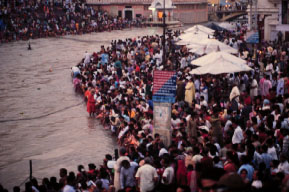
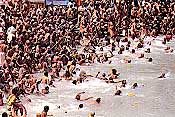
According to this book Festivals, Fairs and Fasts of India regarding the Ganga Sagara Mela it says, "In Bengal, the Ganga Sagara festival (Mela) is held on Makara Sankranti (15th January when the sun goes from kumbha [Aquarius] rasi to makara [Pisces] rasi) on Sagara Island. Sagara means the ocean, and the island is located where the river Ganga enters the ocean. A well-attended fair is held and people come from long distances to bathe here. After the bath Ganga Ma or the Goddess Ganga is worshipped. It is believed that Ganga entered the ocean at this point to wash the bones of the 60,000 sons of Sagara, in whose memory the island is held sacred. There were reportedly killed by a curse from sage Kapila (see Ganga Dussehra)"page 17.
Thank you to Goloka Candra dasa for pointing out that "Makara rasi is not Pisces but Capricorn. And to say that the Sun goes from Kumbha rasi to Makara rasi is to reverse the direction of movement of the Sun. Makara Sankranti is when the Sun moves from Dhanus (Sagittarius) rasi into Makara (Capricorn) rasi as it happened just about an hour ago, triggering the start of Makara solar masa (and the auspicious Uttarayana half of the solar year) at the next sunrise (tomorrow 15JAN2010) and the Ganga Sagara Mela festival.
In South India, the auspicious Thai solar month and Ponggal harvest festival starts. The second day of this festival (16JAN2010) is especially dedicated to go-seva and go-puja."
According to the legend, King Sagara of the Ikshvaku dynasty
ruling at Ayodhya in Uttar Pradesh had two queens, Keshani and Sumati,
but neither had a child. Sagara performed severe austerities before his
wives could produce sons. But whereas Keshani gave birth to a son called
Asmajas, Sumati bore 60,000 sons. Sagara performed the Ashwamedha sacrifice
to declare his suzerainty over the neighbouring kingdoms. According to
the prevalent custom, the sacrificial horse was let loose and allowed to
wander into the neighbouring kingdoms. If the horse was caught, a battle
ensued and the outcome decided the winner. The 60,000 sons of Sagara were
following the horse when they saw him enter a cavern where sage Kapila
was meditating. Not seeing the horse in the cavern, they presumed that
Kapila had captured it. They did not kill Kapila as he was a
sage but they started disturbing his meditations. Annoyed at being disturbed,
Kapila with a curse burnt the 60,000 sons of Sagara. Time passed and later
Bhagiratha, the great grandson of Sagara, chanced to come across the bones
of his dead ancestors. He wanted to perform the shraddha of his ancestors
but there was no water available for the ceremony. Agastya having drunk
all the waters of the ocean, the country was passing through a severe drought.
Bhagiratha prayed to Brahma, the Creator, to end the drought. Brahma asked
him to pray to Vishnu, the Preserver, to allow the heavenly Ganga, issuing
from His big toe, to come down to earth. Vishnu when prayed to by Bhagiratha
agreed, but asked him to request Shiva, the third member of the Hindu trinity
of Gods, to allow the torrential rain to fall on his head before it came
to the earth as the river was very forceful and if she were allowed to
come down unchecked, her fall would split the earth. Shiva agreed to take
the gigantic weight of the cascading Ganga on the matted hair piled high
on his head. This ensnared and delayed the progress of the river which,
in meandering through the labyrinth of his hair, lost its force and then
gently descended to the Himalayas from whence it flowed to the plains bestowing
its waters on the parched earth. And that is why the anthropomorphic image
of Ganga is shown in the matted hair of Shiva who is also called Gangadhara.
Being born in the Himalayas, Ganga is considered the elder sister of Parvati,
who is also a daughter of the Himalayas.
According to the Agni Purana and Padma Purana,
the Ganga descended to the earth on Ganga Dussehra day and a bath in the
holy river on this day is said to purify one of all sins. To die on the
banks of the Ganga is considered most auspicious. If that is not possible,
then the immersion of the ashes after cremation in the river Ganga is a
must, as it then releases one from the cycles of birth and re-birth.
the seven ways of worshipping the Ganga are: by
calling out her name, 'Oh Ganga'; having darshan of her; by toughing her
waters; by worshipping and bathing; by standing in the waters of the river;
and by carrying clay dug out of the river. Ganga in her anthropomorphic
form is shown as a beautiful young woman standing on a crocodile and holding
a waterpot in her hands. Her image, with that of the Goddess Yamuna, another
sacred river deity, is often depicted on the doors of temples and palaces.
In Gujarat, there is a legend according to which Ganga came down to the
earth on Rishi Panchami, the fifth day of Bhadra (September) at Tarnetar.
There is a sacred tank where people congregate for a holy bath on that
day (pages 82-82.) (see Tarnetar festival 106-107, 120-121. not so relevant
to us - nice pictures of the fair and bathing ghats though.) (Shakti M.
Gupta. 1991. Festivals, Fairs and Fasts of India. Clarion Books)