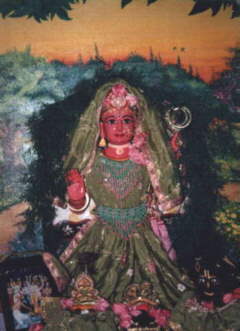
The Story of Tulasi Devi
chapter 1-2-3-4-5-6-7-8-9-10-11-12-13-14-15-16-17-18-19-20
The text was occasionally supplemented with clarifications and elaborations
from the Siva Purana which was translated by a board of scholars and published
in India by Swami Vigyananda and published in India by Munciram Manohal
Ral".
THE APPEARANCE OF TULASI DEVI
Narada Muni asked Lord Narayana, "O Bhagavan! How did the pure, chaste Tulasi Devi become Your wife? Where was she born? Who was she in her previous birth? What family did she come from? And what austerities did she perform to get You as her husband--You, who are above the material energy, not subject to change, the Cosmic Self, the Supreme God, the Lord of all, omniscient, the cause of all, omnipresent, container and preserver of all. And how did Tulasi Devi, Your chief goddess, become a tree? O You who resolve all doubts, my mind is curious to know all about these points; therefore, it compels me to ask you these questions. Kindly remove these doubts from my mind."
Lord Narayana then related the following account...
Manu Daksa Savarni was a partial expansion of Lord Visnu. He was extremely
virtuous, devoted to the Lord, and very famous for his good deeds. Daksa
Savarni's son, Dharma Savarni, was also extremely virtuous. Dharma Savarni's
pious son was called Visnu Savarni, and his son, who was a great Vaisnava,
was known as Raja Savarni.
However, Raja Savarni's son, Vrisadhvaja, was fanatically devoted to
Lord Siva. Lord Siva lived in Vrisadhvaja's house for three celestial yugas
(ages) and loved him more than his own sons. Vrisadhvaja did not revere
Lord Narayana, Goddess Laksmi or any of the demigods. He abolished the
worship of Laksmi in the month of Bhadra (Aug., Sept.) and the worship
of Saraswati in the month of Magha (Jan., Feb.). He did not participate
in the sacrifice and worship performed out of respect for Lord Visnu (Narayana)
and criticised them rather severely.
The demigods did not curse him because they feared Lord Siva. However,
Surya, the sun god, no longer able to restrain his wrath, cursed him: "O
King, just as you are completely devoted to Lord Siva and only to Lord
Siva, and just as you do not recognise any of the other demigods, I declare
that you will now lose your wealth and prosperity!"
When Lord Siva heard this curse, he became angry. Seizing his trident,
he ran after Lord Surya. Afraid, the sun god went with his father, Kasyapa
Muni, to Brahmaloka, the highest material planet, to take shelter of Lord
Brahma. But Lord Siva pursued him there. Lord Brahma, also afraid of Lord
Siva, took Lord Surya and Kasyapa Muni to the region of Vaikuntha, the
spiritual or eternal world. There, with throats parched due to anxiety,
they took refuge of Lord Narayana, the Lord of all. They offered obeisances
to Him and praised Him repeatedly and finally explained why they were so
apprehensive.
Lord Narayana bestowed His mercy on them and granted them the power
to be fearless. He said, "O fearful ones, be consoled. How can you be afraid
of anyone while I am here? If anyone remembers Me when he is in danger,
wherever he may be, I hurry to him with my Sudarsan disc in my hand and
save him. O demigods! I am always the creator, preserver and destroyer
of this universe. In the form of Visnu, I am the preserver; in the form
of Brahma, the creator; and in the form of Siva, the destroyer. I am Siva,
I am you, and I am Surya. I assume numerous forms and preserve the universe.
So go back to your respective places. You have nothing to be afraid of.
All will be well.
"From this day on, you have nothing to fear from Lord Siva. He is the
shelter of the pious, is easily pleased, is the servant and lord of his
devotees, and is great minded. Lord Siva and the Sudarsana cakra
are dearer to Me than My life. In the world of valour, they excel all.
Lord Siva can easily create ten million Suryas and ten million Brahmas.
For him, nothing is impossible. He is not conscious of the external world.
Meditating on Me, his heart centred, he is absorbed day and night. From
his five faces he repeats My mantra with devotion, and he always sings
My glories. Day and night, I also always think of his welfare. To whatever
degree one worships Me, to that degree I favor one. The nature of Siva
is all-auspiciousness."
While Lord Narayana was speaking, Lord Siva arrived. His eyes red,
and he was sitting on his bull carrier holding his trident. He dismounted
quickly and humbly offered obeisances with devotion to the Lord of Laksmi,
the tranquil Supreme Being.
Lord Narayana, Visnu, was sitting on His jewel-studded throne. He was
decorated with a crown, earrings, and a garland, and was holding His disc.
His form was extremely beautiful, and His complexion like a fresh blue
rain cloud. Each of His attendants had four arms and was fanning Him with
four hands. His body was anointed with sandal paste and He was wearing
a yellow garment. Lord Visnu, who shows kindness to His devotees, was chewing
betel nut that had been offered to Him by His wife Laksmi. Smiling, He
was watching and listening to the dancing and singing of the Vidyadharis.
After Lord Siva bowed down to Lord Narayana, he bowed to Lord Brahma.
Lord Surya and Kasyapa Muni respectfully saluted Lord Siva. Then Lord Siva
worshiped Lord Visnu, the Lord of all, and seated himself on a throne.
The attendants of Lord Narayana began to fan Lord Siva with white whisks
to relieve him of the fatigue of his journey. Lord Siva, because of being
in contact with Lord Visnu's virtues, then assumed a cheerful disposition
and
adored the Eternal Being with his five mouths.
Lord Narayana was highly gratified. With sweet, nectarean words, He
said, "O Lord Siva, you are the symbol of all good and welfare. Thus, to
ask about your welfare would be foolish. I would ask you only out of respect
for the rules of society and the method prescribed in the Vedas. One who
yields fruits of devotion and gives all prosperity should not be asked
about his austerities or material prosperity. Since you preside over knowledge,
it would be useless to ask if you are increasing in knowledge. It would
be equally useless to ask a conqueror of death if he is free from all danger.
But you have come to my residence for a reason. What is it? Have you become
angry over something?"
"O Lord Visnu!," Lord Siva began. "King Vrisadhvaja is my great devotee.
Lord Surya has cursed him and that has made me angry. Out of affection
for my son, the king, I was about to kill Surya. But Surya sought shelter
of Lord Brahma, and now both of them have sought Your protection. Those
who are distressed and take shelter of You, either by speaking about You
or by remembering You, become completely safe and free from danger. They
overcome death and old age. What to speak of those who come personally
to You and take shelter. When one remembers You, his dangers disappear.
All good comes to him. O Lord of the world! What will become of my foolish
devotee who, by the curse of Lord Surya, has lost his fortune and prosperity?"
Lord Visnu replied, "O Lord Siva! A half hour has elapsed here in Vaikuntha.
In that time, twenty-one celestial yugas have passed away. Therefore, King
Vrisadhvaja, through the revolution of irresistible and dreadful time,
is dead. His son, Hamsadhvaja, in the course of time, also died. Hamsadhvaja
begot two noble sons named Dharmadhvaja and Kusadhvaja. They are both great
Vaisnavas but, because of Lord Surya's curse, they have become luckless.
They lost their kingdoms, including all property and prosperity. But they
are now engaged in worshiping Goddess Laksmi, who is pleased with their
efforts. Therefore, She has agreed to descend to Earth and expand Herself
partially by taking birth from the wives of those two kings. Then, by the
favor of Goddess Laksmi, Dharmadhvaja and Kusadhvaja will become prosperous,
mighty kings. O Lord Siva! Your devotee Vrisadhvaja is dead, so return
to your abode. O Lord Brahma, Lord Surya and Kasyapa Muni--you also should
return your realms."
Bhagavan Visnu then went with His wife to the inner apartments. The
demigods went cheerfully to their own abodes, Lord Siva continuing his
practice of austerity.
Dharmadhvaja and Kusadhvaja performed harsh asceticism and worshiped
Goddess Laksmi. Thereafter, they separately obtained the blessings they
desired. By Goddess Laksmi's favor, they again became the rulers of the
earth. They acquired great spiritual merits, were married, and begot children.
King Dharmadhvaja was married to Madhavi. After some time, she became pregnant
with a partial incarnation of Goddess Laksmi. However, the infant remained
in Madhavi's womb for one hundred celestial years. Day by day Madhavi's
lustre increased. Then, on an auspicious day and moment, when there was
a full moon, in the month of Kartika, on a Friday, she gave birth.
The grace of the Goddess of Fortune, Laksmi, manifested through the
baby. There were marks of the lotus flower on the infant's feet. Her face
looked like the autumnal moon, her eyes resembled blooming lotuses, and
her lips appeared like ripe bimba fruit. Her palms and the soles of her
feet were reddish, her navel was deep, and just above it were three folds.
Her buttocks were round, and her body was delightfully warm in the winter
and cool in the summer--very pleasant to touch. Her breast was firm and
her waist thin, and the light shining from her body surrounded her like
a halo. Her complexion was white, like a Champaka flower, and her hair
looked beautiful. Because her beauty was incomparable, the sages called
her Tulasi.
Chapter Two
TULASI PERFORMS AUSTERITIES
As soon as she was born, Tulasi resolved to go to the mountainous region of Badarinatha to practice severe austerities. Though many persons tried to dissuade her, no one was able to; for she was determined to stay and pray in the forest till Lord Krsna appeared and agreed to become her husband. During a period of one hundred thousand celestial years, she endured the following:
In the summer, she exposed herself to four fires around her and the
sun above; in the winter, she submerged herself in the icy waters; and
in the rainy season, she subjected herself to heavy downpours at the funeral
grounds. For 20,000 years, she subsisted on fruits and water; for 30,000
years, she chewed dry leaves; for 40,000 years she lived only on air; and
for 10,000 years she ate nothing and just stood on one leg.
Finally, she saw Lord Brahma in the sky, riding on his swan carrier
and sweeping down towards her. Believing that he had come to grant her
a boon, she bowed down low to him.
Lord Brahma said, "O Tulasi, ask me for a boon. Whether it be devotion
to Lord Hari or servitorship to Him or freedom from old age or freedom
from death--I will grant it."
"Yes, O Lord, I will ask. Please listen. I will not hide my desires
out of fear or shame, since you are all-knowing. My name is Tulasi. Formally
I was a cowherd girl in Goloka, and there I served Radharani, the beloved
of Sri Krsna. I am a partial expansion of Radharani and was her favourite
companion. But one day in the place where the rasa dance had occurred,
Krsna became intimate with me and I fainted from excessive joy. While I
was lying there, Radharani suddenly appeared and saw me in that condition.
She was not at all pleased. Blinded with fury, she first reproached Krsna
and then cursed me. She said, `O vile one! Go! And take birth as
a human being!'
"Then Krsna said to me, `When you take birth in India, if you practice
austerities, Lord Brahma will grant you a blessing. He will arrange for
you to marry the four-armed Narayana, who is an expansion of Myself.' Then
Krsna disappeared. And out of fear of Radharani, I left Goloka and was
born in this world...So please grant me that boon. I want to have that
handsome and peaceful Narayana as my husband."
Lord Brahma replied, "O Tulasi, Sudama was a partial expansion of Krsna
and was one of Krsna's cowherd boyfriends in Goloka. As a result of a curse
by Radharani, he is presently living on earth among the Danavas (demons).
His name is Sankhacuda. He is very energetic and no one can compare with
him in strength. While living in Goloka, he was very attracted to you and
wanted to marry you. But because he feared Radharani, he did not make any
overtures.
"Just as you are a jatismara--that is, one who knows her previous births--Sankhacuda
also is. Remembering his past desire to be close to you, he has performed
severe austerities to obtain you as his wife. I now wish to grant his desire.
Therefore, O beautiful one, please agree to wed him. However, later on,
by the special arrangement of Providence, you will get the beautiful Narayana
as your husband. But after that, He will curse you and you will be transformed
into the world-purifying Tulasi plant (holy basil Ocillium Basildum Sanctum).
You will be the best of flowers and dearer to Narayana than His own life.
No one's worship will be complete without your leaves. You will remain
as a tree in Vrndavana and will be widely known as Vrndavani. The cowherd
men and women will worship Lord Hari with your leaves. As the presiding
deity of the Tulasi plant, you will always enjoy the company of Krsna,
the best of cowherd boys."
Tulasi Devi smiled and gladly said to Lord Brahma, "O Father, I will
be honest with you. I am not as devoted to the four-armed Narayana as I
am to the two-armed Krsna. For in Goloka, my close encounter with Krsna
was suddenly interrupted, leaving me still longing for Him. Thus, it was
only because Krsna had asked me that I have been praying to get Narayana
for my husband. But now it appears certain that by your grace I will again
get Krsna, who is very difficult to attain. However, O lord, please grant
me the following boon: that I lose my fear of Radharani."
Lord Brahma replied, "O child, I shall now give you the sixteen-lettered
Radha mantra. By this boon you will be as dear to Radharani as Her life,
and She will approve of Your intimate dealings with Krsna."
Lord Brahma initiated Tulasi Devi into to the sixteen-lettered mantra,
the hymn, and the mode of worship of Sri Radha. Then, blessing her, he
disappeared.
As directed, Tulasi engaged herself in worshiping Srimati Radharani
and, after twelve years, attained success. Obtaining the desired boon,
she reaped the fruits that were unattainable by others. As the pangs of
her austerities ended, she became cheerful. When one gets the fruits of
one's labour and then considers the difficulties experienced in attaining
them, the difficulties then seem pleasurable.
Tulasi was in the prime of her youth and she longed for the company
of Sri Krsna. Finishing her food and drink, she lay down on a beautiful
bed decorated with flowers and perfumed with sandal paste. She went to
sleep with a happy heart. But while she slept, Kamadeva, the god of love,
shot five arrows at her--arrows that were meant to enchant her. Consequently,
though she was anointed with cooling sandal paste and slept on a bed strewn
with flowers, her body began to feel as though it were on fire. Out of
joy, the hairs on her body stood on end, her eyes reddened and her body
began to tremble. One moment she looked thin and at another moment she
grew restless or drowsy. Sometimes she became agitated or warm with desire,
at other times she fainted, then recovered, then sorrowed. Sometimes
she got up from the bed, walked this way and that way, sat down or lay
down.
This abnormal condition of her body and mind increased daily; so much
so that her soft bed felt like a bed of thorns; delicious fruits and water
tasted like poison; her house seemed like a desert; her soft delicate cloth
felt hot like fire; and the vermilion mark on her forehead pained like
a boil.
In her dreams she saw a nicely dressed, smiling, jolly youth. He was
adorned with jewels, besmeared with sandal paste and garlanded with flowers.
Gazing at her face, he spoke to her affectionately, and embraced and kissed
her repeatedly. One moment he went away; the next moment he returned; then
she cried out, "O Lord of my heart, where are you going? Please don't go!"
When she awakened, she wept again and again. In this way Tulasi Devi passed
her days at Badarikashrama.
Chapter Three
THE BIRTH OF SANKHACHUDA
The sage Kasyapa was the son of the prajapati (forefather) Marici and
the grandson of Lord Brahma, and was very learned. Daksa, another prajapati,
gave him thirteen of his daughters in marriage. One of Kasyapa Muni's wives
was known as Danu. She was very attractive and chaste, and Kasyapa cared
for her with love and devotion. Danu bore many mighty sons, one of whom
was Vipracitti, who was exceedingly powerful and courageous. His son Dambha
was self-controlled and a great devotee of Lord Visnu. But he could not
beget a son, so he became anxious. Therefore, to improve the situation,
he went to Puskara Forest and performed severe austerity for a hundred
thousand years. There, sitting in a steady posture and uttering the Krsna
mantra, he practiced japa.
While practicing, an intolerable effulgence shot out from Dambha's
head and spread everywhere. It was so hot that all the demigods, sages
and Manus were scorched by it. Thus, with Indra leading, they all sought
shelter of Lord Brahma.
Arriving at Lord Brahma's abode, they praised him and then informed
him of the situation. After hearing about it, Lord Brahma, to relate the
problem to Lord Visnu, led them to Vaikuntha. There, with palms joined
reverentially, they praised the great saviour and Lord of the three worlds.
The demigods then asked, "O Lord, we do not know what has caused this.
Please tell us. What is that light by which we have been scorched?"
Lord Visnu laughed and lovingly said, "O demigods, do not be afraid;
remain calm and unshaken. No flood will occur and it is not the time of
universal dissolution. The asura Dambha, one of my devotees, is performing
asceticism to obtain a son. I shall soon bless him and that will quiet
him."
Encouraged by this, Lord Brahma and the other demigods returned to
their own realms.
Lord Visnu then went to Puskara where Dambha was practicing austerity.
Seeing that Dambha was repeating His name, the Lord consoled him and asked,
"What blessing do you want Me to grant you?"
Dambha offered his obeisances with great devotion and praised the Lord
repeatedly. Then he said, "O Lord of lords, O lotus-eyed one, obeisances
unto You. O Lord of Laksmi, O Lord of the three worlds, please be merciful
to me. Please give me a powerful and courageous son who will be Your devotee,
be invincible to the demigods, and be the conqueror of the three worlds."
Lord Visnu asked Dambha to stop his austerity, granted him the blessing,
and disappeared. As the Lord vanished, Dambha offered obeisance in that
direction and returned home. Within a short while his blessed wife became
pregnant. She radiated an effulgence that illuminated the inner apartment
of her residence. The soul residing in her womb was Sudama, one of Lord
Krsna's leading cowherd companions who had been cursed by Srimati Radharani.
When Dambha's chaste wife gave birth to a radiant-looking son, Dambha
invited the sages to his place and had the post-natal rites performed.
There was great jubilation and, on a favourable day, the father named him
Sankhacuda.
The son grew up in his father's residence like the moon in its bright
half. In his childhood he learned all the traditions, customs, injunctions
and prohibitions, and became resplendent. Engaging in childhood play, he
delighted his parents and became the favourite of all the family members.
Later on, to obtain a boon from Lord Brahma, Sankhacuda performed an
austerity in Puskara for a long while. He concentrated his mind, restrained
his senses and organs of action, and chanted a mantra that his preceptor,
Jaigisavya, had imparted to him. Finally, Lord Brahma went to Sankhacuda
to grant him a blessing. Lord Brahma asked, "Tell me what boon you want."
Seeing Lord Brahma, the Danava king bowed to him humbly and praised
him with devotional words. Then he said, "Please make me invincible to
the demigods, and also enable me to marry Tulasi.
"So be it," Brahma replied. Then he gave Sankhacuda the Divine amulet
of Lord Sri Krsna. This amulet, called Sarvamangalamaya (Conqueror of the
World), was considered the most auspicious of all auspicious things in
the world, for it guaranteed victory everywhere.
Brahma continued, "Now you should go to Badarikashrama. Tulasi Devi
is performing penance there by her own will. You should marry her there.
She is the daughter of King Dharmadhvaja." Lord Brahma then disappeared.
Sankhacuda, whose austerity had now borne fruit at Puskara, tied that
most precious amulet round his neck. He then set out for Badarikashrama,
his face beaming with joy.
Chapter four
TULASI DEVI TESTS
KING SANKHACHUDA
Tulasi saw Sankhacuda approaching in his jewelled airplane and noticed
that he was in the prime of his youth. He was handsome like Cupid, white-complexioned
like the Champaka flower and decorated with gems. His face resembled the
full moon of autumn, his eyes looked like lotuses in full bloom, and his
cheeks flashed with the glow of his earrings. A Parijata flower garlanded
his neck, musk and saffron anointed his body, and sandal paste perfumed
his person.
As he came closer, Tulasi hid her face in her shawl and smiled at him
with sidelong glances. Blushing at the thought of this first meeting, she
bowed her head nervously and eagerly drank in with her eyes the lotus of
his face.
Sankhacuda also gazed at Tulasi, seated as she was on a lovely bed
strewn with flowers and sandalwood. Her teeth shown like pearls, her lips
were like Bimba fruit, her nose was graceful and her complexion golden.
She resembled the autumnal moon. Adding to her grace, just below the parting
of her hair, was the mark of sandal paste and musk; and, just below them,
a mark of vermilion. She had a low yet deep navel, and below it, three
lovely abdominal folds. Her palms were reddish, her fingernails were glowing,
and her feet were radiant and crimson, coloured with lac-dye. Her glowing
toenails surpassed the glow of the autumn moon, giving her an unrivalled
beauty.
Tulasi was adorned with lovely jingling ornaments, and the knot of
hair at the back of her head was decorated with a jasmine wreath. Shark-shaped
earrings adorned her cheeks while a diamond necklace beautified her breast.
She wore gorgeous bangles of conch on her arms and wrists, as well as precious
jewels on her fingers.
Sankhacuda sat down and said to her, "O beautiful girl, whose daughter
are you? And how have you come to this forest? You look most
fortunate and blessed. Indeed, you are the personification of heavenly
joy--the best of women! You are a model of loveliness and can certainly
bewilder even the saints!"
When Tulasi gave no reply, he asked, "O gracious one, why don't you
speak? I am your servant, so please greet me with the melody of your speech."
Her head lowered, her face smiling, the beautiful-eyed Tulasi said,
"I am the daughter of King Dharmadhvaja and have been practicing
asceticism here. But who are you? And why are you talking to me? If a noble
man sees a virtuous woman alone, he does not talk to her. So go away--wherever
you please."
But Sankhacuda did not move.
Tulasi continued. "The shastras say that only a degraded man desires
a woman. At first a woman is sweet to a man, but later proves fatal. Though
her mouth rains honey, her heart is like a jar of poison. She uses sweet
words but her heart is sharp like a razor. To achieve her own selfish ends
she is submissive to her husband; otherwise, she is unsubmissive. While
her face looks cheerful, her heart is dirty. Even the Vedas and the Puranas
cannot fathom her character. A wise man never trusts a base woman. She
has no friend or enemy; for all she wants are new lovers. When a woman
sees a well-dressed man, she inwardly desires him, but outwardly she appears
chaste and modest. She is naturally passionate, attracts men's minds, and
eagerly engages in sex. Though outwardly she hides her lust and appears
modest, when she meets her lover in secret, she is ready to swallow him
up. When she does not have sex with him, she feels offended, her body burns
with anger, and she begins to quarrel. When her passions are fully satisfied,
she becomes cheerful; when unsatisfied, morose.
"A woman likes a good lover more than sweet foods or refreshing drinks;
she likes him even more than her own son; he is dearer to her than her
life. But if the lover becomes impotent or aged, she regards him as an
enemy. Quarrels and anger ensue. Then she devours him as a snake eats a
rat. She is rashness personified and a mine of vices. A woman is hypocritical,
obstinate and unfaithful. Even Lord Brahma and other gods are deluded by
her. She is a hindrance on the path of austerity, an obstacle to liberation,
an impediment to developing faith in Lord Hari, a refuge of all delusion
and a living chain that binds men to the world. She is like a magician
and is as false as dreams. She appears to be very beautiful, but is she
is a bucket of stool, urine, gas and blood. When God created her, he arranged
that she should become the spirit of delusion to the deluded and poison
to those who desire liberation. Thus, on no account should a woman be desired,
and by all means she should be avoided."
Sankhacuda smiled and then answered, "O goddess, what you have said
is not completely false. It is partly true and partly false. From the Creator
have come chaste and unchaste women. One is praiseworthy, the other isn't.
Examples of chaste women are Laksmi, Sarasvati, Durga, Savitri and Radha.
Women who are expansions of them are auspicious, glorious and very commendable,
such as Satarupa, Devahuti, Svadha, Savaha, Daksina, Anasuya, Ganga, Diti,
Aditi, Vedavati, etc. In every yuga cycle these women are excellent. The
heavenly prostitutes are also expansions and partial expansions of the
above women, but they are not praiseworthy because they are unchaste.
Women who are in the mode of goodness are virtuous and pure. The sages
declare them to be excellent. But those who are in the modes of passion
and ignorance are not so praiseworthy. The passionate ones are fond of
sense pleasures, indulge in them, and always want to fulfil their selfish
goals. Such women are usually insincere, deluded and irreligious. Generally,
they are unchaste. But woman in the mode of ignorance are considered the
worst. They are irresistible.
"A virtuous man would never court another man's wife in either public
or private. But I have come to you by Lord Brahma's command--to marry you
according to the Gandharva rite. (In this, the bride and bridegroom meet
each other of their own accord and consummate their meeting in sexual union.
No sacred rituals are necessary.
"My name is Sankhacuda. When the demigods see me, they flee in fear.
In my previous birth, I lived in Goloka and was a cowherd boy named Sudama.
I was a close friend of Sri Krsna's, one of His attendants. I was one of
the eight celebrated cowherds. Then Srimati Radharani cursed me to be born
in India in a demon family. By Krsna's grace and by His mantra, I am a
jatismara, that is, I know the history of my previous birth. You also are
a jatismara. So you know that in your previous birth, in Goloka, when Radharani
caught you alone with Krsna, she became angry and cursed you to be born
here, in India. In Goloka I very much wanted to consort with you; but because
I feared Radharani, I did not do so."
Sankhacuda stopped talking. Then Tulasi smiled and cheerfully said,
"Persons like you are famous in this world and good women desire such husbands.
You have defeated me in argument. A man who is conquered by a woman is
very impure and condemned by people in general. The forefathers and the
demigods regard men who are conquered by women as low and contemptible.
Even their fathers and mothers mentally despise them. The Vedas say that
when a child is born or a relative dies, the brahmanas are purified in
ten days; the ksatriyas in twelve days; the vaisyas in fifteen days; and
the sudras as well as other low classes in twenty-one days. But a man conquered
by a woman always remains impure. Only when his body is burned to ashes
does he become purified. Neither the ancestors nor the demigods accept
from him offerings of cakes, flowers, etc. Men whose hearts are totally
conquered by women acquire no fruits from their knowledge, austerities,
japa, fire sacrifices, worship, learning or fame.
"I tested you to determine how strong you are in knowledge. One should
choose one's husband by examining a man's merits and defects. If one gives
his daughter in marriage to a man devoid of all good qualifications, to
an old man, to a man who is ignorant or poor, illiterate, diseased, ugly,
wrathful, harsh, lame, limbless, deaf, dumb, inactive, or impotent--this
sin is equivalent to the sin of murdering a brahmana. But if one gives
his daughter in marriage to a young Vaisnava who is learned, well-qualified
and peaceful, one acquires the fruits of performing ten horse sacrifices.
If one raises a daughter and then sells her out of greed for profit, he
falls to the hell known as Kumbhipaka. There, for a period equal to fourteen
of Lord Indra's lifespans, such a sinner has to drink his daughter's urine
and eat her stool as well as be bitten by worms and crows. When this period
ends, he has to be born in this world as a diseased person and earn his
livelihood by selling and carrying meat."
CHAPTER FIVE
TULASI MARRIES SANKHACHUDA
When Tulasi Devi stopped speaking, Lord Brahma suddenly appeared there.
After Sankhacuda and Tulasi offered him their respects, Lord Brahma said,
"O Sankhacuda! Why are you wasting your time in such empty talks with Tulasi?
Marry her now by the Gandharva rites. As you are a gem among males, she
is a gem among females. When a clever couple marry, the union is very happy.
And who would abandon happiness when it is at hand? Anyone who would do
so is worse than a beast. And you, Tulasi! Why are you testing this noble
and qualified person who can subdue both the gods and the demons?
Marry Sankhacuda, just as Laksmi is married to Narayana, Radhika to Krsna,
my Savitri to me, Saci to Indra and Aditi to Kasyapa. Stay with the handsome
Sankhacuda for a long time and, as you like, wander with him to various
places. When Sankhacuda leaves his body, you will return to Goloka and
get Krsna as your husband." Lord Brahma then blessed them and returned
to his own abode.
Sankhacuda then married Tulasi by the Gandharva rite. Glorifying the
marriage, the demigods sounded their drums and showered flowers on them
from the sky.
Sometimes the newly married couple would go to a flower grove and at
other times to a river bank. There they would sleep on flower beds smeared
with sandal paste and enjoy marital pleasures. Tulasi easily stole the
heart of her husband, and Sankhacuda also attracted Tulasi's heart. After
Tulasi garlanded her husband with parijata flowers, which prevent disease
and old age, she placed a precious jewelled ring on his finger and offered
him rare beautiful gems. Bowing down to his feet with devotion, she
repeatedly said, "I am at your service!"
Sankhacuda smiled. He then presented Tulasi with clothes he had obtained
from Lord Varuna's house; he also gave her a precious necklace of jewels,
an armlet he had gotten from Swaha (Agni's wife), armlets from Chhaya (the
sun god's wife), earrings from Rohini (the moon god's wife), finger rings
from Rati (Cupid's wife), conch ornaments from Visvakarma, as well as excellent
bedding adorned with pearls and jewels. After further adorning her, he
placed her feet on his chest and said, "I am your servant."
They left the hermitage and began to travel to various places. They
went to different mountains, flower gardens, caves, beaches, riversides
and forests. Wherever they went, they enjoyed each other's company with
great satisfaction, never tiring of one another. Sankhacuda then brought
Tulasi to his own kingdom and there they continued to delight in each other's
company.
CHAPTER SIX
LORD VISNU HELPS THE
DEMIGODS
Sankhacuda enjoyed his kingdom for one Manvantara (4,320,000 years)
and, during that period, gained control over all the Devas, Dhanavas, Gandharvas,
Kinnaras and Raksasas. He dispossessed the gods of their realms and privileges,
deprived them of their rights with respect to worship and offerings, and
seized their weapons and ornaments. Consequently, they wandered about the
universe like helpless beggars. Finally, they united in a group and went
to Lord Brahma's assembly. Sobbing, they related the whole story of how
Sankhacuda had oppressed them. Lord Brahma took them to Lord Siva's realm
and related to Siva the details of the case.
Lord Siva then took them all to the highest place, Vaikuntha, where
there is neither old age nor death. As they approached the first gate,
they saw the watchmen guarding the gate and sitting on jewelled seats.
The watchmen had beautiful dark blue bodies and looked effulgent. They
had smiles on their faces, lotus like eyes, and four arms--each hand holding
a conch, mace, disc and lotus. They wore yellow garments, were decorated
with jewelled ornaments, and were garlanded with forest flowers.
Lord Brahma asked them for admittance and they nodded their approval.
Then, after passing through sixteen gates, the group finally arrived before
Lord Narayana. The assembly hall was filled with saints and four-armed
attendants who resembled Narayana and were wearing Kaustubha jewels. The
assembly hall was so brilliant with rays of light that it appeared as though
the moon had just arisen. By Lord Narayana's mercy, there were diamonds,
gems and necklaces of jewels placed in various areas. In some spots there
were rows of pearls that shed their splendour and brilliance, and in other
spots there were mirrors arranged in a circle. In certain areas there were
jewels called Padmaragas which were artistically arranged to appear like
lotuses spreading their radiant beauty everywhere. There were rows of steps
made of Syamantaka jewels. Throughout the hall were wonderful pillars built
of Indranilam jewels. There were sandal leaves strung high from pillar
to pillar. There were also golden jars full of water. All around were parijata-flower
garlands, sweet-scented sandal trees, and saffron and musk; the whole atmosphere
was permeated with sweet fragrances.
The Vidyadaras were dancing in one area. The assembly hall measured
eight thousand miles in circumference. All over, numerous servants were
engaged in various services. Lord Brahma, Lord Siva and other demigods
saw Lord Hari (Narayana) sitting in the centre on a precious jewelled throne;
He looked like the moon surrounded by many stars. He was wearing a crown
on His head, earrings, a wildflower garland round His neck and sandal paste
on His body. Holding a lotus in His hand, He was smiling, watching
the dancers and listening to the music. He looked very tranquil. Laksmi
was gently holding His feet and He was chewing the sweet-scented betel
she had given Him. Ganga was fanning Him devotedly with a white chamara,
and others were singing hymns to Him with their heads lowered in devotion.
Lord Brahma and the other gods offered their obeisances to Lord Visnu.
As they did, their hairs stood on end, tears flowed from their eyes and
their voices were choked with emotion. Then Lord Brahma, his hands clasped
and his head bowed, informed the Lord about Sankhacuda's doings.
Lord Hari smiled and said, "O lotus born! I know all about Sankhacuda.
In his previous birth he was my great devotee, a very energetic cowherd
boy in Goloka. I will tell you something about him which is quite sanctifying.
His name was Sudama and he was my chief attendant. He is now a Danava because
in Goloka Radha pronounced a terrible curse on him. Here is how it happened...
"One day I left Radha's company and went to the rasa dance area with
the gopi named Viraja. Radha soon heard from one of Her maidservants that
I had flirted with Viraja. Blinded with fury, She hastened there with Her
attendants to see if this were true. Seeing that it was, Radha immediately
converted Viraja into a river. I myself disappeared, so Radha rushed home
angrily with Her attendants.
"Later, when I was with Sudama and She saw me, Radha rebuked me very
much. However, I remained silent. But Sudama could not tolerate this, so
he rebuked Radha in My very presence. This was quite intolerable to Her
dignity. Her eyes became red with anger and She immediately ordered thousands
of Her attendants to drive him away. Sudama then trembled with fear. As
Radha's attendants tried to drive him away, he resisted and repeated his
reproaches against Her. When She heard them, She cursed him, saying, `May
you be born in the womb of a Danavi (demon woman)!'
"Sudama bowed down to Me and, crying, began to leave. But Radha, who
is quite merciful, began to melt. Weeping, she tried repeatedly to stop
him from leaving. "Wait!" She called. "Wait! Where are you going? You don't
have to go. Please come back." She became distressed, and Her attendants
and the cowherd boys began to weep. I then explained to them, `In about
a half a moment Sudama will return, having fulfilled the conditions of
the curse. Of course a half moment here is equal to about one Manvantara
(4,320,000 years) on Earth.' I then called to Sudama. `O Sudama, when the
curse expires, please come back here!'
"O demigods, that expert mystic and devotee Sankhacuda will return
to Goloka. Therefore, O gods, take My trident and go quickly to India.
Lord Siva will kill the Danava with the trident. The demon is wearing My
auspicious amulet around his neck. It is called the "Conqueror of the World."
As long as he keeps wearing it, no one can kill him. So I will go to him
disguised as a Brahman and beg the amulet from him. But you have granted
him the boon that he cannot die unless his wife's chastity is violated.
I will take care of this as well. Then he will surely die. Later, when
his wife leaves her body, she will become my dearest wife." Narayana then
gave Lord Siva his trident.
CHAPTER SEVEN
AN ENVOY SENT TO SANKHACHUDA
Lord Brahma and the other demigods returned to their respective abodes.
Later, to gain victory for the demigods, Lord Siva pitched his big tent
and camped on the banks of the Chandrabhaga River under a beautiful fig
tree. He then sent Puspadanta, the leader of the Gandharvas, as a messenger
to Sankhacuda. When Puspadanta arrived at Sankhacuda capital, he noticed
that it was more beautiful than Indra's realm and more opulent than Kuvera's.
The city was 40 miles wide and 80 miles long. It was built of pearl
and jewel crystals, and on all sides there were roadways. Seven inaccessible
moats, one after another, surrounded the city.
There were hundreds of shops full of trade articles and marketable
commodities. Palatial buildings of traders and merchants were all over.
Thousands and thousands of beautiful buildings, constructed with scarlet
gems, inlaid with various ornaments and decorated with fancy articles,
gave the place a boundless charm.
The Gandharva chief saw that Sankhacuda's palace was spherical like
the moon. Four successive moats with fiery flames encircled it. On top
of the palace were ramparts, made of jewels, that touched the sky. The
palace was inaccessible to enemies but offered no hindrance to friends.
The twelve gates, decorated with lotuses, jewelled mirrors, paintings
and statues, were guarded by twelve gatekeepers. On all sides the place
was protected by very powerful, graceful, well-dressed and richly adorned
demons who were holding heavenly weapons in their hands. When Puspadanta
approached the first gate, he saw that it was guarded by a man who had
a hideous face, copper complexion and tawny eyes, and who was smiling
and holding a trident in his hand. Puspadanta explained to him the purpose
of his mission--that he was a war ambassador--and the guard allowed him
to pass inside; the other gatekeepers did the same. At the last gate he
said to the guard, "O guard, quickly inform your king that a war is about
to occur."
The guard did so and, obtaining Sankhacuda's permission, ushered the
messenger inside. There, the Gandharva saw the well-formed, handsome demon
seated in the centre of the royal assembly on a golden throne. One attendant
was holding a jewelled umbrella over the king's head while other attendants
were fanning him with white chamaras (whisks). Countless demons surrounded
him and armed guards walked here and there. Sankhacuda was beautifully
dressed in heavenly garments, covered with garlands, and anointed with
fragrance.
Seeing all this, Puspadanta was thunderstruck and said to Sankhacuda,
"O King, I am a messenger of Lord Siva and my name is Puspadanta. My lord
has ordered me to tell you the following: The demigods have sought the
protection of Lord Hari. So you had better restore to them their kingdoms
and rights. Lord Hari has given His own trident to Lord Siva and asked
him to wage war against you if necessary. Presently, Lord Siva is residing
under the shade of a fig tree on the bank of the Puspabhadra River. Either
you must return to the demigods their property or you must be ready to
fight with Lord Siva...What shall I tell my lord is your reply?"
The demon laughed loudly and said, "You had better leave. I shall go
to him in the morning."
The messenger returned to Lord Siva and conveyed the demon's message.
In the meantime the following group of persons appeared before Lord Siva:
Kartika, Nandi, Mahakala, Bana, Manibhadra, the eight Bhairavas, the eleven
Rudras, the eight Vasus, the twelve Adityas, Indra, Agni, Chandra, Viswakarma,
the two Aswini-kumaras, Kuvera, Yama, Jayanta, Nala-Kuvara, Vayu, Varuna,
Budha, Mangala, Dharma, Sani, Kama, Ugra-chanda, Kottari, the hundred-armed
Bhadrakali, as well as many other personages.
Bhadrakali was seated on an excellent chariot. Her paraphernalia, clothing,
garland and sandal paste were red. Inspiring her devotees with courage
and infusing fear into the enemy, she began dancing, laughing and singing.
Her rolling tongue and the skull she held in her hand were each eight miles
in circumference. She carried a trident, an iron spear, conches, a wheel,
mace, lotus, bow, arrows, dumbbells, a scimitar, thunder, the weapons of
Visnu and Varuna, a snake noose, the weapons of Agni, Narayana, Brahma,
Gandharva, Garuda, Pasupata, a pestle, shield, staff, as well as other
irresistible weapons. This fearsome goddess was accompanied by millions
of devotee Yoginis and Dakinis, and also countless ghosts, goblins and
demons known as Bhutas, Pretas, Pisachas, Kusmandas, Brahma Raksasas and
Raksasas, as well as Yaksas and Kinnaras. Then Kartikkeya arrived and he
bowed down to his father Lord Siva, who asked him to sit on his left side
and help him. The army remained there in battle array.
CHAPTER EIGHT
SANKHACHUDA CONSOLES TULASI
At the palace, the mighty Sankhacuda went to the women's quarters and
informed Tulasi about the imminent war. Hearing this, her palate, lips
and throat became dry. With a sorrowful heart, she said to him, "O my lord,
my friend, my master! Stay for a moment and sit within my heart. Fill me
with life for a moment. Please satisfy my human desire. Let me gaze at
you fully so that my eyes may be satisfied. My breathing is very
agitated now. For at the end of night I had a very bad dream. Therefore,
I feel a burning within myself."
The king finished his meal and, in truthful and beneficial words, said
to Tulasi, "O my queen, when it is time to reap the results of one's past
acts, one experiences good and evil, pleasure and pain, fear and sorrow.
In time, trees grow, branches develop, flowers blossom and fruits appear.
In time, the fruitful tree decays. Similarly, in time, human beings grow
and decline. In time, the creator creates, the preserver preserves and
the destroyer destroys. This is the law of creation, preservation and destruction.
Therefore, you should always adore Lord Krsna, as He is the Lord of Brahma,
Visnu and Siva; He is the creator, maintainer and destroyer, He has no
beginning nor end, and He does not depend on material nature. Lord Krsna,
by His own will, has manifested nature with its animate and inanimate objects.
"All things, from Lord Brahma down to a blade of grass, are artificial
and temporary. In time, they grow and decay. Thus it would be better for
you to adore Radha's consort, Lord Krsna, who is distinct from the three
modes of material nature, who is the Supersoul within all and the Lord
of all. Take shelter of Krsna, for it is by His command that the
wind blows swiftly, the sun radiates heat, Indra pours rain, death visits
human beings, fire burns, and the moon travels through the sky. Seek the
Supreme Krsna, who is the death of death, the time of time, the creator
of the creator, the preserver of the preserver and the destroyer of the
destroyer. Take refuge in Him. My dearest, no one is a friend of anyone,
but Lord Hari (Krsna) is the friend of all. Therefore, pray to Him and
serve Him.
"My love, who am I and who are you? By our karma, Providence has united
us. Providence will also separate us. When danger comes, only fools are
disturbed. The wise are never thus shaken. Like wheels, pleasure and pain
always revolve. In Badarikashrama you absorbed yourself in austerities
to obtain Lord Narayana as your husband. Surely you will get Him. I myself
practiced austerities to obtain you as my wife. And by Lord Brahma's grace
I have gotten you. Very soon you will get Govinda in Goloka Vrndavana.
And when I leave my demoniac body, I too shall go there. In that realm
we will regularly see one another. By Radha's curse I was born in the precious
land of India. But I will return to Goloka. Therefore, my dear, do not
worry about me. You too will quit your human form and assume a spiritual
form and go to Lord Hari. So you need not sorrow."
Tulasi was thus consoled.
Sankhacuda spent the night with Tulasi in the temple of gems, which
was lit by diamond lamps. They rested on a nicely decorated bed that was
strewn with flowers and anointed with sandal paste. Then Tulasi, who had
not eaten any food and thus looked thin, became overwhelmed with grief
and began weeping. The king, who knew the truth about life, clasped her
to his chest and again appeased her in various ways. The spiritual instructions
he had received in Bhandira Forest from Lord Krsna, which were capable
of destroying all sorrows and delusions, he now carefully conveyed to Tulasi.
Upon receiving them, her joy knew no bounds, for she realised that everything
in this world is temporary. She and her husband then spent the remainder
of the night in loving exchanges.
CHAPTER NINE
SANKHACHUDA PREPARES
FOR WAR
At Brahma Muhurta (48 mins before sunrise), Sankhacuda got up from his
flower-strewn bed. He discarded his night clothes, bathed in pure water,
put on freshly washed clothing, and smeared his body and forehead with
bright tilaka markings. He performed his necessary rites and worshiped
his personal Deity.
He then saw such auspicious things as curd, ghee, honey, parched rice,
etc., and, as usual, distributed to the brahmanas the best jewels, pearls,
clothing and gold. To make his departure for war favourable, he gave to
his guru some pearls, gems and diamonds, and he gave to the poor some horses,
elephants and cows. He then gave to the brahmanas a thousand storehouses,
three lakhs (300,000) of towns and seven lakhs (700,000) of villages. He
installed his son Suchandra as the acting king and entrusted to him the
care of his family, kingdom, treasury, subjects, wealth, storehouses and
conveyances.
Sankhacuda dressed himself for war and armed himself with bow and arrows.
The king ordered the armies to gather, so three hundred thousand horses,
one hundred thousand elephants, ten thousand chariots, three crores of
archers (30 million), three crores of armed soldiers and three crores of
trident holders readied themselves for battle. After counting his forces,
the king appointed a maharatha, an expert in the science of warfare, as
commander-in-chief over three lakh aksauhini forces (300,000). [An aksauhini
is a whole army consisting of 109,000 foot soldiers, 65,610 horses, 21,870
chariots and 21,870 elephants]. Ordering three aksauhinis to beat war drums,
he remembered Lord Hari and emerged from the pavilion. Sankhacuda rode
on a fine chariot and, headed by his guru and his elders, left for Lord
Siva's place.
Lord Siva at that time was staying on the banks of the Puspabhadra
River at Siddhasrama. This holy place was known to enable sadhus to easily
attain perfection in yoga. It was here that Lord Kapila practiced asceticism,
and thus devotees of Lord Kapila went there and did the same. The place
was bounded on the west by the western sea, on the east by the Malaya mountain
range, on the south by the Sri Saila mountain and on the north by the Gandha-madhan
mountain. The Puspabhadra River was forty miles wide and four thousand
miles long. This auspicious river offered great spiritual merit, and was
always full of transparent, sparkling water. She is the favourite spouse
of the Lavana (salt) ocean and is indeed very sacred. This river issues
from the Saraswati in the Himalayas and, keeping the Gomati River on her
left side, she eventually merges with the western ocean.
CHAPTER TEN
LORD SIVA'S COUNSEL
When the demon arrived there, he saw Lord Siva sitting in a yogic meditation
posture at the root of a fig tree. Looking as bright as a million
suns, Lord Siva was smiling. He appeared as though the Infinite Light were
radiating from every pore of his body. He was wearing a tiger skin and
holding a trident and axe, and his head was covered with bright bunches
of matted hair. He had five faces and three eyes in each, and there were
sacred snakes coiled around his neck. He was the death of death, the destroyer
of the world and a powerful lord. His face was serene and beautiful. He
immortalises his devotees, awards the fruits of asceticism and is a source
of prosperity. He destroys the world and rescues sinners from hell.
Upon seeing Lord Siva, Sankhacuda got down from his chariot and, with
his entire army, bowed low to him. He also saluted Bhadrakali, who was
on Lord Siva's left side, and Kartikkeya, who was in the front. In response,
they bestowed blessings on him. Nandi and other devotees of Lord Siva got
up and greeted him in a suitable manner. Sankhacuda spoke cordially to
them and then sat down beside Lord Siva, who greeted him cheerfully and
said, "O King, Lord Brahma, the creator of the world and the father of
religious duty, had a Vaisnava son named Marici, who begat the virtuous
Kasyapa. Daksa, another son of Lord Brahma, bowed to Kasyapa and gave him
his thirteen daughters in marriage. Of these daughters, Danu, who was very
blessed and chaste, gave birth to forty sons. They were all very spirited
and known as Danavas. Amongst them, Vipracitti was prominent--he was most
valorous, pious and devoted to Lord Visnu. His son's name was Dambha and
he obtained Sukracarya as his guru. Following his teacher's advice, he
worshiped Lord Krsna at Puskara by reciting the Krsna mantra for one hundred
thousand years. Consequently, by Lord Krsna's boon, he was able to get
a son like yourself.
"In your former birth, in Goloka, you were very religious and were
the chief cowherd friend of Lord Krsna. By Radha's curse you have become
lord of the demons here. But you are also a Vaisnava. And a Vaisnava regards
everything--from the form of Lord Brahma down to the form of a blade of
grass--as very illusory. Even if the four kinds of liberation are offered
to him, namely, Salokya, Sarsti, Sayujya and Samipya (to live on the same
planet as Lord Visnu, to have the same opulence's as Lord Visnu, to merge
with Lord Visnu and to have equal association with Lord Visnu, respectively),
he does not care at all for them; for he is only interested in serving
Lord Visnu. Nor does he care to have the position of Indra, Kuvera or Brahma,
for he thinks them all insignificant. He only cares to worship and serve
Lord Krsna. Now you are a true Krsna devotee. Therefore, why do you care
for those things that belong to the demigods and which are false to you?
Better return to the demigods their kingdoms and please me by this act.
Let the demigods be reinstated in their own positions and you govern your
own kingdom happily. You are all descendants of Kasyapa Muni. So it is
not desirable for relatives to feud. In fact, the sin committed by killing
a brahmana is not even one sixteenth as great as that of creating hostilities
amongst one's relatives.
"O King, pause. If you think that by restoring to the demigods their
kingdoms, you will lose prestige, you should also consider that no one's
position is stable or unchanging. When the world is completely dissolved,
even Lord Brahma disappears; then, by the will of God, he subsequently
reappears. And later, by virtue of his knowledge, he again creates everything.
But the type of knowledge, intellect and memory that people receive depends
on the amount of austerity they practiced in their previous births.
"Also, consider this: truth is the support of dharma or virtue.
In the Satya-yuga (golden or truthful age), virtue is complete; in the
Treta-yuga (silver age), it is reduced by one fourth; in the Dvapara yuga
(copper age) by one half; and in the Kali yuga (iron age or age of quarrel),
by three fourths; and at the end of the Kali yuga, virtue becomes reduced
even more, like the moon on the dark-moon night.
"Or consider the sun: in the summer its light is very intense; but
not so in the winter. At noon, the sun is very hot; but not so in the morning
and evening. In time, the sun rises; in time, it becomes powerful; and
in time, it sets. By the working of time, it is obscured by clouds.
"Then consider the moon: when the moon is devoured by Rahu (as in a
lunar eclipse) it trembles; when it is released, it becomes bright again.
In the full-moon night it becomes full, but does not remain so. In the
bright fortnight it waxes daily, but in the dark fortnight it wanes daily.
In the bright fortnight, the moon looks healthy and rich but in the dark
fortnight it looks decreasingly thinner, as if afflicted by consumption.
Thus at one time the moon looks powerful and at another time it looks weak
and pale.
"Similarly, Bali Maharaja is presently living in Patala loka (one of
the planets beneath the earth) but at another time he will become lord
of the demigods. At one time the earth is lush with grains and is the resting
place of all beings, but at another time it becomes covered with water.
The entire world, including everything moving and non moving, appears at
one time and disappears at another.
"Only Lord Krsna, the Supreme Personality of Godhead, remains the same.
It is by His grace that I obtained the name Mrtyunjaya (the Conqueror of
Death). I have witnessed many dissolutions of the world and I shall continue
to witness them. Lord Krsna is both material nature and the Supreme Being.
He is the individual soul as well as the Supreme Soul. Though He assumes
many forms, He is beyond those forms. Whoever repeats His name and sings
His glories can conquer death; he does not come under the influence of
birth, death, disease, old age and fear. Lord Krsna has created Brahma,
the creator; Visnu, the preserver; and me, the destroyer. By His will we
possess those potencies and influences. O King! I have delegated Kala,
Agni and Rudra to do the work of destruction, whereas I myself only repeat
His name and sing His glories incessantly, day and night. For this reason
I am called Mrtyunjaya, and by my knowledge, I have conquered death. I
am fearless. When death sees me, he flies away just as snakes flee when
they see Garuda."
King Sankhacuda thanked and praised Lord Siva repeatedly, and replied
modestly. "What you have said is quite true. But please allow me to say
a few words. Kindly listen...You have just said that fighting with one's
relatives is a great sin. Then why did the Lord, on behalf of the demigods,
take away all of Bali Maharaja's possessions and send him down to Patala?
And why did the Lord, for the same reason, kill Hiranyaksa, Hiranyakasipu,
Sumbha and other Danavas (demons)? Long ago the demons and the demigods
worked hard together churning the ocean to obtain nectar from it; but why
did the Lord give the nectar to the demigods? O lord, this universe is
the sporting ground of Lord Krsna; and anyone He favours with fortune and
glory obtains them. The quarrelling between the demigods and the demons
is eternal. Victory and defeat come to each party alternately. So it is
improper and unnecessary for you to interfere in our quarrel. For you,
O great lord, are both my relative and my friend. And your nature is of
the Highest Self. To you, the demigods and the demons are equal. So it
is certainly shameful for you to become our opponent and favor the demigods.
If you win this battle, the glory and fame you would gain would not be
as great as if we win. And if we defeat you, the disgrace and infamy you
would earn would be much greater than that which we would if we were defeated:
for we are small and you are great.
Lord Siva smiled and gently said, "O King, you have descended from
a Brahman family, so if I am defeated by you, how shall I incur shame?
In former days the Lord fought with Madhu and Kaitabha as well as Hiranyakasipu
and Hiranyaksa. And I fought with Tripura. And the universal mother, Durga
Devi, fought with Sumbha and other demons. But none of the demons just
mentioned, who were killed in the war, can be compared to you in prowess.
You are the best of Lord Krsna's attendants. The demigods have sought Lord
Hari's protection, so He has sent me on their behalf to approach you. If
I am defeated by a sublime person like yourself, how can I be disgraced?
But I'm surprised to hear you talk of disgrace and infamy. There is no
point in continuing this useless talk. Now, either return to the demigods
their kingdoms or prepare to fight with me. I am firm in my determination."
Sankhacuda quickly got up, bowed down to Lord Siva, and ascended his
chariot with his ministers. Lord Siva ordered his army to be ready immediately,
and Sankhacuda did the same. Musical instruments blared out, formally announcing
the start of war. There was a great clamour along with the cries of the
warriors. Then the fight between the demigods and demons began, and both
sides fought righteously. Indra fought with Vrsaparvan, Bhaskara (the sun
god) with Vipracitti, Nisakara (the moon god) with Dambha, Fire with Gokarna,
Kuvera with Kalakeya, and Viswakarma with Maya. Mrtyu (the death god) battled
with Bhayamkara, Yama with Sambara, Vayu with Bala, Vaurna with Vikamka,
Budha with Dhritapristha, Sani with Raktaksa, Jayanta with Ratnasara, the
Vasus with the groups of Varchases, the two Aswini Kumaras with the two
Diptimans, Nalukuvara with Dhuma, and Dharma with Dhurandhara. Mangala
contended with Ganakaksa, Vaisvana with Sobhakara, Mammatha with Pipita,
the twelve sun gods with Gokamukha, Curna, Kahdga, Dhumra, Samhala, Visva
and Palasa. The eleven Rudras fought with eleven terrible and powerful
asuras, Mahamani fought with Ugracanda and others, and Nandisvara and the
rest fought with the leading demons.
Lord Siva, the goddess Kali and their son Karttikeya encamped at the
root of the holy fig tree.
King Sankhacuda, adorned with gems and surrounded by millions of demons,
sat down on a beautiful jewelled throne.
Then a great battle ensued. Many mystical and supernatural weapons
were hurled, and numerous demigods and demons were killed. Maces, long
and short swords, Pattisas, Bhusundis, Mudgaras (different types of iron
clubs), javelins, spears, axes and other weapons glowed in the soldiers'
hands. Fighting with these weapons, the jubilant warriors roared and cut
off each other's heads. Elephants, horses, chariots and foot soldiers,
along with their drivers and passengers were hit and torn apart. Arms,
thighs, hands, hips, ears and feet were cut off. Flags, arrows, swords,
coats of mail and beautiful ornaments were split apart. From the tussle,
glowing heads with earrings as well as elephant like thighs were strewn
about the earth. Severed arms with their ornaments and weapons were scattered
about like honeycombs. Warriors running on the battlefield saw several
headless bodies that jumped and which were still holding their weapons.
The warriors discharged so many arrows at each other that the sun became
obscured and it appeared as if the rainy season had arrived. Heroes roared
like lions, blew conches loudly and fought furiously. Though the combat
was terrible and tumultuous, it was pleasurable to the fighters. Then the
demigods were defeated. Many were wounded by weapons and missiles, and,
frightened, they fled the battlefield.
CHAPTER TWELVE
KARTTIKEYA AND
KALI ENTER THE BATTLE
The demigods returned to Lord Siva and sought refuge in him. Disturbed,
they cried out, "O Lord, please save us! Save us!"
Lord Siva, noting the demigods' defeat and hearing their fearful cries,
became greatly enraged. Glancing at the demigods sympathetically, he assured
them of his protection. He ordered his son, the great hero Karttikeya,
to attack the enemy. Fighting courageously with the hosts of demons, Kartikkeya
shouted angrily and roared heroically, killing one hundred aksauhinis in
the battle. Then Kali, her eyes like a red lotus, chopped off their heads,
drank their blood and rapidly ate their flesh. She fought in many ways,
frightening both the demigods and the demons. Wherever she went, she drank
the Danavas' blood. With one hand she grabbed ten million elephants and
ten million men and playfully shoved them into her mouth. Thousands of
headless bodies appeared to be dancing on the battlefield. All the cowards
were terrified by the overwhelming tumult.
Karttikeya again became furious. Showering countless volleys of arrows,
he struck thousands of demon leaders within a few seconds. Terrified, many
of the Danavas fled, but those who stayed were slain. The demons Vrsaparvan,
Vipracitti, Danda and Vikampana fought with Karttikeya by turns, and
all of them were wounded by his spear. Kali assisted Kartikkeya, and together
they won the battle. In the heavens, the celestials pounded their drums
and showered down flowers. Sankhacuda saw the appalling spectacle wrought
by Karttikeya and Kali; it appeared as terrible as the final dissolution
of the world. Furious, he prepared for battle. Accompanied by many heroes,
he climbed into his diamond-studded airplane, which was equipped with weapons
and missiles. This enlivened and encouraged his men, especially when Sankhacuda,
sitting in the middle of the plane, drew his bowstring to his ear and discharged
volleys of arrows. The shafts were terrifying and could not be endured.
They resembled a shower of rain and covered the battlefield with intense
darkness, relieved only by occasional flashes of fire.
At this, Nandisvara and the other demigods fled, however, Karttikeya
stayed. Then the Danava king showered mountains, serpents, pythons and
trees so horrendously that they could not be resisted. Thus Karttikeya
looked like the sun covered by thick sheets of frost. Sankhacuda broke
Karttikeya's car, cut to pieces his bow, chariot and horses, and shattered
his peacock carrier. Then he hurled his effulgent spear at Karttikeya's
chest, and the force of the blow caused him to fall unconscious.
Quickly regaining consciousness, Karttikeya mounted his sturdy, bejewelled
chariot, took up his weapons and missiles and fought awesomely. Using his
mystic weapons, he furiously split the weapons that had been hurled at
him, namely, the serpents, mountains, trees and rocks. Then he put out
a fire with his water weapon, split apart the demon's bow and chariot,
and killed his charioteer. Roaring and shouting repeatedly like a hero,
he split Sankhacuda's armour and crown, and then hurled his blazing spear
at the demon's chest. Sankhacuda collapsed unconscious.
But within a second that powerful asura regained consciousness and,
with the strength of a lion, got up and roared. The demon grabbed another
bow and more arrows and mounted another chariot. Foremost in the use of
mystic powers, the demon caused a tremendous downpour of arrows on Karttikeya
that completely enshrouded him. Then the demon grabbed an invincible iron
spear, which was filled with Lord Visnu's energy; it was radiant like a
hundred suns and looked like the vast fire that occurs at the end of the
world. Sankhacuda hurled it at Karttikeya and it hit him with the impact
of a massive fireball, causing him to drop unconscious.
Kali immediately went to him, lifted her son to her breast and carried
him to Lord Siva. By virtue of his deep knowledge, Lord Siva revived Karttikeya
and endowed him with inexhaustible strength. He then got up full of vigour
but remained guarded by Lord Siva.
Kali, followed by Nandiswara, the Gandharvas, the Yaksas, the Raksasas
and the Kinnaras, returned to the battlefield. Hundreds of war drums were
pounded and hundreds of persons carried wine. When Kali began to roar like
a lioness, the demons fainted. Seeing this, she burst into cackles of laughter
repeatedly, boding ill to the asuras. Then Kali drank wine and danced on
the battlefield, and the Yoginis, Dakinis and the demigods also drank,
roaring and revelling.
When Sankhacuda saw Kali, he hastened to the field. Though his men
were frightened by her, he assured them of his protection.
Kali then hurled a fire weapon and it shot over the field like the
fire that manifests when the world is about to come to an end. of final
devastation; but the king shot a water weapon at it and quickly extinguished
it. Kali hurled the Varuna weapon at him but he baffled it with the Gandharva
weapon. Kali threw the Maheswara weapon, but he destroyed it with his Vaisnava
weapon. Then, after uttering some mantras, Kali discharged the Narayana
weapon. Seeing it coming at him, the king jumped off his chariot and bowed
down to it, causing the weapon to zoom upwards like the fire of final dissolution.
The demon, full of devotion, fell prostrate on the ground. The goddess
recited a mantra and hurled a Brahmastra at him, but he baffled it with
his own Brahmastra. Then she threw a weapon at him that was eight miles
long, but Sankhacuda cut it to pieces with his celestial weapon.
Infuriated, the demon discharged celestial missiles at the goddess
but she merely opened her mouth wide, swallowed them and roared with loud
laughter. This terrified the demons. Sankhacuda then hurled a weapon at
her that was eight hundred miles long, but she shattered it into a hundred
pieces with celestial missiles. He flung the Vaisnava missile at the goddess
but she blocked it with a Mahesvara missile.
The fight continued for a long time and all the demigods and demons
stood watching it.
Kali was now infuriated. Just as she readied herself to throw the Pasupata
weapon, a heavenly voice from the sky cried out, "O Goddess! Do not throw
this missile at Sankhacuda. So long as Lord Hari's amulet remains on his
neck and his wife's chastity is not violated, the king cannot be killed--even
by the never-failing Pasupata weapon. Lord Brahma gave him this boon."
Kali heeded the voice and desisted from hurling the weapon. But out of
hunger she devoured millions of demons. She then hastened to devour Sankhacuda
but he resisted her with his sharp celestial weapons. She next aimed a
scimitar at him that flashed like the noonday sun but the king cut it to
pieces. So she ran after him to swallow him. But the skilful demon prevented
her by expanding his body.
Highly enraged, the dreadful goddess smashed his chariot, killed his
charioteer, and hurled a terrible spear at him--one that looked like the
awesome fire that occurs when the world is about to end. But the king caught
it with his left hand. The goddess then angrily struck him with her fists
and caused the demon enough pain to make him reel and fall unconscious
for a moment. Regaining consciousness, he got up, but he would not engage
in hand-to-hand combat with Kali. Rather, he bowed down to her.
The goddess then threw other weapons at Sankhacuda, but he partly cut
them down and partly took them up and absorbed them, rendering them futile.
Regarding her as his mother, he did not aim any weapons at her. Then Kali
caught hold of him, whirled him around repeatedly and angrily flung him
into the sky. The demon came down with a tremendous crash, but he immediately
got up and bowed to the goddess. Next, he gladly climbed up onto another
stunning jewelled chariot and, feeling no fatigue at all from the battle,
continued fighting.
Then Kali, feeling hungry, began drinking the blood and eating the
fat and flesh of the demons. After this the goddess returned to Lord Siva
and described to him in detail the progression of the war--from beginning
to end. Hearing about the demise of the demons, Lord Siva laughed. Kali
remarked that the only demons alive were the ones who crawled out of her
mouth while she was chewing them, which amounted to about one hundred thousand.
"And when I took hold of the Pasupata weapon to kill Sankhacuda, an invisible
celestial voice cried, " He cannot be killed by you." Then the powerful
demon stopped hurling weapons at me. All he did was shatter those which
I hurled at him."
CHAPTER THIRTEEN
LORD SIVA ENTERS THE BATTLE
After hearing the goddess' report, Lord Siva, versed in the highest
knowledge, went with his entire retinue into battle. He sat on his great
bull and was encircled by Virabhadra and others, as well as the Bhairavas
and the Ksetrapalas, all equal to him in valour. As Lord Siva entered the
battle ground, he assumed a heroic form and shone well as the incarnation
form of the destroyer.
When Sankhacuda saw him, he alighted from his aerial chariot and offered
obeisances to him by lying flat on the ground. Then he got up, quickly
returned to his chariot, and, seizing his bow and arrows, readied himself
for the fight.
The fight lasted for a year. The two heroes showered arrows fiercely
on one another the way clouds continuously pelt the earth with rain. When
Sankhacuda playfully shot dreadful arrows, Lord Siva split them all with
his own arrows. Lord Siva hit the demon's limbs with various weapons. Sankhacuda
then grabbed his sword and shield, hastened toward Lord Siva's sacred bull
and hit it on the head. Seeing this, Lord Siva smashed that sword and the
shining shield by his Ksurapra weapon. Then the demon threw his spear but
Lord Siva shot an arrow at it and split it in half. Sankhacuda, now infuriated,
flung a discus, but Siva punched it with his fist and splattered it. The
demon threw his club vigorously at Lord Siva, however Siva split it apart
and reduced it to ashes. Grabbing an axe, Sankhacuda rushed toward Lord
Siva, but Siva released such a volley of arrows at him that he fell unconscious.
The Danava quickly regained consciousness and mounted his beautiful
chariot. Covering the whole sky, he shone resplendently with his mystic
weapons and arrows.
When Lord Siva saw him coming toward him, he pounded his drum with
enthusiasm and twanged his bowstring with a loud sound. Siva filled all
four quarters with the sound of his horn and then, roaring loudly, frightened
the demons. Next, the noble bull bellowed thunderously, filling the sky,
earth and eight quarters and shaming the proud trumpeting elephants. Lord
Siva surpassed all previous sounds by clapping the earth and the sky. The
warriors emitted a raucous laughing sound, portending ill for the asuras.
Siva also roared in that mighty battle.
The demons were frightened by these piercing and dreadful sounds. However,
the Danava king became extremely angry.
Lord Siva shouted, "O wicked one, stay! Stay!," and the gods and his
companions quickly shouted, "Victory! Victory!"
Sankhacuda then hurled at Lord Siva his awesome flame-shooting spear;
as it travelled, it blazed brilliantly like a mighty fire. However, one
of Lord Siva's followers shot a meteor at it and stopped it. As the battle
between Lord Siva and the demon king continued, the heavens, earth, mountains,
oceans and rivers shook and trembled. Lord Siva split apart hundreds and
thousands of Sankhacuda's arrows, and the king did the same to Lord Siva's
shafts. Then the infuriated Siva hit Sankhacuda with his trident and knocked
him unconscious. But quickly regaining consciousness, he grabbed his bow,
discharged some arrows and hit Lord Siva and his assistants. Then, by means
of magic, the asura assumed ten thousand arms and quickly surrounded Lord
Siva with ten thousand discuses. But Lord Siva shot wonderful arrows at
them and split them all apart. Sankhacuda next seized his mace and, accompanied
by a massive army, charged Lord Siva with the intention of destroying him.
However, Lord Siva split the mace, making the Danava furious. The demon
then seized a spear that, to the enemy, blazed unbearably; as he neared
Lord Siva, the latter hit him in the chest with his trident. Then, a huge,
valorous being came out of the demon's chest and said, "Stand by, stand
by." Lord Siva laughed loudly and, with his sword, cut off the fearsome
head that was emerging, and it fell to the ground.
Spreading her mouth wide open, Kali angrily consumed countless demons,
crushing their heads with her fierce fangs. The enraged Ksetrapala consumed
many other demons, and Lord Siva shot missiles at some and killed them.
Others were just wounded. Virabhadra and Nandisvara destroyed many other
demons. Thus a major portion of Sankhacuda's army was killed while many
of his terrified troops cowardly fled the battlefield. But Sankhacuda stood
firm and said to Lord Siva, "I'm here, ready to fight with you. Come on.
So what if many of my men have been killed. Fight me, face to face!"
CHAPTER FOURTEEN
LORD VISNU APPEARS
Sankhacuda threw mystic missiles at Lord Siva. He also, like a cloud
pouring rain, showered arrows on him. He used different kinds of illusory
methods that were invisible and bewildering to the demigods and Lord Siva's
followers. Seeing this, Lord Siva released his supernatural Mahesvara missiles
and these quickly destroyed the illusions, divesting them of their brilliance.
Then the powerful Lord Siva suddenly grabbed his trident--a trident that
could not be withstood even by great persons--so as to slay Sankhacuda.
But to stop him, an unembodied heavenly voice boomed, "O Siva, do not throw
the trident now. Listen to this request...There is no doubt that you are
able to destroy the universe in a second. So what would be the difficulty
in destroying this one Danava, Sankhacuda? Still you should not ignore
the rules of the Vedas. O great one, rather make it truthful and fruitful.
Understand that Lord Brahma has stated that as long as Sankhacuda wears
the armour of Lord Visnu --namely, the amulet around his neck--and as long
as his wife maintains her marital faithfulness, he can neither die nor
grow old. He is under these boons. Therefore, please make these boons truthful
by not violating them."
Lord Siva replied, "So be it."
At that moment Lord Siva desired to see Lord Visnu, and so Lord Visnu
appeared there. Lord Siva told Him what he desired and Lord Visnu agreed
to help him.
So, dressed as an aged brahmana, Lord Visnu, foremost in mystic power,
approached Sankhacuda and requested, "O King of the Danavas, please grant
my request. You give away in charity all kinds of wealth and riches, so
please grant me what I desire. I am a quiet, peaceful, aged brahmana. I
am very hungry and thirsty. But first make your promise, and then I will
tell you what I want."
The king, with a kind face and a pleasing eye, swore to Him that he
would give Him whatever He asked for. So the brahmana said affectionately,
"I would like your amulet."
Sankhacuda, a well-wisher of the brahmanas who spoke the truth, thus
handed over to the disguised Lord Visnu his divine amulet.
Then Lord Visnu assumed the form of Sankhacuda and went to Tulasi Devi's
palace. When He approached the entrance, He created the appearance of a
victory homecoming, causing others to beat their drums and to shout "Victory".
Tulasi Devi was awakened from sleep. On hearing the sounds, the chaste
woman was ecstatic. She eagerly peeped through the windows onto the road.
When she realised that her husband had returned, she observed all auspicious
rites and offered cash gifts to the brahmanas. Then she beautified herself.
Lord Visnu went to Tulasi's apartment.
When she saw the Lord and thought He was her husband, she was gladdened.
She bathed His feet, offered obeisances to Him, and sobbed. Then she had
Him sit on the jewelled throne and handed Him the auspicious betal leaf
that had been made fragrant with camphor. She said, "Today my life has
become happy. For my beloved, who went to fight, has now returned home."
Drinking him in with wide eyes and a smiling face, Tulasi Devi sweetly
asked him about the events of the battle. "My lord, how did you do
in the battle with Lord Siva? He is the protector of the demigods and the
annihilator of countless universes. You have returned cheerfully after
defeating the great lord. How did you beat him? Tell me all about it."
Lord Visnu laughed and said sweetly, "When I reached the battlefield,
there was a terrible clamour. A big battle then followed. The demigods
fought the demons, and each side was eager for victory. The demigods defeated
the demons. But then I fought the powerful demigods. Those whom I defeated
sought shelter of Lord Siva. Then Lord Siva, to help them, fought me for
a long time. My dear wife, Lord Siva and I fought continuously for a year.
All the demons were killed. Then Lord Brahma made us agree to peace. Thus,
at Lord Brahma's order, the powers of authority were re-assigned to the
demigods...So, I have come home and Lord Siva has gone to Sivaloka. All
have returned to health and normalcy. Thus the trouble has ended."
Lord Visnu then lay down on the bed with Tulasi devi and became close
with her.
CHAPTER FIFTEEN
THE FINAL BATTLE
At this time, on the battlefield, King Sankhacuda approached Lord Siva
without his armour. The latter seized his blazing trident to slay the demon.
The trident's name was Vijaya, and it was as bright as a hundred summer
suns. The front of it was presided over by Lord Narayana, the middle by
Lord Brahma, the root by Lord Siva and the edge by Time. It was bright
like the fire of devastation at the end of the world--dauntless, irresistible,
fixed and destructive in its aim. In brilliance it equalled the Sudarsana
Chakra, and it was the topmost of all weapons. No one but Lord Visnu or
Lord Siva could wield it, and all but them were afraid of it. The trident
was 14,000 cubits long and 100 cubits wide. One could not tell from where
and how it proceeded. By its own will, this trident could destroy all the
worlds.
Lord Siva raised the trident high, aimed and hurled it at Sankhacuda.
Seeing it coming, the demon king dropped his bow and arrows, collected
his mind, sat down in a yoga posture, and meditated on the lotus feet of
Lord Krsna with great devotion. The trident whirled around Sankhacuda's
head for a while. Then, at Lord Siva's command, it smashed into the demon's
head and burned him and his chariot to ashes. Thereafter, the trident returned
to Lord Siva, and then left for the airways at the speed of the mind, and
finally returned with force and gladness to Lord Narayana.
In the heavens, the celestials beat their drums, the Gandharvas and
Kinnaras sang, the sages and demigods chanted eulogies and all the damsels
danced. Flowers continuously rained down upon Lord Siva, and Lord Visnu,
Brahma, Indra and other notables praised him.
Out of compassion, Lord Siva tossed the demon's bones into the sea
and these bones became transformed into all the conches in the world. They
are always considered very holy and favourable in the worship of the demigods.
The water in the conch is also considered very sacred and satisfying to
the demigods--as sacred as the water in any holy river. It can be offered
to all the demigods but not to Lord Siva. Wherever the conch is blown,
Laksmi dwells there with great delight. If one bathes with the conch water,
this is equivalent to bathing in all the holy rivers. Wherever the conch
is placed, Lord Hari and Goddess Laksmi live there, and all inauspicious
things disappear from that place. However, wherever the females and sudras
blow the conch, Goddess Laksmi becomes annoyed and, out of fear, travels
to other places.
Lord Siva then mounted his bull carrier and, with all his followers,
returned to his own residence. All the demigods also returned to their
abodes with great joy. Before leaving, Lord Siva favoured Sankhacuda
by releasing him from his curse, and thus he regained his original form
as the cowherd boy Sudama.
Adorned with jewels, holding a flute, mounted on a divine chariot,
and surrounded by numerous cowherd boys from Goloka Vrndavana, Sankhacuda
then flew to the spiritual sky, Goloka, which is full of devotees of Lord
Krsna who have various transcendental relationships with Him.
When Sudama saw Srimati Radharani and Sri Krsna, he bowed down to Their
lotus feet with devotion. Seeing him, the Divine couple were filled with
love for him and, with kind faces and joyful eyes, lifted him up and took
him on Their laps.
CHAPTER SIXTEEN
TULASI CURSES LORD VISNU
Meanwhile, at the palace, Tulasi Devi was still lying on the bed with
Lord Visnu, who was still disguised as Sankhacuda. She suddenly realised
that there was a distinct difference in the way her husband had expressed
his affection to her in the past from the way he had just expressed it.
This made her suspicious, and she began to wonder whether the man with
whom she had just been intimate was really her husband. Then, not feeling
the same happiness, affection and attraction, she looked at him distrustfully
and said, "You're--you're not--" Realising in the core of her heart
that He was not her husband, she asked, "Who--who are you?"
Tulasi Devi became angry. "Yes, who are you? I want to know immediately.
For I know you have deceived me to enjoy me! You have outraged my modesty!
For this I shall curse you!"
Lord Visnu then assumed His own true beautiful form. Tulasi saw the
Lord of the demigods before her. His complexion was deep blue, like fresh
rain clouds, His eyes were like autumnal lotuses, and He was decked with
jewels and ornaments. His smiling face looked very gracious, and He wore
a yellow robe. Seeing Vasudeva's handsome form, Tulasi fainted.
A few moments later she regained consciousness and said, "O Lord, you
are like a stone! You are merciless! You violated my chastity by deception.
And by this means you have killed my husband. O Lord, you are merciless!
Yes, Your heart is like a stone. Therefore, I curse you to become a stone.
Those who call you holy are doubtlessly wrong. Your devotee committed no
offence and yet, for the sake of others, You killed him! Why?"
Overpowered with grief and sadness, Tulasi cried loudly and repeatedly
lamented.
Seeing her so upset, Narayana, who is an ocean of mercy, tried to console
her according to dharmic rules. He said, "O exalted one, you performed
austerities for a long time to get Me as your husband. And Sankhacuda also
performed austerities for a long time to get you as his wife. By that austerity,
he fulfilled his wish. It was then necessary for Me to fulfil your wish.
For this reason, I did what I did. Now leave your earthly body and assume
a spiritual body--and be married to Me. Be like Laksmi. Your body will
become a famous river known as Gandaki, a virtuous, pure and transparent
river in this holy land of India. Your hairs will be transformed into holy
trees; and since the trees will be born of you, they will be known as Tulasi
trees. All the residents of the three worlds will perform worship
with the leaves and flowers of this tree. Thus, you, Tulasi, will reign
as the best among trees and flowers."
CHAPTER SEVENTEEN
BLESSINGS TULASI
DEVI WILL BESTOW
Lord Narayana continued...
"The sanctifying Tulasi tree will grow in Goloka, on the coast of the
Viraja River, on the rasa-dance site, in the forests of Vrndavana, Bhandira,
Champaka, Chandana, and in the groves of Madhavi, Ketaki, Kunda, Mallika
and Malati. You will live in sacred places and bestow the highest religious
merit. All the holy spots will converge and reside at the root of the Tulasi
tree, and thus spiritual merits will accrue to all. O fair one, all the
demigods and I will wait there to gather the falling Tulasi leaves.
"Whoever will be moistened or anointed with the water that has been
sanctified by Tulasi leaves, will reap the benefits of having bathed in
all the sacred rivers and performed all kinds of sacrifices.
"Lord Hari will not be as pleased with the gift of a thousand jars
of honey as with one Tulasi leaf.
"Offering one such leaf as a gift will bring the same reward obtained
by offering millions of cows.
"If one offers Tulasi leaves during the month of Kartika, he gets the
same rewards as those just mentioned.
"If, at the time of death, one drinks or gets the Tulasi-leaf water,
one will be freed of all his sins and proceed to Vaikuntha.
"Whoever drinks the Tulasi-leaf water daily will be redeemed in his
lifetime and receive the benefit of a dip in the Ganges.
"Whoever plucks a Tulasi leaf, keeps it on his person, and then leaves
his body in a holy place, will go to Visnuloka.
"Anyone who worships Me with this leaf daily will reap the blessings
of a hundred thousand horse sacrifices.
"Anyone who leaves his body holding a Tulasi leaf in his hands will
be saved from all sins.
"Anyone who wears a necklace composed of Tulasi wood, will surely,
at every step, get the reward of a horse sacrifice.
"Whoever breaks his promise while holding the Tulasi leaf will go to
the Kalsutra hell for as long as the sun and moon last.
"Anyone who gives false evidence in the presence of the Tulasi leaf,
will go to the Kumbhipaka hell for as long as the lifespans of fourteen
Indras.
"Whoever at the time of death drinks or gets a little Tulasi-leaf water
will certainly proceed to Vaikuntha, leaving in a jewelled airplane.
"Lord Hari will decapitate that person who, on the day of the new moon
or the full moon, or on the twelfth or last day of the lunar month, or
after being anointed with oil just before taking a bath, or at noon, night,
daybreak or sundown, or in a state of impurity or in one's night dress--will
cull or pluck the Tulasi leaf.
"O chaste one, even if such a leaf is kept for three nights and becomes
dry, it can still be employed in connection with funeral ceremonies, vows,
gifts, consecration of temples and the worship of demigods.
"If Tulasi leaves that were offered to Lord Visnu have fallen on the
ground or on water are then properly washed, they may still be used for
other sacred purposes.
"You will always be the presiding deity of the Tulasi plant here on
Earth, and at the same time you will always sport with Sri Krsna in solitude
in Goloka. You will also be the presiding deity of the Gandaki River, and
thereby shower India with religious merit. You will further be the wife
of the ocean of salt, which is My partial expansion. O chaste goddess,
you will always remain personally by My side and enjoy My company, as Laksmi
does.
CHAPTER EIGHTEEN
BLESSINGS
OF THE SALIGRAM
Lord Hari continued...
"As for Me, by your curse, I will become a stone and remain close to
the bank of the Gandaki River. Millions of Vajrakita worms, with their
sharp teeth, will make convolutions or rings in the stones there (Chakras),
representing Me. These will be known as Saligrams or sacred stones.
"Those stones which have one entrance hole, four rings (Chakras), are
marked with a garland of wild flowers, and look like a fresh rain cloud,
will be known as Laksmi-Narayana murtis or forms.
"Those stones that have one entrance hole, four rings (Chakras), look
like fresh rain clouds but have no garland mark will be called Laksmi-Janardana
chakras.
"Those that have two entrance holes, four rings (Chakras), are impressed
with the marks of cow-hooves but have no garland mark, will be called Raghunatha
chakras.
"Those that are very small, have two rings (Chakras), look like fresh
rain clouds but have no garland mark will be called Vamana chakras. They
shall be auspicious to householders.
"Those stones that are very small, have two rings and a garland mark
will be called Sridhara chakras. They will bring prosperity to householders.
"Those stones that are large, circular, have two rings but no garland
mark will be known as Damodara chakras.
"Those that are medium-large, have two rings, have the marks of arrows
and quivers will be known as Rana-rama chakras.
"Those that are medium-sized, have seven rings, and have the marks
of an umbrella and ornaments will be called Rajarajesvaras (king of kings)
chakra, and give royal prosperity to the people.
"Those that are large, have fourteen wheels (Chakras), look like fresh
rain clouds will be called Ananta chakras. They will bestow the fourfold
fruits--artha, kama, dharma and moksa (wealth, pleasure, righteousness
and liberation).
"Those that are spherical, beautiful, medium-large, have two rings,
look like rain clouds, and are marked with cow hooves will be called Madhusudana
chakras.
"Those that have one ring (Chakra) will be called Sudarsana chakras.
"Those that have their rings (Chakras) hidden will be called Gadadhara
chakras.
"Those that have two rings (Chakras) and the face of a horse will be
called Hayagrivas.
"Those that have two rings (Chakras), their mouths very wide and extended,
and look very terrifying will be called Narasimhas. They will bestow detachment
on their worshipers.
"Those that have two rings, extended mouths and garland marks (elliptical)
will be called Laksmi Nrisimhas. They will bestow blessings on the householders
who worship them.
"Those that have, near their doors, two rings that are of equal size
and beautiful, with manifested marks, will be known as Vasudevas. They
will fulfil all desires.
"Those that have a thin ring, look like fresh rain clouds, and have
many fine holes within their wide gaping facets will be called Pradyumnas.
They will give happiness to all householders.
"Those whose rings are united and whose backs are capacious will be
called Sankarsanas. They will always bestow happiness to householders.
"Those that look yellow, round and very beautiful will be known as
Aniruddhas. They also will give happiness to householders.
"Wherever there are Shaligrama stones, Lord Hari Himself exists. And
wherever Lord Hari is, Goddess Laksmi and all the holy places also exist.
"By worshiping the Shaligrama shila (stone), one destroys the sin of
having killed a brahmana and any other type of sin.
"By worshiping Shaligrama stones of the following shapes, the following
effects take place:
"If the stone looks like an umbrella, one may obtain a kingdom.
"If the stone looks round, great prosperity.
"If it is cart-shaped, miseries.
"If its ends are spear-shaped, death.
"If its facets are distorted, poverty.
"If it is yellow, evils and afflictions.
"If its rings (Chakras) look broken, diseases.
"If its rings (Chakras) are split into fragments, certain death.
"If one observes vows, offers gifts, consecrates a temple, performs
shraddha or funeral ceremonies, or worships the demigods before the Shaligrama
shila--all these acts become highly exalted.
"If one worships the Shaligrama shila, one acquires the merits of bathing
in all the tirthas (holy rivers) and being initiated into all the Vedic
sacrifices.
"Furthermore, one acquires all the merits acquired by performing all
the Vedic sacrifices by visiting all the holy places, by fulfilling vows,
by practicing all austerities and by reading all the Vedas.
"Whoever performs His Abhisheka (bathing) ceremony always with Shalagrama
water--being sprinkled with this water at the initiation and installation
ceremonies--acquires the spiritual merits gained by offering all sorts
of gifts and walking around the entire earth.
"Without a doubt, the demigods are pleased with the person who daily
worships the Shalagrama shila. He becomes so holy that even all the holy
places desire his touch. He becomes a jivanmukta (liberated while in his
physical body) and very godly. Ultimately he goes to Vaikuntha and serves
Lord Hari there eternally. Any sin, such as the killing of a brahmana,
flies away from him just as snakes flee at the sight of Garuda (Lord Visnu's
eagle carrier). The earth is consecrated by the dust of his feet. By his
birth, he redeems one hundred thousand of his ancestors.
"Anyone who, while dying, drinks the Shalagrama shila water, will be
freed from all his sins and go to Vaikuntha. He becomes completely freed
from the effects of karma (material action and reaction) and, without a
doubt, becomes forever absorbed in the vision of Lord Visnu's feet.
"Anyone who lies while holding the Shaligrama in his hands goes to
Kumbhipaka hell for as long as Lord Brahma is alive (311 trillion and 40
billion earth years).
"If one breaks his promise while holding the Shaligram in his hand,
he goes to the Asipatra hell for one hundred thousand manvantaras.
"He who worships the Shaligram shila without offering Tulasi leaves
on it, or who separates the leaves from the stone, will have to suffer
separation from his wife in his next birth.
"And if one does not offer the Tulasi leaves in a conch, he remains
without his wife for seven births and becomes diseased.
"He who maintains the Shaligrama shila, the Tulasi, and the conch in
one place, becomes very dear to Lord Narayana.
"It is painful for a person to separate from his beloved, whose company
he once enjoyed. You were the dearmost of Sankhacuda for one manvantara,
so it is now very difficult for you to separate from him.
CHAPTER NINETEEN
TULASI RETURNS
TO THE SPIRITUAL WORLD
When Lord Hari stopped speaking, Tulasi left her physical body, assumed
a celestial form and went to Vaikuntha. There she remained in the heart
of Sri Hari, as did Goddess Laksmi. Lord Hari also went with her to Vaikuntha.
As soon as Tulasi Devi quit her physical body, this body became the
Gandaki River; and Lord Hari manifested Himself as the mountain on the
bank of that river, giving spiritual merit to the people. The worms on
that mountain cut and fashion, i.e. construct, various kinds of stones.
Those that fall into the river and assume the colour of clouds, without
a doubt, yield results; but those that drop onto the dry land become brown
by the sun's rays and unfit for worship.
Lord Hari duly honoured Tulasi and began to sport with her along with
Goddess Laksmi. He elevated Tulasi to the rank of Laksmi, making her blessed
and glorious. Laksmi and Goddess Ganga allowed and tolerated this new union
of Lord Narayana and Tulasi. However, Goddess Saraswati became angered
and could not tolerate Tulasi's elevated position.
Once, in the presence of Lord Hari, the dignified Saraswati quarrelled
with Tulasi and hurt her. Tulasi, humiliated and insulted, disappeared.
Then, out of anger, the wise and adept Tulasi became invisible even to
Lord Hari.
When Lord Hari did not see Tulasi, he appeased Saraswati and, obtaining
her permission, proceeded to the Tulasi forest--Vrndavana. He was very
much disturbed by separation from her. There, he took a bath; then, with
proper rites, he worshiped the chaste Tulasi with His whole heart, and
then meditated on her with devotion, and uttered, "Obeisances to Tulasi
Devi, Queen of Vrndavana Forest." During the worship, Tulasi was offered
a lighted ghee lamp, frankincense, sandal flowers and sacrificial offerings.
Anyone who worships Tulasi in this way will achieve complete perfection.
The Lord then began to praise His glorious devotee. "The Tulasi trees
collect in many groups, thus the pandits call it Vrinda. I praise that
dear Tulasi. Long ago she appeared in the Vrindavana forest and is thus
known as Vrindavani. I adore that auspicious and glorious one. She is always
worshiped in countless universes and so is known as Visvapujita--one who
is worshiped throughout the world. I worship that Visvapujita.
"Countless universes are made pure and holy by her contact. She is
therefore called Visvapavani--one who purifies the whole universe. Remembering
her, I am suffering from separation from her. Though other flowers be heaped
upon the demigods, they are not satisfied unless Tulasi is offered. Thus
she is considered the essence of all flowers and is called Puspasara. Now
I am anguished and troubled and very eager to see her--she who is purity
incarnate. I crave the favor of that goddess. Because attainment of her
brings faith and joy, she is called Nandini. O may she be pleased with
Me. In the whole world she is incomparable, thus she is called Tulasi.
I take refuge of that dear Tulasi. Very chaste and dear, she is the life
of Krsna and so is known as Krsnajivani. O may that goddess save my life."
After Lord Hari finished the ceremony and prayers, Tulasi was pleased
and came out of the tree. She immediately took refuge at Lord Hari's lotus
feet. He blessed her by saying, "O Tulasi, you will be worshiped by all
throughout the world. Dearest, I will hold you on my head and in my heart;
and all the demigods will hold you on their heads."
When Lord Hari saw that the dignified Tulasi was weeping because her
feelings had been hurt by Saraswati, He clasped her to His breast, took
her to Saraswati and reconciled their differences. Then He blessed Tulasi,
saying, "You will be worshiped by all, honoured by all and respected by
all. And all will carry you on their heads. I also will worship, honour
and respect you and carry you on My head."
Tulasi was now very happy. Saraswati then embraced her and seated her
by her side. Laksmi and Ganga, smiling, also hugged her, and then took
her home.
CHAPTER TWENTY
WORSHIP
OF TULASI DEVI
Whoever worships Tulasi Devi with her eight names and their meanings--Vrinda,
Vrindavani, Viswapavani, Visvapujita, Tulasi, Puspasara, Nandini, and Krsna
Jivani--and properly sings this hymn of eight verses, acquires the merit
of performing an Ashvamedha (horse) sacrifice.
Because Tulasi was born on the lunar day of the full moon in the month
of Kartika, Lord Hari prescribed this day for her worship.
Whoever worships her on this day will be freed from all sins and go
to Vaikuntha.
Whoever, out of reverence, gives Lord Visnu a Tulasi leaf in the month
of Kartika, will gain the same benefit obtained by giving the gift of ten
million cows.
By hearing or recalling the Tulasi hymn, a son will be born to the
sonless woman, a wife will be obtained by the wifeless man, health will
be restored to a diseased person, freedom will be given to a prisoner,
fearlessness will be bestowed upon the terrified, and salvation will be
given to the sinners.
In the Kanva Sakha branch of the Vedas, the method of worshiping and
meditating on Tulasi Devi is described. Without invoking the goddess, one
can reverentially meditate on her and adore her with sixteen ingredients
in the following way:
"Of all flowers, Tulasi is the best. She is worshipable and beautiful,
and burns up the fuel of sins like a flame of fire. Of all the goddesses,
she is the most sacred. Because no one can compare to her, she is called
Tulasi. I worship this goddess who is entreated by all. She is placed on
the heads of all, desired by all, and makes the universe holy. She bestows
liberation from this world and devotion to Lord Hari. I worship her."
After this meditation and worship, the wise should read her praises
and bow down to her.
END
