Articles on Vegetarianism
Vege articles are updated to bring you the REAL picture
of what's going on in the world
This page was last updated 14th January 2010
Visit our Site Map for even more articles
- topics - related issues
"A human can be healthy without killing animals for
food.
Therefore if he eats meat he participates in taking
animal life merely for the sake of his appetite."
- Leo Tolstoy
 older
articles
older
articles
much
older articles
Dear respected vaisnavas,
Please accept my obeisances. All Glories to Srila Prabhupada
A petition is being sent to the President of India to
address this tragedy of cow slaughter in India, s
parked by the the tragic lack of cow protection even
in Braja.
Please take 3 seconds to sign it to really kick off your
sankirtan day!
Also please forward to anyone who may not be able to
access this with regard to the limited contacts above.
http://www.protectingcows.com
Best Wishes
Your servant
Bhaktisiddhanta Swami
Why is India vegetarian friendly?
http://www.indianweekender.co.nz/Pages/ArticleDetails/47/719/Heritage/Why-is-India-vegetarian-friendly
Tuesday, January 12, 2010
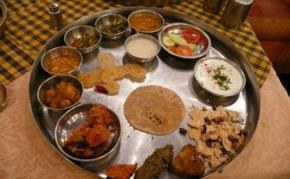
India seems to be the only country that houses the most vegetarians
than any other country in the world. Given that more than half of the population
eats meat. Well, it’s simply the numbers game when it comes to India. Only
by India’s sheer strength of population that there are more vegetarians
in India than the rest of the world combined. According to a 2006 survey
by ‘The Hindu’ newspaper, it was found that 40 percent of the Indian population.
That makes it some 400 million Indians are vegetarians.
Vegetarianism in India has been a lifestyle for centuries. Hence there
is no beef or pork in any McDonald's in India. In fact the only non-vegetarian
items as in McDonald’s India’s online menu have chicken and fish. To a
kiwi friend of mine who visited Mumbai recently, the menu in McDonald’s
had very little meat options and disappointing to his palate. In saying
that, even a traditional non-vegetarian in India is more dependent on vegetarian
food as on most of the days he is dependent on a vegetarian diet. Even
on meat eating days like a Sunday most dishes are vegetarian except for
one or two side-dishes with meat. Non-vegetarians in India typically consume
meat only once or twice per week and it wouldn’t be totally off the mark
to assume that meat may be regularly consumed by less than 30 percent of
the Indian population due to its higher cost.
The reasoning behind the practice of vegetarianism is wide-ranging though
influenced mainly by the tenets of Hinduism, Buddhism, Jainism or Sikhism.
The other compelling reason is the affordability of non-vegetarian food.
Health and social consciousness increasingly play a part in bringing about
a change in the Indian psyche towards a vegetarian lifestyle. It’s fashionable
for Bollywood stars to say they are vegetarians. “Vegetarianism is becoming
a way of life now, not just in food but also in lifestyle products as people
care more about health, environment and animals. They do not want to brush
their teeth using bone-powder, they want to exclude leather from their
furniture,” says NG Jayasimha, campaign manager, People for the Ethical
Treatment of Animals (PETA) India.
Add to this the corporate strategies that hinge on vegetarianism for
products like toothpaste, ice-creams, skin care products, soaps, apparels
etc. Here’s an example of how big brands have joined the vegetarian bandwagon.
Pizza Hut has at least 60% of its sales in the Indian market to vegetarian
food items. McDonald’s vegetarian selections account for around 50-65%
of total sales. Colgate India carries the ‘always 100% vegetarian’ label
on the carton. Baskin Robbins has 100% vegetarian ice-creams which are
advertised in a big way. The world-famous-in India celebrity chef Sanjeev
Kapoor also mentions interesting facts about the Indian ‘vegetarian-friendly’
society. “If I release a book on ‘non-vegetarian’ recipes, even then 70
out of 100 dishes would be vegetarian than just purely non-vegetarian dishes.”
India as a vegetarian country draws her veggie-food culture in a big
way from her religions. The earliest records of vegetarianism as a way
of harmonious living by a significant number of people come from ancient
India. The rise of vegetarianism in India goes back to more than 500 BCE,
which saw the rise of Buddhism and Jainism preaching the principle of ahimsa
or non-violence till today.
The spiritual traditions right from the days of Emperor Ashoka in 300
BCE which assert the principle of Ahimsa (non-violence) being the highest
dharma (Ahimsa paramo dharmah) led to Article 51A (g) of the Indian Constitution
which enjoins on every citizen to have the fundamental duty to show compassion
towards all living creatures. "You must not use your God given body for
killing God's creatures, whether they are human, animal or whatever" advises
the Yajur Veda. Shri Guru Granth Sahib, the holy book of Sikhs says, “You
kill living beings, and call it a righteous action. Tell me, brother, what
would you call an unrighteous action.”
The Vedic scriptures of India, which predate Buddhism, also stress nonviolence
as an ethical foundation of vegetarianism. "Meat can never be obtained
without injury to living creatures," states the Manusmriti - the ancient
Hindu code of ethics, "Let one therefore shun the use of meat." Even in
the Mahabharata there are many injunctions against killing animals.
Saints and sages believed that eating vegetarian food to be a part of
purification, bestowing good health and a restful mind. Our bodily constitution
and mental framework are determined by what we eat. The great Indian mystic
Osho shares, “Vegetarianism is nothing but a by-product of deep meditation.
If a person goes on meditating, by and by he will see that it has become
impossible to eat meat.” Mind-Body guru Deepak Chopra says “In general,
it is obvious that a vegetarian diet is healthier, it is better for ecology,
and less violent on life as a whole. Eating habits are based on culture,
geography and influenced by religion.” In Sikhism the langar food
served at Gurudwaras is always vegetarian. All the food offerings in a
Hindu worship can only be vegetarian.
Given all this, the one thing in favour of the Indian vegetarian lifestyle
is the fact that it has a positive impact on climate change. Could the
world leaders at Copenhagen not have ignored this about Indian lifestyle
as one of the many strategies to save the planet? Or should they heed to
Albert Einstein’ advice as one of the many planet saving strategies, when
he said “Nothing will benefit human health and increase the chances for
survival of life on Earth as much as the evolution to a vegetarian diet."
After all that is said than done, vegetarianism or otherwise like many
things in life is simply a matter of taste, choice, habit, availability
and reasoning.
Signature Campaign for the welfare of Indian Cows
http://eng.gougram.org/
A proposal to The Honourable President of India will be submitted in
January, 2010
Our nation is a country of villages. Lives of villagers are mainly based
on agriculture. Agriculture largely depends on the cow and bull. The bull
is given a place of pride in our culture and national heritage. The holy
‘Gou Matha’ is a source of both food and economy. She is the centre of
ayurveda, environment, Indian economics, culture and agriculture.
Neglect of villagers and cows has produced ill effects on earth, environment
and health of living beings. Due to this, our culture, agriculture and
economic conditions suffer. Due to the failure of crops, farmers are committing
suicide. Our religions, culture as well as constitution do not support
the killing of cows and other animals. In fact, the cow protection issues
created the platform for the Indian freedom struggle. During that time,
all freedom fighters assured that ‘after getting freedom, there will be
no more cows slaughter in the nation’. But even today, cow slaughter is
going on unabated.
Therefore our request to The President is…
1.Declaration – cow as the National Animal.
2.Formulation of laws to preserve various breeds of Indian cows and
to ban the cow slaughter.
3.Provision of separate ministry to handle the issues related to cow.
4.Promotion of Indigenous cow protection movements to save Jana, Jala,
Janvar, Jungle, Jeeva.
We all request you to give us a chance to protect the respect of the
National symbole, that is ‘Gou Matha’.
Be one of us.
Fill the details to participate in the Signature Campaign
http://eng.gougram.org/signature-campaign-for-the-welfare-of-indian-cows/
Vrindavan cows kidnapped to be killed- How Vrindavan
is Losing its Cows to Slaughter
http://vegancowprotect.wordpress.com/2009/05/08/vrindavan-cows-kidnapped-to-be-killed-how-vrindavan-is-losing-its-cows-to-slaughter/
Posted on May 8, 2009 by Jeannette
BY: ANTONY BRENNAN
May 04, VRINDAVAN, INDIA (SUN) — Subhangi Devi Dasi lives in Vrindavan
India. Recently she was awoken early in the morning to witness a site none
of us would even dream could be happening.Krishna’s cows are being violently
kidnapped in the night. It is believed the cows are killed and sold for
their flesh and leather products.
“I was sleeping,” Subhangi Devi Dasi says. “At 2.00 am I hear cows crying,
people screaming and yelling. I run out to my balcony and see a truck backing
away and cows franticly running in all directions down the lanes, all crying.
I have never seen that in Vrindavan.”
Subhangi was witnessing the kidnapping of the local cows. “Then I see
some local men throwing stones at the trucks and swearing in Hindi, some
other men came with machetes and one with a rifle,” Subhangi says. These
men were coming to protect the cows “The truck backed out of the road and
drove off.”
Arjuna, one of the men trying to protect the cows says the kidnappers
came with several trucks. “They caught and stole 48 cows just here in this
area,” he says. “The men were ruthless, throwing the cows in the back of
their trucks, beating then and in some cases killing them if they were
resisting,” Arjuna says. “Blood was everywhere.”
Villagers say the kidnappers are armed attack anyone who tries to stop
them. “A month or so back.” Arjuna says. “The police put up barricades
to try to stop the kidnappers. That night they rammed the barricades with
their trucks.”
“It is so out of control,” says Arjuna. “Vrindavan is the land of cows
and these demons have become aware that there are so many cows and goshallas
just ripe for the picking.” The locals are helpless. They can do little
without risking their own lives.
It is reported that 15 days ago, when the police tried to stop them,
the kidnappers rammed a police jeep. A policeman fired a shot and he got
a rock in the head for his effort. It is reported that he police had to
pull back as there were only four of them, whilst there were eight heavily
armed kidnappers. “They criminals seem to be aware of how much resistance
they will encounter and come prepared to meet it.;” Arjuna says.
“Sometimes they brick the cows in the head with rocks and sometimes
shoot them or hack them with machetes if they resist,” says Arjuna. “They
used to come in one truck now they travel with four trucks at a time.”
Subhangi Devi Dasi says she has heard the cows can fetch up to 10,000
rupees. It is no wonder kidnappers are armed and are prepared to injure
even the police. Villagers who to try to prevent the kidnappings are said
to be placing themselves and their families in a very dangerous situation.
Devotees and well wishers should contact Uttar Pradesh government ministers
and demand action be taken against those who kidnap and kill cows. Kumari
Mayawati is the chief minister of Uttar Pradesh. Letters can be faxed to
Minister Mayawati at the following fax number: +91 522 2237620.
Kidnapping of cows is a criminal offence In Vrindavan. Residents of
Vrindavan say the villagers and cows need support and protection whilst
the need resources to stop and catch those who prey on the cows.
You can also call Minister Mayawati directly on +91 522 2235733. If
you wish you can send your letter by email to dontkillcows@gmail.com. All
the letters sent to this email address will be collated and presented to
Minister Mayawati with a petition asking her government to take action.
My comments: I’m writing with a heavy heart. After reading this article,
I was motionless for sometime and still in shock. I don’t know how such
incidents keep happening. Entire Vrindavan people should be aggressive
and do something concrete (large-scale strike/road-blocking media
houses should be notified) to bring the attention of the nation. I think
simply petitioning will not be of much help. While Vrindavan people do
this, the people outside can do their part (like writing to news companies,
etc). If this is not immediately stopped, those murderers will increase
their activities.
Op-Ed: Food for the Soul
http://news.iskcon.com/node/2240/2009-08-29/op-ed_food_soul
By Nicholas D. Kristof for The New York Times on 23 Aug 2009
On a summer visit back to the farm here where I grew up, I think I figured
out the central problem with modern industrial agriculture. It’s not just
that it produces unhealthy food, mishandles waste and overuses antibiotics
in ways that harm us all.
More fundamentally, it has no soul.
The family farm traditionally was the most soulful place imaginable,
and that was the case with our own farm on the edge of the Willamette Valley.
I can’t say we were efficient: for a time we thought about calling ourselves
“Wandering Livestock Ranch,” after our Angus cattle escaped in one direction
and our Duroc hogs in another.
When coyotes threatened our sheep operation, we spent $300 on a Kuvasz,
a breed of guard dog that is said to excel in protecting sheep. Alas, our
fancy-pants new sheep dog began her duties by dining on lamb.
It’s always said that if a dog kills one lamb, it will never stop, and
so the local rule was that if your dog killed one sheep you had to shoot
it. Instead we engaged in a successful cover-up. It worked, for the dog
never touched a lamb again and for the rest of her long life fended off
coyotes heroically.
That kind of diverse, chaotic family farm is now disappearing, replaced
by insipid food assembly lines.
The result is food that also lacks soul but may contain pathogens.
In the last two months, there have been two major recalls of ground beef
because of possible contamination with drug-resistant salmonella. When
factory farms routinely fill animals with antibiotics, the result is superbugs
that resist antibiotics.
Michael Pollan, the food writer, notes that monocultures in the field
result in monocultures in our diets. Two-thirds of our calories, he says,
now come from just four crops: rice, soy, wheat and corn. Fast-food culture
and obesity are linked, he argues, to the transformation from family farms
to industrial farming.
In fairness, industrial farming is extraordinarily efficient, and smaller
diverse family farms would mean more expensive food. So is this all inevitable?
Is my nostalgia like the blacksmith’s grief over Henry Ford’s assembly
lines superseding a more primitive technology? Perhaps, but I’m reassured
by one of my old high school buddies here in Yamhill, Bob Bansen. He runs
a family dairy of 225 Jersey cows so efficiently that it can still compete
with giant factory dairies of 20,000 cows.
Bob names all his cows, and can tell them apart in an instant. He can
tell you each cow’s quirks and parentage. They are family friends as well
as economic assets.
“With these big dairies, a cow means nothing to them,” Bob said. “When
I lose a cow, it bothers me. I kick myself.” That might seem like sentimentality,
but it’s also good business and preserves his assets.
American agriculture policy and subsidies have favored industrialization
and consolidation, but there are signs that the Obama administration Agriculture
Department under Secretary Tom Vilsack is becoming more friendly to small
producers. I hope that’s right.
One of my childhood memories is of placing a chicken egg in a goose
nest when I was about 10 (my young scientist phase). That mother goose
was thrilled when her eggs hatched, and maternal love is such that she
never seemed to notice that one of her babies was a neckless midget.
As for the chick, she never doubted her goosiness. At night, our chickens
would roost high up in the barn, while the geese would sleep on the floor,
with their heads tucked under their wings. This chick slept with the goslings,
and she tried mightily to stretch her neck under her wing. No doubt she
had a permanent crick in her neck.
Then the fateful day came when the mother goose took her brood to the
water for the first time. She jumped in, and the goslings leaped in after
her. The chick stood on the bank, aghast.
For the next few days, mother and daughter tried to reason it out, each
deeply upset by the other’s intransigence. After several days of barnyard
trauma, the chick underwent an identity crisis, nature triumphed over nurture,
and she redefined herself as a hen.
She moved across the barn to hang out with the chickens. At first she
still slept goose-like, and visited her “mother” and fellow goslings each
day, but within two months she no longer even acknowledged her stepmother
and stepsiblings and behaved just like other chickens.
Recollections like that make me wistful for a healthy rural America
composed of diverse family farms, which also offer decent and varied lives
for the animals themselves (at least when farm boys aren’t conducting “scientific”
experiments). In contrast, a modern industrialized operation is a different
world: more than 100,000 hens in cages, their beaks removed, without a
rooster, without geese or other animals, spewing out pollution and ending
up as so-called food a calorie factory, without any soul.
Subject: FW: So you think you don't eat BEEF or PORK!
FYI
------------------------------------------------------------------------------------------------------------------
From: Ajamila ACBSP
Date: 14-Nov-09 05:56 (00:56 -0500)
If you eat any Kellogs products, thinking you are not eating BEEF or
PORK
then please read Kellogs' clear admittance that most of their products
contain BEEF and PORK.
Circulate this to your fellow devotees and good things will happen to
you
for sure because it is upholding Krishna dharma. Hare Krishna!!
ys
ad
Here's what Kellogg said when asked by Mukesh Kenia
"From: < <mailto:kellogg@casupport.com; kellogg@casupport.com
Date: Mon, Oct 26, 2009 at 10:31 PM
Subject: Consumer Affairs 020527082A
To: <mailto:rpmmike@gmail.com; rpmmike@gmail.com
Thank you for your inquiry regarding gelatin used in some
of our
products. We are glad you contacted us and we are happy
to provide you
with this information.
Gelatin is used to help the texture of the product and
is derived from
either beef or pork. All gelatin used at Kellogg is certified
Kosher.
Gelatin derived from pork is found in Kellogg'sR cereal
products that
contain marshmallow additives, for example Kellogg'sR
Marshmallow Froot
Loops cereal and Kellogg's SmorzR cereal. It is also found
in all
varieties of Kellogg'sR Rice Krispies TreatsR Squares
and Special KR
Protein Snack Bars.
Gelatin derived from beef is found in all varieties of
Kellogg'sR
Frosted Pop-TartsR, Kellogg'sR Frosted Mini-WheatsR cereal,
and
Kellogg'sR Rice Krispies TreatsT cereal. None of the equipment
that
comes in contact with the gelatin in Kellogg'sR Frosted
Pop-TartsR is
used in the production of the other pastries. As a result,
Plain
(unfrosted) Kellogg'sR Pop-TartsR do not contain gelatin.
The
pre-gelatinized wheat starch contained in some of our
toaster pastries
is derived from wheat and does not contain any gelatin.
All Kellogg'sR fruit snacks contain gelatin. In fruit snacks
beef and
pork gelatin are used interchangeably based on availability
in the
marketplace.
Again, thank you for contacting us. We appreciate your
loyal use of our
products and hope that this provides you with the information
you need
to make food choices appropriate for you and your family.
Sincerely,
Grace De La Cruz
Consumer Affairs Department
(Text PAMHO:18535803) --------------------------------------
Health Care Reform and the “V” Word
http://news.iskcon.com/node/2305/2009-10-01/health_care_reform_and_“v”_word
Post a CommentSend to friendPrinter-friendly versionDownload a PDF
version of this page.
By Sesa Dasa on 1 Oct 2009
We’re spending $147 billion to treat obesity, $116 billion to treat
diabetes, and hundreds of billions more to treat cardiovascular disease
and the many types of cancer that have been linked to the so-called Western
diet.
Kudos to Michael Pollan. His September 9, 2009 Op-Ed contribution to
the New York Times, Big Food vs. Big Insurances, raises unspoken, yet hard
to ignore, issues in the US Health Care Reform debate. Pollan points out,
“The American way of eating has become the elephant in the room in the
debate over health care.”
According to the Centers for Disease Control and Prevention, three-quarters
of health care spending now goes to treat “preventable chronic diseases.”
Not all of these diseases are linked to diet there’s smoking, for
instance but many, if not most, of them are:
We’re spending $147 billion to treat obesity, $116 billion to treat
diabetes, and hundreds of billions more to treat cardiovascular disease
and the many types of cancer that have been linked to the so-called Western
diet. One recent study estimated that 30 percent of the increase in health
care spending over the past 20 years could be attributed to the soaring
rate of obesity, a condition that now accounts for nearly a tenth of all
spending on health care.
A certain degree of anticipation grew in my heart as I read through
Pollan’s two page article. It all made good sense to me, preventable diseases
– yes, obesity – yes, diabetes – yes. Then, quite abruptly the article
ended, leaving me somewhat puzzled and disappointed. You see, I was waiting
for the “V” word but it never manifested.
How could he ignore vegetarianism?! Pollan argues his point convincingly
by focuses on the numbers, the costs to health care insurers and the politics
of government and agribusiness. Yet, with the exceptions of couple of unelaborated
references to soda, fast food, and fresh produce he too seems to avoid
speaking about the actual elephant in the room. The “elephant” is what
we eat.
“Let me read this thing again,” I thought, “maybe I missed something.”
To my relief, I found that I had missed a key point in Pollan’s piece.
My relief turned into enthusiasm when I realized what Pollan was actually
doing. He wasn’t avoiding the elephant in the room; he was opening the
door for me (and others) to specifically add the “V” word to the debate.
We all have a role to play in health care reform. Such a major change in
direction for a society like the US is not going to happen unless we all
add our own special viewpoint to the debate. Yes, I will take this opportunity
to follow Pollan’s lead by presenting numbers specifically linked to vegetarianism
and health as opposed to the money and politics he focuses on.
In a recent study conducted by Susan E. Berkow and Dr. Neal D. Barnard
of the Physicians Committee for Responsible Medicine reported at bio-medicine.org,
the authors found that the body weight of both male and female vegetarians
is, on average, 3 percent to 20 percent lower than that of meat eaters:
Obesity is one of the most pressing health problems in the United States
and will soon become the country’s leading cause of preventable deaths,”
says Deborah Wilson, M.D. writing for the Vegetarian Starter Kit, published
by People for the Ethical Treatment of Animals. “Because vegetarian diets
are the only diets that work for long-term weight loss, it’s no surprise
that population studies show that meat-eaters have three times the obesity
rate of vegetarians and nine times the obesity rate of vegans…Adopting
a vegan diet won’t just help you slim down, it will also help you fight
an array of ailments, including heart disease, cancer, diabetes, arthritis,
and more.
In the July 2009 issue of its journal The American Dietetic Association
(Volume 109, Issue 7, Pages 1266-1282) published its official position
on Vegetarian diets:
It is the position of the American Dietetic Association that appropriately
planned vegetarian diets, including total vegetarian or vegan diets, are
healthful, nutritionally adequate, and may provide health benefits in the
prevention and treatment of certain diseases. Well-planned vegetarian diets
are appropriate for individuals during all stages of the life cycle, including
pregnancy, lactation, infancy, childhood, and adolescence, and for athletes.
A vegetarian diet is defined as one that does not include meat (including
fowl) or seafood, or products containing those foods. The results of an
evidence-based review showed that a vegetarian diet is associated with
a lower risk of death from ischemic heart disease.
Vegetarians also appear to have lower low-density lipoprotein cholesterol
levels, lower blood pressure, and lower rates of hypertension and type
2 diabetes than nonvegetarians. Furthermore, vegetarians tend to have a
lower body mass index and lower overall cancer rates. Features of a vegetarian
diet that may reduce risk of chronic disease include lower intakes of saturated
fat and cholesterol and higher intakes of fruits, vegetables, whole grains,
nuts, soy products, fiber, and phytochemicals.
Clearly, there is a link between vegetarianism and better health, and
better health translates into lower health care costs. Great, so with regard
to health care reform, lower health care costs, going vegetarian is a platform
on which everyone wins.
Still, a question lingers in my mind. Why did Pollan stop short of using
the “V” word? Are there some who don’t win with regard to vegetarianism
and health care? Perhaps Pollan was intimidated by those who don’t see
a win. Vegetarians remember all too well how the meat industry jumped on
Oprah Winfrey back in the 90’s when she questioned meat industry health
and safety standards. Oprah could afford to fight the lawsuit, perhaps
Pollan can’t. Faced with opposition from this powerful wing of the agribusinesses
Pollan mentions, perhaps his strategy of opening the door for broader participation
in the debate also includes bringing in more diverse voices to achieve
more collective strength to combat a powerfully entrenched meat industry.
The health benefits derived from vegetarianism certainly go far beyond
simply what we ingest. Both our external environment and internal environment,
or consciousness, impact our physical health. This is a fact also recognized
by nutritionists. Holly Alley, MS, RD, LD, Nutrition Specialist, Department
of Food and Nutrition at the University of Georgia, College of Family and
Consumer Sciences, Cooperative Extension Services summaries how these two
environments contribute to good health (www.fcs.uga.edu):
People become vegetarians for many reasons. These may include religious
reasons (Hindu, Moslem, Buddhists, Seventh Day Adventist), health, fad,
economic, or moral [against the killing of animals] reasons…These health
benefits found in vegetarians may not be solely due to diet. Lifestyle
habits other than diet, such as exercise, religious practices, smoking,
and alcohol can also influence health. The research does not always separate
out whether it is the diet alone which makes the difference or whether
these other lifestyle factors also play a part.
Who can deny that lifestyle factors do play a part in our health? Accepting
that they do play a part in our health, then the voices of their advocates
must be part of the debate. Arguments of concern from those who are vegetarians
because of the devastating effects meat eating has on our global environment,
arguments of passion from those who are vegetarians because of religious
reasons, and arguments of sensitivity those who are vegetarians because
of the terrible cruelty and violence inflicted upon animals must be added
to the medical arguments on the benefits of vegetarianism. Only such a
collective effort will fully expose the elephant in the room, and lead
to improved health care for all Americans.
Gee, I feel better already.
What Are We Really Eating?
http://news.iskcon.com/node/820/what_are_we_really_eating
Send to friendPrinter-friendly versionDownload a PDF version of this
page.
By Madhava Smullen on 25 Jan 2008
[][]
Image: Gavin Bell
We live in a world of enticingly packaged, processed foods where nobody
really cares what they’re eating, so long as it looks good. As a child,
I remember seeing a guest on a TV chat show say that they were allergic
to various products, and therefore had to check the ingredients on everything
when they went shopping. “Oh my God!” the host exclaimed in horror. “That
must be such a pain! I could never do that!”
More recently, I was traveling in California with some friends and decided
to visit Universal Studios in Hollywood. When hunger struck, we searched
for the most vegetarian restaurant we could find and discovered one with
a delightful buffet-style line featuring a variety of salads, pasta and
pizza.
The girl at the counter filled up our plates with pasta once she’d let
us know, none too confidently, that it didn’t contain eggs.
Then the fun really started.
“Do you know if there’s animal rennet in the cheese?” My friend Janmastami
asked.
The girl looked blank. He tried to rephrase the question. “What is the
cheese made with?”
This time she stared at him with an expression reserved for the severely
mentally retarded. Her jaw slackened a little. Her eyes opened wide.
“Cheese is made with milk,” she said. “Milk comes from a cow.”
If only it were that simple. As a vegetarian, I may find this kind of
routine ignorance funny – at least in retrospect – but it doesn’t inspire
confidence in our eating establishments. Food companies themselves, while
presenting a slightly more sophisticated front, aren’t much better. For
a start, there is no law in any country that requires retailers to mark
their products as vegetarian.
When you do find a “vegetarian” label, it’s simply a voluntary practice
on the part of the manufacturer, and doesn’t reflect any universally agreed
upon standard. Different manufacturers have their own opinion on what is
or isn’t vegetarian, so even if a product announces to you that it’s fine
for you to eat, it may actually contain, for example, animal-derived glycerine.
Certain labels, like that of the Vegetarian Society in the UK, are reliable
– but ISKCON devotees must be sure to double check, as the manufacturers
generally consider eggs suitable for vegetarians.
So what can you do? Shock that poor TV host from the eighties, and check
your ingredients every time. It’s the only way. Checking once and creating
a list of “safe” products isn’t reliable, as manufacturers often change
the ingredients in a product without warning – for instance, a rennet-free
cheese may start using rennet again at any time.
But you’re still not in the safe zone yet. When you do check your ingredients,
you’ll probably find that most of them might as well be written in Arabic.
Packages don’t inform you that your ice-cream contains a gelling agent
derived from animal ligaments, skins, tendons, bones and hooves. No, that
would take up far too much space, and ruin your appetite. So instead, they
use a neat little word like “gelatine.” You might be surprised to know
how many ISKCON members don’t know this – a disturbing thought.
Here are some more common animal ingredients you should watch out for:
Cochineal, also known as E120, is a red dye often used in ice-cream,
yogurt, glacé cherries, jams and drinks. Sound delicious? You’ll
stop licking your lips after you’ve heard that it’s made from the crushed
female un-hatched larva of the Cochineal beetle.
Animal rennet is an enzyme made from the stomach of calves and lambs,
and is often used in cheese. Fortunately, it’s usually listed in ingredients
as “animal rennet,” since rennet can also be made from vegetables.
Gylcerine is a type of animal fat that is often blended with vegetable
fats. Many soap products contain it, and do not always state whether it
is plant or animal-based. If in doubt, contact the manufacturer. Glycerine
is also found in some chewing gums.
Lecithin is found in egg yolks, the tissues and organs of many animals,
and some vegetables such as soybeans and corn. It’s often used in butter
and margarine, and other foods high in fat and oils. If it’s vegetarian,
the ingredients will state “Soy Lecithin.” Luckily, Lecithin is usually
made from soy these days.
Beware of the phrase “Natural flavors,” on a product. Sounds friendly,
doesn’t it? But often, these will be derived from beef or other meats.
Contact the company and ask them what they use in their natural flavors.
They may not always tell you, but the more people that do this, the more
they’ll be likely to start making it available knowledge.
The world of processed foods is a strange one that seems to be intent
on making sure you don’t know what you’re putting in your mouth. Today’s
world, as Srila Prabhupada’s guru Bhaktisiddhanta Sarasvati so succinctly
put it, is “No place for a gentleman.” But while you’re here, you would
do well to brush up on your knowledge of animal ingredients.
PETA (People for the Ethical Treatment of Animals) have a comprehensive
list that should get you started. Good sources of additional information
are the Consumer's Dictionary of Cosmetic Ingredients and the Consumer's
Dictionary of Food Additives, available at most libraries or bookstores.
And of course, if you have a question regarding an ingredient in a product,
just call the manufacturer.
Vegetarian Menu in American Hospitals
http://news.iskcon.com/node/2413/2009-12-04/vegetarian_menu_american_hospitals
Post a CommentSend to friendPrinter-friendly versionDownload a PDF
version of this page.
By Sally Andersen for VegDaily on 19 Nov 2009
Vegetarianism is considered a healthy, viable diet. Necessary nutrients,
proteins, and amino acids for the body's sustenance can be found in vegetables,
grains, nuts, soymilk and dairy.
Hospitals are catching on to the fact that meat is not good for the
environment, their budget, their patients’ health, or even the animals!
Health Care Without Harm (HCWH) has introduced the Balanced Menus Challenge,
a program that asks health care institutions to reduce their meat purchases
by 20% within 12 months of taking the challenge.
So far, 14 hospitals across the U.S. have taken the challenge and will
be offering more plant-based meals. The change with also include creating
more meals with less meat the American Institute for Cancer Research’s
New American Plate, which states that meat should not take up more than
25% of your plate and that vegetables should cover at least 50%.
HCWH says that “reducing meat purchasing at health care facilities is
a potent food service climate change reduction strategy as well as an opportunity
for hospitals to model healthy eating patterns for patients, staff and
visitors.”
Want to Drop Your Carbon Emissions? Stop Eating Beef,
India’s Minister Declares
http://news.outlookindia.com/item.aspx?669793
NEW DELHI, INDIA, November 22, 2009: Environment Minister Jairam Ramesh,
a vegetarian himself, was not invoking any ancient Hindu scriptures, but
what he said would certainly warm the cockles of those hearts who consider
eating beef an anathema.
Citing measures for developed countries to cut carbon emissions he said,
“It has been seen that developed countries which eat beef have the maximum
amount of emissions. They can cut down on emissions, if they stop eating
beef. The single-most important cause of emissions is eating beef,” Ramesh
said.
Ramesh quoted a number of studies and global climate change expert R.K.
Pachauri to support his view, but the issue has been debated for years.
Last year, a United Nations Food and Agriculture Organization study found
that meat production accounts for nearly a fifth of all greenhouse gas
emissions that are causing temperatures to rise, causing erratic rainfall,
higher sea levels and stronger storm events.
hindusim today
India Tells West to Stop Eating Beef
http://news.iskcon.com/node/2401/2009-11-23/india_tells_west_stop_eating_beef
By Dean Nelson for Telegraph on 20 Nov 2009
The environment minister, Jairam Ramesh, said if the world abandoned
beef consumption, emissions would be dramatically reduced and global warming
would slow down.
"The solution to cut emissions is to stop eating beef. It leads to emission
of methane which is 23 times more potent than carbon dioxide," he said.
"The best thing for us, India, is we are not a beef-eating nation.
The United States, the world's largest emitter along with China, is
also the world's greatest beef-eating nation and consumes 25 per cent more
than Europe.
His comments follow a call last month by Lord Stern, the author of a
British Government study on climate change, for people to give up eating
meay to reduce emissions. "Meat is a wasteful use of water and creates
a lot of greenhouse gases," said Lord Stern. "It puts enormous pressure
on the world's resources. A vegetarian diet is better."
Hindus are forbidden to eat beef and India has more vegetarians than
any other country in the world. More than 30 per cent of its 1.1 billion
people do not eat meat at all.
According to the United Nations Food and Agriculture Organisation, livestock
is responsible for 18 per cent of the the Earth's greenhouse gas emissions.
Cows produce harmful methane gas and environmentalists argue beef production
causes greater damage than any other farming because it requires far more
land and water than for any other form of animal husbandry.
Serious Environmentalism is Also Serious Vegetarianism
http://www.washingtonpost.com
WASHINGTON D.C., November 16, 2009: James E. McWilliams, is an associate
professor of history at Texas State University at San Marcos and a recent
fellow in the agrarian studies program at Yale University.
McWilliams spoke in South Texas recently on the environmental virtues
of a vegetarian diet. He noted: “The livestock industry, as a result of
its reliance on corn and soy-based feed, accounts for over half the synthetic
fertilizer used in the United States, contributing more than any other
sector to marine dead zones.”
He continues, “It consumes 70 percent of the water in the American West
water so heavily subsidized that if irrigation supports were removed,
ground beef would cost $35 a pound. Livestock accounts for at least 21
percent of greenhouse-gas emissions globally more than all forms
of transportation combined. Domestic animals most of them healthy
consume about 70 percent of all the antibiotics produced. It takes
a gallon of gasoline to produce a pound of conventional beef. If all the
grain fed to animals went to people, you could feed China and India.”
McWilliams is also the author of “Just Food.” For the full article see
source above.
Bellying up to environmentalism
http://www.washingtonpost.com/wp-dyn/content/article/2009/11/15/AR2009111502210.html
By James E. McWilliams
Monday, November 16, 2009
I gave a talk in South Texas recently on the environmental virtues of
a vegetarian diet. As you might imagine, the reception was chilly. In fact,
the only applause came during the Q&A period when a member of the audience
said that my lecture made him want to go out and eat even more meat. "Plus,"
he added, "what I eat is my business -- it's personal."
I've been writing about food and agriculture for more than a decade.
Until that evening, however, I'd never actively thought about this most
basic culinary question: Is eating personal?
We know more than we've ever known about the innards of the global food
system. We understand that food can both nourish and kill. We know that
its production can both destroy and enhance our environment. We know that
farming touches every aspect of our lives -- the air we breathe, the water
we drink, and the soil we need.
So it's hard to avoid concluding that eating cannot be personal. What
I eat influences you. What you eat influences me. Our diets are deeply,
intimately and necessarily political.
This realization changes everything for those who avoid meat. As a vegetarian
I've always felt the perverse need to apologize for my dietary choice.
It inconveniences people. It smacks of self-righteousness. It makes us
pariahs at dinner parties. But the more I learn about the negative impact
of meat production, the more I feel that it's the consumers of meat who
should be
making apologies.
Here's why: The livestock industry as a result of its reliance on corn
and soy-based feed accounts for over half the synthetic fertilizer used
in the United States, contributing more than any other sector to marine
dead zones. It consumes 70 percent of the water in the American West --
water so heavily subsidized that if irrigation supports were removed, ground
beef would cost $35 a pound. Livestock accounts for at least 21 percent
of greenhouse-gas emissions globally -- more than all forms of transportation
combined. Domestic animals -- most of them healthy -- consume about 70
percent of all the antibiotics produced. Undigested antibiotics leach from
manure into freshwater systems and impair the sex organs of fish.
It takes a gallon of gasoline to produce a pound of conventional beef.
If all the grain fed to animals went to people, you could feed China and
India. That's just a start.
Meat that's raised according to "alternative" standards (about 1 percent
of meat in the United States) might be a better choice but not nearly as
much so as its privileged consumers would have us believe. "Free-range
chickens" theoretically have access to the outdoors. But many "free-range"
chickens never see the light of day because they cannot make it through
the crowded shed to the aperture leading to a patch of cement.
"Grass-fed" beef produces four times the methane -- a greenhouse gas
21 times as powerful as carbon dioxide -- of grain-fed cows, and many grass-fed
cows are raised on heavily fertilized and irrigated grass. Pastured pigs
are still typically mutilated, fed commercial feed and prevented from rooting
-- their most basic instinct besides sex.
Issues of animal welfare are equally implicated in all forms of meat
production. Domestic animals suffer immensely, feel pain and may even be
cognizant of the fate that awaits them. In an egg factory, male chicks
(economically worthless) are summarily run through a grinder. Pigs are
castrated without anesthesia, crated, tail-docked and nose-ringed. Milk
cows are repeatedly impregnated through artificial insemination, confined
to milking stalls and milked to yield 15 times the amount of milk they
would produce under normal conditions. When calves are removed from their
mothers at birth, the mothers mourn their loss with heart-rending moans.
Then comes the slaughterhouse, an operation that's left with millions
of pounds of carcasses -- deadstock -- that are incinerated or dumped in
landfills. (Rendering plants have taken a nose dive since mad cow disease.)
Now, if someone told you that a particular corporation was trashing
the air, water and soil; causing more global warming than the transportation
industry; consuming massive amounts of fossil fuel; unleashing the cruelest
sort of suffering on innocent and sentient beings; failing to recycle its
waste; and clogging our arteries in the process, how would you react? Would
you say, "Hey, that's personal?" Probably not. It's more likely that you'd
frame the matter as a dire political issue in need of a dire political
response.
Vegetarianism is not only the most powerful political response we can
make to industrialized food. It's a necessary prerequisite to reforming
it. To quit eating meat is to dismantle the global food apparatus at its
foundation.
Agribusiness has been vilified of late by muckraking journalists, activist
filmmakers and sustainable-food advocates. We know that something has to
be done to save our food from corporate interests. But I wonder -- are
we ready to do what must be done? Sure, we've been inundated with ideas:
eat local, vote with your fork, buy organic, support fair trade, etc. But
these proposals all lack something that every successful environmental
movement has always placed at its core: genuine sacrifice.
Until we make that leap, until we create a culinary culture in which
the meat-eaters must do the apologizing, the current proposals will be
nothing more than gestures that turn the fork into an empty symbol rather
than a real tool for environmental change.
James E. McWilliams, an associate professor of history at Texas State
University at San Marcos and a recent fellow in the agrarian studies program
at Yale University, is most recently the author of "Just Food."
Turn vegetarian and conquer climate change
October 30, 2009, 10:08 am
Filed under: Environmental Politics, Global Warming, Vegetarianism
http://environmentkrishna.wordpress.com/2009/10/30/turn-vegetarian-and-conquer-climate-change/
The Economic Times
LONDON: Going the vegetarian way can help to tackle the problem of global
warming apart from its known health benefits to human, according to a climate
expert.
“Meat is a wasteful use of water and creates a lot of greenhouse gases.
It puts enormous pressure on the world’s resources. A vegetarian diet is
better,” Lord Stern of Brentford said.
“Direct emissions of methane from cows and pigs is a significant source
of greenhouse gases. Methane is 23 times more powerful than carbon dioxide
as a global warming gas,” he said.
Lord Stern, author of the 2006 Stern Review on the cost of tackling
global warming, said that a successful deal at the upcoming Climate Change
Conference in Copenhagen would lead to soaring costs for meat and other
foods that generate large quantities of greenhouse gases.
“I think it’s important that people think about what they are doing
and that includes what they are eating,” he said.
A former chief economist at the World Bank, Stern warned that British
taxpayers would need to contribute about £ 3 billion a year by 2015
to help poor countries to cope with the impact of climate change.
Speaking on the eve of an all-parliamentary debate on climate change,
Lord Stern admitted that he himself is not a strict vegetarian.
Ahimsa Silk
http://nvclub108.blogspot.com/2009/03/ahimsa-silk.html
HG Muralidhara Priya Prabhu, one of our most ecstatic monks here at
the Bhaktivedanta Ashram here in NYC, has written an article detailing
something that most devotees may not know about-the process of how their
silk cloth (saris and dhotis) are made.
It's not a pretty process, and it's certainly something that wouldn't
please Guru and Gauranga.
Here's another chance for devotees to "walk the walk" as examples of
conscious and conscientious members of the planet, inspiring by our practical
examples and deep knowledge
Silk - should we wear it or not?
By Muralidhara-priya Das
Should we be using silk? If we want to practice compassion and non-violence
toward all living entities, then we should think twice about what we are
putting on our bodies. Originally in Vedic times they used what was called
Wild Silk.
Wild silks are produced by caterpillars other than the mulberry silkworm
and can be artificially cultivated. The worms are allowed to naturally
leave the cocoon. A variety of wild silks have been known and used in China,
South Asia, and Europe since early times, but the scale of production was
always far smaller than that of cultivated silks. They differ from the
domesticated varieties in color and texture, mainly because before the
cocoons are gathered in the wild usually the emerging moth has damaged
them, so the silk thread that makes up the cocoon has been torn into shorter
lengths.
Commercially reared silkworm pupae are killed by dipping them in boiling
water before the adult moths emerge, or by piercing them with a needle,
allowing the whole cocoon to be unraveled as one continuous thread. This
permits a much stronger cloth to be woven from the silk. Wild silks also
tend to be more difficult to dye than silk from the cultivated silkworm.
Kusuma Rajaiah, an Indian man, has developed a new technique for producing
silk that does not require killing silk worms in the process. Right now,
producing a silk saree involves killing of at least 50 thousand silkworms.
Rajaiah has won the patent for producing the “Ahimsa” silk. However, the
production of the silk is more expensive. For example, a saree that costs
2400 rupees to produce using regular silk, will cost 4000 rupees when made
with Ahimsa silk.
Rajaiah says: “My inspiration is Mahatma Gandhi. He gave a message to
the Indian silk industry that if silk can be produced without killing silkworms,
it would be better. He dreamt but that did not happen in his lifetime.
I am the happiest person that at least I could do this little thing.”
Rajaiah says he started giving a serious thought to “Ahimsa” silk when
in the 1990s. Janaki Venkatraman, wife of the former President, asked if
she could get a silk saree that is made without killing silk worms. In
Rajaiah’s new process he follows the old method, which allows the moth
to escape from the cocoon by waiting for 7-10 days and then uses the shells
to produce yarn.
So if you don’t know if your silk saree or dhoti are produced with “Ahimsa”
silk or not, then it probably wasn’t, as over 99% of all silk bought is
produced with the method of killing the worm by boiling or stabbing with
a needle. Here are a couple of websites were you can purchase “Ahimsa”
silk.
http://www.ahimsasilks.com
http://www.ahimsapeacesilk.com
The rise of the non-veggie vegetarian
http://news.bbc.co.uk/2/hi/uk_news/magazine/8341002.stm
By Finlo Rohrer
BBC News Magazine
Vegetarianism used to be simple - its protagonists foreswore the flesh
of any dead animal. Today there are "veggies" who eat fish, and people
who eat no meat but don't call themselves vegetarians. What happened?
The conversation usually goes something a bit like this:
"Yeah, I'm a vegetarian."
"But that looks like fish you're eating."
"Oh yeah, I eat fish."
Confusion, perplexity and occasionally heated debate can follow as the
"vegetarian" and their interrogator cover the issue of what is an animal
and whether fish feel pain. But the Vegetarian Society, which has acted
as the custodian of British vegetarianism since 1847, has a simple definition.
"A vegetarian does not eat any meat, poultry, game, fish, shellfish
or crustacean, or slaughter byproducts," it says. They can make that even
more pithy: "We don't eat dead things."
The society tackles the issue of fish-eating vegetarians with a page
headed in red capitals: "VEGETARIANS DO NOT EAT FISH."
Juliet Gellatley, director of the vegan and vegetarian group Viva, is
also clear on the issue of whether fish eaters can use the term vegetarian.
"They cannot. The definition is very clear. It's someone who doesn't
eat anything from a killed animal.
"It does cause confusion if someone who calls themselves a vegetarian
goes into a restaurant and orders a prawn cocktail."
Many of the fish-eating vegetarians will be making a dietary exception
for health reasons. The government advises the consumption of at least
two portions of fish a week, one of which should be oily fish. This intake
is thought to help fight heart disease. Vegetarian organisations have to
counter by noting that some nutritional benefits of eating oily fish can
be gained from elsewhere. They recommend things like flaxseed oil and walnuts.
VARIANTS
Classic vegetarian: Eats no part of any dead animal
Vegan: Eats no animal product
Meat-avoider: Tries not to to eat meat but has occasional lapses
Meat-reducer: Is trying to eat less meat, probably for health reasons
Green eater: Avoids meat because of environmental impact
There may also be a tendency among some fish-eating vegetarians to assign
a different ethical equation to the consumption of fish. It is something
that is vehemently rejected by vegetarians.
"There is ample evidence in peer-reviewed scientific journals that mammals
experience not just pain, but also mental suffering including fear, anticipation,
foreboding, anxiety, stress, terror and trauma," says Revd Prof Andrew
Linzey, director of the Oxford Centre for Animal Ethics and author of Why
Animal Suffering Matters.
"The case for fish isn't so strong, but scientific evidence at least
shows that they experience pain and fear. Anyone who wants to avoid causing
pain should give up eating fish."
But there is a wider problem of identification.
"Fish don't invoke the same compassionate response that a calf, lamb,
piglet, or duck does," says Ms Gellatley. "We are mammals, we relate much
better to other mammals. When we see a pig in a factory farm and you can
see that animal is in pain that has a very direct effect on people."
Vegetarian escalator
And then there's the issue of depleted fish stocks.
Fish-eating vegetarians used to have their own term - "pescetarian"
- although it seems not to be in common use today. But, Ms Gellatley says,
there is a rise in the use of a new term for the part-vegetarian.
Eschew on that - vegetarians typically start by giving up red meat
"The name 'flexitarian' is coming into use. It's fairly meaningless
really."
But for vegetarian activists, anybody taking on the vegetarian badge
can be a positive, even if they fall short of the strict definition, says
Ms Gellately, alluding to a virtual vegetarian escalator.
"People are moving along a pathway - the positive thing is that they
see vegetarianism as aspirational."
While activists might offer anecdotal evidence for trends like fish-eating
vegetarianism, concrete numbers are not easy to come by.
There is a view that after a period of healthy growth in the 1990s,
classic vegetarianism is now stagnant. It rose from 0.2% of the population
during World War II to 1.8% in 1980, according to the consumer research
company Mintel.
The firm's most recent survey suggested 6% concurred with the statement
"I am a vegetarian". But the Food Standards Agency's recent Public Attitudes
to Food Issues survey found just 3% of the population was strictly vegetarian,
and 5% partly vegetarian.
Viva cites a survey done on behalf of the Linda McCartney vegetarian
food brand which suggested a figure of 10%.
Easy label
Kate Sibley is one example of the more complex definitions of vegetarian
these days.
Vegetarian food has had some powerful backers
She was raised mostly as a vegetarian, but given fish for health reasons.
She became an orthodox vegetarian at university but then returned to eating
fish later. It's now the only meat that she eats.
"I was brought up as a vegetarian. We were given the choice when we
were young. It was all about animal rights and how animals were factory
farmed. [My parents] told us the the reasons and we agreed with them.
"We were fed fish. It's important for your brain to have oily fish [when
young]. When I became a proper vegetarian I started to get quite ill and
tired."
Her objection is mainly to the way meat is produced, not to the idea
of eating an animal. She uses the term "vegetarian" almost for the sake
of convenience. If she is dining with people for the first time, it makes
things simpler.
One of the reasons it's so hard to assess the level of vegetarianism
is because of the multiple definitions of the term.
It is clear, however, that meat-free and meat-substitute meals make
up more and more of what we eat. The marketers and the activists are dealing
with new groups of people, known as meat-avoiders and meat-reducers. Outside
those who have a clear philosophical platform for eschewing meat, there
are increasing numbers of these people, either cutting down on meat or
trying not to eat it where possible, but without necessarily ever calling
themselves "vegetarian".
Mintel categorises 23% of the population as meat-reducers, people attempting
to eat less meat, probably mainly for health reasons. Another factor is
climate change - livestock rearing produces methane, which is 23 times
more powerful than carbon dioxide in global warming terms, according to
Lord Stern. It identifies 10% as meat-avoiders, people who plan to eat
little or no meat but sometimes lapse, and who might well accept the ethical
basis of vegetarianism.
"More than a quarter of people say they eat less meat than they did
five years ago. There is a shifting change in the diet," says Ms Gellatley.
"A third of our membership are meat reducers."
Many people will start by giving up red meat for health reasons, then
give up white meat, and so on. Despite initially doing it for non-ethical
reasons, these people can then take on the philosophical mantle, says Ms
Gellatley.
But despite the health messages about certain kinds of meat, and the
arguments over the amount of energy it takes to produce meat, the vast
majority in the UK still eat meat. And one-fifth, according to Mintel,
like to have meat every day.
The Rise of the Non-Veggie Vegetarian
http://www.news.bbc.co.uk
What happened? Juliet Gellatley, director of the vegan and vegetarian
group Viva, is clear on the issue of whether fish eaters can use the term
vegetarian. “They cannot. The definition is very clear. It’s someone who
doesn’t eat anything from a killed animal. It does cause confusion if someone
who calls themselves a vegetarian goes into a restaurant and orders a prawn
cocktail.”
Part of the confusion comes from the growing popularity of vegetarianism
and the hesitant or gradual steps taken by newcomers to the fold.
Many of the fish-eating vegetarians will be making a dietary exception
for health reasons. The government advises the consumption of at least
two portions of fish a week, one of which should be oily fish. This intake
is thought to help fight heart disease. Vegetarian organizations have to
counter by noting that some nutritional benefits of eating oily fish can
be gained from elsewhere. They recommend things like flaxseed oil and walnuts.
The definitions of vegetarians now include - the classic vegetarian
who eats no part of any dead animal. The vegan who eats no animal product.
The meat-avoider who tries not to eat meat but has occasional lapses. The
meat-reducer who is trying to eat less meat, probably for health reasons
and last, the green eater who avoids meat because of environmental impact
“More than a quarter of people say they eat less meat than they did
five years ago. There is a shifting change in the diet,” says Ms Gellatley.
“A third of our membership are meat reducers.” Many people will start by
giving up red meat for health reasons, then give up white meat, and so
on. Despite initially doing it for non-ethical reasons, these people can
then take on the philosophical mantle, says Ms Gellatley.
hinduism today
A Look In The Mirror About Animal Rights
http://www.animalrightsblog.com
USA, November 4, 2009: [HPI note: This is an excerpt from the opinion
piece published by the admin of the Animal Right's Blog, a widely-read
blog on the subject. Unequivocally condemning the animal sacrifices in
Nepal, it warns against blindness and hypocrisy.]
Let us not be too blind. It can be difficult to argue against this clearly
horrifying ritual without first looking ourselves in the mirror. Every
year, 46 million turkeys in the United States are slaughtered for what
appears to be a ritualistic celebration of life - Thanksgiving.
On a scale, certainly the American slaughter of turkeys is far greater
than the Gadhimai Mela festival. The brutality is no different. And, there
is no denying it, American consumers pay for the slaughter of 10 billion
land animals every year. That’s 320 animals every second of every day–many
more than those who perish per minute at the brief and bloody two-day Nepalese
festival.
The blog suggests writing to local Nepalese Embassy to protest against
the sacrifices.
hinduism today
Nepal’s Massive Animal Sacrifice Rites Attract Criticism
http://www.timesonline.co.uk
BARIYAPUR, NEPAL, November 6, 2009: Plans to sacrifice more than 500,000
animals during the two-day Durga Puja festival in Nepal have met with the
wrath of animal rights activists, who called for the ancient ritual to
be banned.
[HPI note: The form of Hinduism practiced in Nepal is influenced by
"left-handed" Shakta tantric practices, which includes extreme rites inexistent
in mainstream Hinduism, including animal sacrifice.]
Every five years the tiny village of Bariyapur, near Nepal’s southern
border with India, is inundated with hundreds of thousands of Hindu devotees
who flock to the local temple where the sacrifices happen. This year it
is expected that about 500,000 animals, including about 25,000 buffaloes,
will be offered to Gadhimai, a form of Durga.
The local authorities support the practice. Most observers think it
is unlikely that the Nepalese Government, which has pledged about $60,000
for the festival, will intercede. An influx of tourists are expected from
India, where such practices are banned. But this year temple authorities
face a more powerful set of opponents than ever before. Pramada Shah, of
Animal Welfare Network Nepal, said, “By perpetuating this we are projecting
Nepal as barbaric.”
hinduism today
Flesh of Your Flesh - Should you eat meat?
http://www.iskcon.net.au/kurma/2009/11/04#a7091
Flesh of Your Flesh - Should you eat meat?
by Elizabeth Kolbert for The New Yorker, November 3, 2009
"Americans love animals. Forty-six million families in the United States
own at least one dog, and thirty-eight million keep cats. Thirteen million
maintain freshwater aquariums in which swim a total of more than a hundred
and seventy million fish.
Collectively, these creatures cost Americans some forty billion dollars
annually. (Seventeen billion goes to food and another twelve billion to
veterinary bills.) Despite the recession, pet-related expenditures this
year are expected to increase five per cent over 2008, in part owing to
outlays on luxury items like avian manicures and canine bath spritz.
“We have so many customers who say they’d eat macaroni and cheese before
they’d cut back on their dogs,” a Colorado pet-store owner recently told
the Denver Post. In a survey released this past August, more than half
of all dog, cat, and bird owners reported having bought presents for their
animals during the previous twelve months, often for no special occasion,
just out of love. (Fish enthusiasts may bring home fewer gifts, but they
spend more on each one, with the average fish gift coming to thirty-seven
dollars.)
A majority of owners report that one of the reasons they enjoy keeping
pets is that they consider them part of the family.
Americans also love to eat animals. This year, they will cook roughly
twenty-seven billion pounds of beef, sliced from some thirty-five million
cows.
Additionally, they will consume roughly twenty-three billion pounds
of pork, or the bodies of more than a hundred and fifteen million pigs,
and thirty-eight billion pounds of poultry, some nine billion birds. Most
of these creatures have been raised under conditions that are, as Americans
know—or, at least, by this point have no excuse not to know — barbaric."
...read the entire very confronting 4 page article
http://www.newyorker.com/arts/critics/books/2009/11/09/091109crbo_books_kolbert
Cows, Environment, Food and People
http://servantoftheservant-ananda.blogspot.com/2009/10/cows-environment-food-and-people.html
U.S. could feed 800 million people with grain that livestock eat, Cornell
ecologist advises animal scientists. Future water and energy shortages
predicted to change face of American agriculture.
Grain-fed livestock consumes resources far out of proportion to the
yield, accelerates soil erosion, affects world food supply and will be
changing in the future.
"If all the grain currently fed to livestock in the United States were
consumed directly by people, the number of people who could be fed would
be nearly 800 million," David Pimentel, professor of ecology in Cornell
University's College of Agriculture and Life Sciences, reported at the
July 24-26 meeting of the Canadian Society of Animal Science in Montreal.
Or, if those grains were exported, it would boost the U.S. trade balance
by $80 billion a year, Pimentel estimated.
With only grass-fed livestock, individual Americans would still get
more than the recommended daily allowance (RDA) of meat and dairy protein,
according to Pimentel's report, "Livestock Production: Energy Inputs and
the Environment."
An environmental analyst and longtime critic of waste and inefficiency
in agricultural practices, Pimentel depicted grain-fed livestock farming
as a costly and nonsustainable way to produce animal protein. He distinguished
grain-fed meat production from pasture-raised livestock, calling cattle-grazing
a more reasonable use of marginal land.
Animal protein production requires more than eight times as much fossil-fuel
energy than production of plant protein while yielding animal protein that
is only 1.4 times more nutritious for humans than the comparable amount
of plant protein, according to the Cornell ecologist's analysis.
Tracking food animal production from the feed trough to the dinner table,
Pimentel found broiler chickens to be the most efficient use of fossil
energy, and beef, the least. Chicken meat production consumes energy in
a 4:1 ratio to protein output; beef cattle production requires an energy
input to protein output ratio of 54:1. (Lamb meat production is nearly
as inefficient at 50:1, according to the ecologist's analysis of U.S. Department
of Agriculture statistics. Other ratios range from 13:1 for turkey meat
and 14:1 for milk protein to 17:1 for pork and 26:1 for eggs.)
Animal agriculture is a leading consumer of water resources in the United
States, Pimentel noted. Grain-fed beef production takes 100,000 liters
of water for every kilogram of food. Raising broiler chickens takes 3,500
liters of water to make a kilogram of meat. In comparison, soybean production
uses 2,000 liters for kilogram of food produced; rice, 1,912; wheat, 900;
and potatoes, 500 liters. "Water shortages already are severe in the Western
and Southern United States and the situation is quickly becoming worse
because of a rapidly growing U.S. population that requires more water for
all of its needs, especially agriculture," Pimentel observed.
Livestock are directly or indirectly responsible for much of the soil
erosion in the United States, the ecologist determined. On lands where
feed grain is produced, soil loss averages 13 tons per hectare per year.
Pasture lands are eroding at a slower pace, at an average of 6 tons per
hectare per year. But erosion may exceed 100 tons on severely overgrazed
pastures, and 54 percent of U.S. pasture land is being overgrazed.
"More than half the U.S. grain and nearly 40 percent of world grain
is being fed to livestock rather than being consumed directly by humans,"
Pimentel said. "Although grain production is increasing in total, the per
capita supply has been decreasing for more than a decade. Clearly, there
is reason for concern in the future."
source: Cornell University Science News http://www.news.cornell.edu/releases/aug97/livestock.hrs.html
The Greenhouse Hamburger
http://servantoftheservant-ananda.blogspot.com/2009/10/how-meat-contributes-to-global-warming.html
Pound for pound, beef production generates greenhouse gases that contribute
more than 13 times as much to global warming as do the gases emitted from
producing chicken. For potatoes, the multiplier is 57
Beef consumption is rising rapidly, both as population increases and
as people eat more meat.
Producing the annual beef diet of the average American emits as much
greenhouse gas as a car driven more than 1,800 miles.
Most of us are aware that our cars, our coal-generated electric power
and even our cement factories adversely affect the environment. Until recently,
however, the foods we eat had gotten a pass in the discussion. Yet according
to a 2006 report by the United Nations Food and Agriculture Organization
(FAO), our diets and, specifically, the meat in them cause more greenhouse
gases carbon dioxide (CO2), methane, nitrous oxide, and the like to spew
into the atmosphere than either transportation or industry. (Greenhouse
gases trap solar energy, thereby warming the earth's surface. Because gases
vary in greenhouse potency, every greenhouse gas is usually expressed as
an amount of CO2 with the same global-warming potential.)
The FAO report found that current production levels of meat contribute
between 14 and 22 percent of the 36 billion tons of "CO2-equivalent" greenhouse
gases the world produces every year. It turns out that producing half a
pound of hamburger for someone's lunch a patty of meat the size of two
decks of cards releases as much greenhouse gas into the atmosphere as driving
a 3,000-pound car nearly 10 miles.
In truth, every food we consume, vegetables and fruits included, incurs
hidden environmental costs: transportation, refrigeration and fuel for
farming, as well as methane emissions from plants and animals, all lead
to a buildup of atmospheric greenhouse gases. Take asparagus: in a report
prepared for the city of Seattle, Daniel J. Morgan of the University of
Washington and his co-workers found that growing just half a pound of the
vegetable in Peru emits greenhouse gases equivalent to 1.2 ounces of CO2
as a result of applying insecticide and fertilizer, pumping water and running
heavy, gas-guzzling farm equipment. To refrigerate and transport the vegetable
to an American dinner table generates another two ounces of CO2-equivalent
greenhouse gases, for a total CO2 equivalent of 3.2 ounces.
But that is nothing compared to beef. In 1999 Susan Subak, an ecological
economist then at the University of East Anglia in England, found that,
depending on the production method, cows emit between 2.5 and 4.7 ounces
of methane for each pound of beef they produce. Because methane has roughly
23 times the global-warming potential of CO2, those emissions are the equivalent
of releasing between 3.6 and 6.8 pounds of CO2 into the atmosphere for
each pound of beef produced.
Raising animals also requires a large amount of feed per unit of body
weight. In 2003 Lucas Reijnders of the University of Amsterdam and Sam
Soret of Loma Linda University estimated that producing a pound of beef
protein for the table requires more than 10 pounds of plant protein with
all the emissions of greenhouse gases that grain farming entails. Finally,
farms for raising animals produce numerous wastes that give rise to greenhouse
gases.
Taking such factors into account, Subak calculated that producing a
pound of beef in a feedlot, or concentrated animal feeding operation (CAFO)
system, generates the equivalent of 14.8 pounds of CO2 pound for pound,
more than 36 times the CO2-equivalent greenhouse gas emitted by producing
asparagus. Even other common meats cannot match the impact of beef; I estimate
that producing a pound of pork generates the equivalent of 3.8 pounds of
CO2; a pound of chicken generates 1.1 pounds of CO2-equivalent greenhouse
gases. And the economically efficient CAFO system, though certainly not
the cleanest production method in terms of CO2-equivalent greenhouse emissions,
is far better than most: the FAO data I noted earlier imply that the world
average emissions from producing a pound of beef are several times the
CAFO amount.
Solutions?What can be done? Improving waste management and farming
practices would certainly reduce the "carbon footprint" of beef production.
Methane-capturing systems, for instance, can put cows' waste to use in
generating electricity. But those systems remain too costly to be commercially
viable.
source: Scientific American http://www.scientificamerican.com/article.cfm?id=the-greenhouse-hamburger
The Low-Carbon Diet
http://servantoftheservant-ananda.blogspot.com/2009/10/low-carbon-diet.html
Change your lightbulbs? Or your car? If you want to fight global warming,
it’s time to consider a different diet.
Full disclosure: I love to eat meat. I was born in Memphis, the barbecue
capital of the Milky Way Galaxy. I worship slow-cooked, hickory-smoked
pig meat served on a bun with extra sauce and coleslaw spooned on top.
My carnivore’s lust goes beyond the DNA level. It’s in my soul. Even
the cruelty of factory farming doesn’t temper my desire, I’ll admit. Like
most Americans, I can somehow keep at bay all thoughts of what happened
to the meat prior to the plate.
So why in the world am I a dedicated vegetarian? Why is meat, including
sumptuous pork, a complete stranger to my fork at home and away? The answer
is simple: I have an 11-year-old son whose future—like yours and mine—is
rapidly unraveling due to global warming. And what we put on our plates
can directly accelerate or decelerate the heating trend.
That giant chunk of an Antarctic ice sheet, the one that disintegrated
in a matter of hours, the one the size of seven Manhattans—did you hear
about it? It shattered barely a year ago “like a hammer on glass,” scientists
say, and is now melting away in the Southern Ocean. This is just a preview,
of course, of the sort of ecological collapse coming everywhere on earth,
experts say, unless we hit the brakes soon on climate change. If the entire
West Antarctic ice sheet melts, for example, global sea-level rise could
reach 20 feet.
Since the twin phenomena of Hurricane Katrina and Hurricane Gore, most
Americans have a basic literacy on the issue of climate change. It’s getting
worse, we know, and greenhouse gases—emitted when we burn fossil fuels—are
driving it. Less accepted, it seems, is the role food—specifically our
consumption of meat—is playing in this matter. The typical American diet
now weighs in at more than 3,700 calories per day, reports the U.N. Food
and Agriculture Organization, and is dominated by meat and animal products.
As a result, what we put in our mouths now ranks up there with our driving
habits and our use of coal-fired electricity in terms of how it affects
climate change.
Simply put, raising beef, pigs, sheep, chicken, and eggs is very, very
energy intensive. More than half of all the grains grown in America actually
go to feed animals, not people, says the World Resources Institute. That
means a huge fraction of the petroleum-based herbicides, pesticides, and
fertilizers applied to grains, plus staggering percentages of all agricultural
land and water use, are put in the service of livestock. Stop eating animals
and you use dramatically less fossil fuels, as much as 250 gallons less
oil per year for vegans, says Cornell University’s David Pimentel, and
160 gallons less for egg-and-cheese-eating vegetarians.
But fossil fuel combustion is just part of the climatediet equation.
Ruminants—cows and sheep—generate a powerful greenhouse gas through their
normal digestive processes (think burping and emissions at the other end).
What comes out is methane (23 times more powerful at trapping heat than
CO2) and nitrous oxide (296 times more powerful).
Indeed, accounting for all factors, livestock production worldwide is
responsible for a whopping 18 percent of the world’s total greenhouse gases,
reports the U.N. Food and Agriculture Organization. That’s more than the
emissions of all the world’s cars, buses, planes, and trains combined.
So why do we so rarely talk about meat consumption when discussing global
warming in America? Compact fluorescent bulbs? Biking to work? Buying wind
power? We hear it nonstop. But even the super-liberal, Prius-driving, Green
Party activist in America typically eats chicken wings and morning bacon
like everyone else. While the climate impacts of meat consumption might
be new to many people, the knowledge of meat’s general ecological harm
is not at all novel. So what gives?
Roughly three percent of all Americans are vegetarians, according to
the Vegetarian Resource Group, a nonprofit that educates people on the
benefits of a meat-free diet. Part of the reason, I know, is the unfortunate
belief that vegetarianism is a really tough lifestyle change, much harder
than simply changing bulbs or buying a better car. But as a meat lover
at heart, I’ve been a vegetarian (no fish, minimal eggs and cheese) for
seven years, and trust me: It’s easy, satisfying, and of course super healthy.
With the advent of savory tofu, faux meats, and the explosion of local
farmers’ markets, a life without meat is many times easier today than when
Ovid and Thoreau and Gandhi and Einstein did it. True, many meat substitutes
are made from soybeans, a monocrop with its own environmental issues. But
most soy production today is actually devoted to livestock feed. Only 1
percent of U.S. soybeans become tofu, for example.
One day I get carryout veggie Pad Thai. The next I cook stir-fried veggies
at home with soy-based sausage patties so good they fool even the most
discriminating meat connoisseurs. Bottom line: Of the most difficult things
I’ve ever done in my life, vegetarianism doesn’t even make the chart.
Some folks, I realize, have a deep-down, gut-level (so to speak) reaction
to vegetarianism as “unnatural.” We humans have canine teeth, after all.
We evolved to include meat in our diets. To abandon such food is to break
thousands of years of tradition and, in some cases, ritual behavior bordering
on the sacred.
All true. But we also evolved as people who defecated indiscriminately
in the woods and who didn’t brush our teeth. Somehow we’ve moved to a higher
level on those counts. Now, with potentially catastrophic climate change
hovering around the corner and with our briskets and London broil helping
to drive the process, it’s time to evolve some more.
A compromise in recent years, of course, has been the idea of animals
raised locally and organically. Becoming a “locavore” who eats regional
fruits and vegetables in season as much as possible makes abundant sense,
of course. And animals from your area can lower the environmental impacts
of your diet in many ways while simultaneously saving cherished local farmland
and progressive farm families.
But with global warming, here’s the inconvenient truth about meat and
dairy products: If you eat them, regardless of their origin and how they
were produced, you significantly contribute to climate change. Period.
If your beef is from New Zealand or your own backyard, if your lamb is
organic free-range or factory farmed, it still has a negative impact on
global warming.
This is true for several reasons. Again, the biological reality of ruminant
digestion is that methane is released. The feed can be local and organic,
but the methane is the same, escaping into the atmosphere and trapping
heat with impressive efficiency. Second, no matter the farming method,
livestock makes manure that produces nitrous oxide, an even more awesomely
impressive heat trapper. Livestock in the United States generates a billion
tons of manure per year, accounting for 65 percent of the planet’s anthropogenic
nitrous oxide emissions.
Even poultry, while less harmful, also contributes. Ironically, data
released in 2007 by Adrian Williams of Cranfield University in England
show that when all factors are considered, organic, free-range chickens
have a 20 percent greater impact on global warming than conventionally
raised broiler birds. That’s because “sustainable” chickens take longer
to raise, and eat more feed. Worse, organic eggs have a 14 percent higher
impact on the climate than eggs from caged chickens, according to Williams.
“If we want to fight global warming through the food we buy, then one
thing’s clear: We have to drastically reduce the meat we consume,” says
Tara Garnett of London’s Food Climate Research Network.
So while some of us Americans fashionably fret over our food’s travel
budget and organic content, Garnett says the real question is, “Did it
come from an animal or did it not come from an animal?”
Which brings us back to vegetarianism and why I live a meat-free life.
The facts speak for themselves. If we really want to fight climate change,
we should change our lightbulbs and purchase hybrid cars and, above all,
vote for politicians committed to a clean energy future. But we should
also eat less meat, a lot less, or none at all.
I believe consumer habits are starting to change similarly to the way
they’ve shifted with compact fluorescent bulbs. Ten years ago people complained
about the harsh quality of light from fluorescents and the hassle of switching
them out. But the bulbs are now made to produce a much warmer quality of
light and the price has come down. What’s more, in seven years of using
only CFLs at my home, I’ve never had a guest make a single comment.
In the near future, as we increasingly discuss the climate “facts” of
meat consumption, and as veggie cuisine gets still easier at home and at
restaurants, we’ll see more and more people changing their diets in the
same way they’re switching to CFLs in droves now. Of this I’m sure.
But when it comes to food, the facts are not enough for many people.
Of this I’m also sure. A holistic nutritionist in my neighborhood says
one’s ideas about food reside in the same part of the brain that houses
our ideas and beliefs about religion. It’s not all rational, in other words.
Facts abound about the harm of fatty, sugary foods, yet the obesity epidemic
grows. And I can’t count the number of environmental conferences I’ve attended
where meat was served in abundance. Even Michael Pollan’s 2006 bestseller
The Omnivore’s Dilemma, wherein he dissects with encyclopedic thoroughness
the eco-hazards and animal cruelty issues surrounding meat and egg production—even
this book astonishingly mentions the words global warming only two times
and climate change not at all. In 464 pages. That’s highly unreasonable,
in my view.
All of which is to say that for people to care, the climatefood
discussion must be about more than just facts, more than pounds of greenhouse
gases per units of food. It’s got to be about morality, about right versus
wrong. And I don’t mean the usual morality of environmental “stewardship.”
Or even the issue of cruelty to farm animals. I’m talking here about cruelty
to people, about the explicit harm to humans that results from meat consumption
and its role as a driving force in climate change. Knowingly eating food
that makes you fat or harms your local fish and birds is one thing. Knowingly
eating food that makes children across much of the world hungry is another.
I served as a Peace Corps volunteer in the Democratic Republic of the
Congo in the mid-1980s, living in a tiny rural village where the staple
crop was hand-tilled corn. It was harvested twice a year, in May and December.
This meant the two annual “rainy seasons” had to begin right on time, in
January and September, and continue for several months afterward. Any deviation
from this rainfall pattern virtually guaranteed a lower corn harvest. And
given the total absence of grocery stores, community granaries, or the
money to buy extra food even if it existed, this meant hunger.
A signature impact of global warming, of course, is a dramatic shift
in precipitation patterns worldwide, including longer and more severe droughts
as well as extreme rainstorms and flooding in non-drought areas. Many scientists
believe these impacts are already being felt by farmers worldwide and could
spell future disaster, especially for subsistence farmers like those I
lived with in Africa. Global wheat prices have jumped about 100 percent
in the past year in part because a record drought in Australia—made worse
by global warming—has devastated farmers across the continent. Food production
in China alone could drop 10 percent as early as 2030, United Nations scientists
warn.
The people I lived with in Africa contribute almost nothing to the problem
of global warming, through their diet or otherwise. Coal-fired electricity
versus wind power? They don’t have electricity. SUVs versus hybrid cars?
They don’t have cars—none at all, or roads for that matter. And meat consumption?
Tiny, tiny portions maybe twice a week.
If we in the West don’t alter course in the coming years, if we allow
extreme global warming to become reality, an impact on the U.S. diet could
very well be a great reduction in the amount of meat on our tables—a reduction
imposed on us by nature instead of achieved by us through enlightened lifestyle
changes. The wide and guaranteed availability of agriculturally productive
land may simply cease. The crop yields we see now could shrink significantly,
thanks to everything from weird weather to pest invasions. But it’s a safe
guess to say we’ll have space for a national diet of plant-based foods
(some crops are expected to benefit from global warming), just not the
option of consuming all those animals.
But in the Congo and other poor countries, in places like Bangladesh
and Peru and Vietnam, where meat consumption is already low, severe climate
change means food off the table. It means hungry children. It means the
rains don’t come on time or at all in tiny villages like the one I lived
in. It means, in the end, cruelty to people.
Are we clear now on the raw facts and urgent morality of our present
meat consumption in America?
We need much more than just a few magazine readers to voluntarily stop
eating meat, of course. It’s a good start, but what we really need are
national policies that encourage lower meat consumption by everyone. This
could be achieved using fees or other market mechanisms that properly price
greenhouse-gas emissions according to the harm they cause. The bad news,
I suppose, is that the cost of meat could rise. The good news is we would
finally have a fair and honest way to judge its danger, and thus more incentives
to do the right thing, more incentives to switch to a healthy and convenient
vegetarian diet of the sort I’ve joyfully embraced for years, despite my
great appreciation for the taste of meat.
We could also, as a nation, just eat a lot less meat as an alternative
to full vegetarianism. Anthony McMichael, a leading Australia-based expert
on climate change and health issues, has crunched the numbers. He estimates
that per capita daily meat consumption would need to drop from about 12
ounces per day in America to 3.1 ounces (with less than half of it red
meat) in order to protect the climate.
I suppose I could measure out 3.1 ounces of meat per day, cook it, eat
it, and still feel morally okay. But frankly I’d rather just go without.
I’d rather be a vegetarian. It’s easier to explain. It’s easier to defend.
And I just plain like it.
source: Mike Tidwell, director of the Chesapeake Climate Action Network,
is the author of The Ravaging Tide: Strange Weather, Future Katrinas, and
the Coming Death of America's Coastal Cities (Free Press).
Beef Industry Fact Sheet
http://servantoftheservant-ananda.blogspot.com/2009/10/god-bless-america.html
The U.S. beef industry is worth an estimated $175 billion with cattlemen
conducting business in all 50 states and operating 800,000 individual farms
and ranches.
In July 2003, there were 104.3 million cattle in the United States.
35.7 million cattle were harvested in 2003.
2002 data shows there were 805,080 cow/calf operations and 95,189 feedlots
in the United States according to CattleFax.
While the United States has less than 10 percent of the world's cattle
inventory, it produces nearly 25 percent of the world's beef supply according
to 2002 USDA data.
The U.S. produced 27.1 billion pounds of beef in 2002.
There are 1.4 million jobs attributed to the beef industry.
The cattle industry is a family business. Eighty percent of the cattle
businesses have been in the same families for more than 25 years; 10 percent
fore more than 100 years.
Cattle are produced in all 50 states and their economic impact contributes
to nearly every county in the nation and they are a significant economic
driver in rural communities.
America’s demand for beef has increased more than 15 percent since 1998.
Consumer beef spending has grown $14 billion compared to the 1990s according
to CattleFax.
Beef is the number one protein in America according to USDA consumption
data. In 2002, the average per capita consumption of beef was 64.4 pounds
according to USDA consumption data.
Steak is the single most popular beef dish in-home, eaten more than
once a month by the average person. Hamburger is the second most popular
in-home item (8.9 percent of all eating occasions) - NPD/National Eating
Trends, 2002.
Beef exports, during 2003, were worth approximately $2.664 billion,
variety meat exports were worth $601 million and tallow exports were worth
$325 million.
During 2002, beef exports represented 9 percent of U.S. domestic beef
production (2.45 billion pounds vs. 27.1 billion pounds).
source: Beef USA - Beef Industry Fact Sheethttp://www.hsgpurchasing.com/Product%20Information/Beef%20Facts.htm
Eight Meaty Facts About Animal Food
http://servantoftheservant-ananda.blogspot.com/2009/10/eight-meaty-facts-about-animal-food.html
WHERE'S THE GRAIN? The 7 billion livestock animals in the United States
consume five times as much grain as is consumed directly by the entire
American population.
HERBIVORES ON THE HOOF. Each year an estimated 41 million tons of plant
protein is fed to U.S. livestock to produce an estimated 7 million tons
of animal protein for human consumption. About 26 million tons of the livestock
feed comes from grains and 15 million tons from forage crops. For every
kilogram of high-quality animal protein produced, livestock are fed nearly
6 kg of plant protein.
FOSSIL FUEL TO FOOD FUEL. On average, animal protein production in the
U.S. requires 28 kilocalories (kcal) for every kcal of protein produced
for human consumption. Beef and lamb are the most costly, in terms of fossil
fuel energy input to protein output at 54:1 and 50:1, respectively. Turkey
and chicken meat production are the most efficient (13:1 and 4:1, respectively).
Grain production, on average, requires 3.3 kcal of fossil fuel for every
kcal of protein produced. The U.S. now imports about 54 percent of its
oil; by the year 2015, that import figure is expected to rise to 100 percent.
THIRSTY PRODUCTION SYSTEMS. U.S. agriculture accounts for 87 percent
of all the fresh water consumed each year. Livestock directly use only
1.3 percent of that water. But when the water required for forage and grain
production is included, livestock's water usage rises dramatically. Every
kilogram of beef produced takes 100,000 liters of water. Some 900 liters
of water go into producing a kilogram of wheat. Potatoes are even less
"thirsty," at 500 liters per kilogram.
HOME ON THE RANGE. More than 302 million hectares of land are devoted
to producing feed for the U.S. livestock population -- about 272 million
hectares in pasture and about 30 million hectares for cultivated feed grains.
DISAPPEARING SOIL. About 90 percent of U.S. cropland is losing soil
-- to wind and water erosion -- at 13 times above the sustainable rate.
Soil loss is most severe in some of the richest farming areas; Iowa loses
topsoil at 30 times the rate of soil formation. Iowa has lost one-half
its topsoil in only 150 years of farming -- soil that took thousands of
years to form.
PLENTY OF PROTEIN: Nearly 7 million tons (metric) of animal protein
is produced annually in the U.S. -- enough to supply every American man,
woman and child with 75 grams of animal protein a day. With the addition
of 34 grams of available plant protein, a total of 109 grams of protein
is available per capita. The RDA (recommended daily allowance) per adult
per day is 56 grams of protein for a mixed diet.
OUT TO PASTURE. If all the U.S. grain now fed to livestock were exported
and if cattlemen switched to grass-fed production systems, less beef would
be available and animal protein in the average American diet would drop
from 75 grams to 29 grams per day. That, plus current levels of plant-protein
consumption, would still yield more than the RDA for protein.
From "Livestock Production: Energy Inputs and the Environment"
By David Pimentel
source: Cornell University Science News http://www.news.cornell.edu/releases/aug97/livestock.hrs.html
Climate chief Lord Stern: give up meat to save the planet
http://www.timesonline.co.uk/tol/news/environment/article6891362.ece
People will need to turn vegetarian if the world is to conquer climate
change, according to a leading authority on global warming.
In an interview with The Times, Lord Stern of Brentford said: “Meat
is a wasteful use of water and creates a lot of greenhouse gases. It puts
enormous pressure on the world’s resources. A vegetarian diet is better.”
Direct emissions of methane from cows and pigs is a significant source
of greenhouse gases. Methane is 23 times more powerful than carbon dioxide
as a global warming gas.
Lord Stern, the author of the influential 2006 Stern Review on the cost
of tackling global warming, said that a successful deal at the Climate
Change Conference in Copenhagen in December would lead to soaring costs
for meat and other foods that generate large quantities of greenhouse gases.
He predicted that people’s attitudes would evolve until meat eating
became unacceptable. “I think it’s important that people think about what
they are doing and that includes what they are eating,” he said. “I am
61 now and attitudes towards drinking and driving have changed radically
since I was a student. People change their notion of what is responsible.
They will increasingly ask about the carbon content of their food.”
Lord Stern, a former chief economist of the World Bank and now I. G.
Patel Professor of Economics at the London School of Economics, warned
that British taxpayers would need to contribute about £3 billion
a year by 2015 to help poor countries to cope with the inevitable impact
of climate change.
He also issued a clear message to President Obama that he must attend
the meeting in Copenhagen in person in order for an effective deal to be
reached. US leadership, he said, was “desperately needed” to secure a deal.
He said that he was deeply concerned that popular opinion had so far
failed to grasp the scale of the changes needed to address climate change,
or of the importance of the UN meeting in Copenhagen from December 7 to
December 18. “I am not sure that people fully understand what we are talking
about or the kind of changes that will be necessary,” he added.
Up to 20,000 delegates from 192 countries are due to attend the UN conference
in the Danish capital. Its aim is to forge a deal to reduce greenhouse
gas emissions sufficiently to prevent an increase in global temperatures
of more than 2 degrees centigrade. Any increase above this level is expected
to trigger runaway climate change, threatening the lives of hundreds of
millions of people.
Lord Stern said that Copenhagen presented a unique opportunity for the
world to break free from its catastrophic current trajectory. He said that
the world needed to agree to halve global greenhouse gas emissions by 2030
to 25 gigatonnes a year from the current level of 50 gigatonnes.
UN figures suggest that meat production is responsible for about 18
per cent of global carbon emissions, including the destruction of forest
land for cattle ranching and the production of animal feeds such as soy.
Lord Stern, who said that he was not a strict vegetarian himself, was
speaking on the eve of an all-parliamentary debate on climate change. His
remarks provoked anger from the meat industry.
Jonathan Scurlock, of the National Farmers Union, said: “Going vegetarian
is not a worldwide solution. It’s not a view shared by the NFU. Farmers
in this country are interested in evidence-based policymaking. We don’t
have a methane-free cow or pig available to us.”
On average, a British person eats 50g of protein derived from meat each
day — the equivalent of a chicken breast or a lamb chop. This is a relatively
low level for a wealthy country but between 25 per cent and 50 per cent
higher than the amount recommended by the World Health Organisation.
Su Taylor, a spokeswoman for the Vegetarian Society, welcomed Lord Stern’s
remarks. “What we choose to eat is one of the biggest factors in our personal
impact on the environment,” she said. “Meat uses up a lot of resources
and a vegetarian diet consumes a lot less land and water. One of the best
things you can do about climate change is reduce the amount of meat in
your diet.”
The UN has warned that meat consumption is on course to double by the
middle of the century.
How is Ghee Being Adulterated?
http://rails.bharatavarsa.net/articles/show/9262
By Maneka Gandhi for The Bihar Times [1] on 18 July 2009
(Bihar, India) Some years ago it was discovered that owners of Vanaspathi
oils were putting cow and pig lard into the oil. There was a furor which
died down after a few months and no one knows till today what happened
to the Jains who owned the enterprise ? but I have little doubt that they
got off and a few bureaucrats and policemen are richer.
Ghee (from Sanskrit gh?ta meaning "sprinkled") is clarified butter,
sacred to the gods. On June 13, a ghee manufacturing unit was raided by
the health officers and police of Agra . Hundreds of tins of ghee were
found in the Jharna nullah locality . The so called ghee was being manufactured
from animal fat boiled in huge iron pans. "25 big drums, 150 tins and four
furnaces, knives and country pistols were recovered from the site" a police
official said. "Animal hides of cows, monkeys, donkeys, horses and dogs
hanging by the trees and bones littered showed the scale of manufacturing
being carried out clandestinely for years."
Now comes the standard Indian part ? "Police said at least 50 people
must have been working there in the sheds but none could be caught, probably
because the information about the raid was leaked to them."
Agra Municipal corporation?s animal husbandry department Chief B.S.
Verma said that residents of the locality had complained for years about
the spurious manufacturing unit but the department could not find the unit.
TV channels aired footage filmed at ghee manufacturing plants. The footage
confirmed that across India animals were being rendered and their fat added
to ghee. The ghee plants had dead animals all around, animal fat boiling
in big drums and slabs of fat hanging from the ceilings.
Members of ISKCON collected samples of commercial ghee in Pune and sent
them to be tested at the Anatech Laboratory and research centre in Bangalore.
The tests based on the Fancier-Transbraned Infrared spectrum Replication
showed beyond a doubt that the ghee contained animal fat. This laboratory
which has analyzed hundreds of ghees said that of all the brands in India,
Amul was the best brand for ghee and butter, with even Nestle adulterated
with about 5% vegetable oil fats. They said that most ghee, including Amul,
was a mixture of cow and buffalo milk
Unfortunately most labs in India do not have the equipment to test.
They can simply say that the ghee is adulterated. Why is ghee being adulterated?
Firstly, because there is no milk. India prides itself on being the world?s
largest producer of leather so all the cows are being killed off rapidly
to service the hundreds of leather units in Chennai, Kanpur and Kolkata
? which kill lakhs of cows and calves. Recent raids have found that only
30% of the "milk" we drink, is milk. The rest is a mixture of soap, urea,
earthworm fat, oil and whiteners. So if there is no milk, how does one
get the ghee? 450,000 tonnes of ghee are supposedly made every year, 80%
of which is eaten and the rest offered to the gods in rituals that include
marriage and death. This is an impossible figure ? the actual ghee would
be less than a quarter.
The second reason is that milk products like ghee only have a 5% profit
margin so the only way to be profitable is to use animal fat.
If you insist on ghee make your own. Boil milk. Keep taking the cream
off. When the cream is cold, take a wooden stick and churn it. The water
separates and the rest becomes unsalted butter. Melt the butter over low
heat gradually in a heavy-bottomed pot. Do not stir. Cook until it is a
clear golden liquid. It may bubble and foam may form on top which you?ll
need to skim off and discard. Remove from heat while the liquid is a clear
gold. Any darker and it?s overcooked. Take a large sieve and line it with
4 sheets of cheesecloth or muslin. Place it over a clean dry pot. While
still hot, carefully strain the ghee through the cheesecloth-lined sieve
into the pot. Transfer the strained ghee carefully into a clean glass jar
and shut tightly. Ghee at room temperature looks semi-solid. Ghee can be
stored for extended periods without refrigeration, provided it is kept
in an airtight container to prevent oxidation. Always use a clean utensil
to scoop out ghee.
Some rights reserved. Source URL: http://news.iskcon.com/node/2148
Australia: One Animal Killed Every Hour for Scientific
Testing
http://news.iskcon.com/node/2112/2009-07-04/australia_one_animal_killed_every_hour_scientific_testing
By Gemma Jones for news.com.au on 3 Jul 2009
One animal in NSW [New South Wales, Australia] is killed every hour
during testing for new medicines and cosmetic products.
The Daily Telegraph has revealed 8813 animals - including birds, guinea
pigs and endangered marsupials - were killed during 12 months of trials.
Another 16,000 were kept conscious and subjected to a "a moderate or
large degree of pain/distress that is not effectively alleviated".
The details are contained in the State Government's latest Animal Research
Review Panel report, with critics claiming the findings prove federal and
state measures to replace animals in research were failing.
Despite a three-year campaign pushing for animal testing alternatives,
deaths during tests of how lethal drugs are were up by 1087 between 2006
and 2007.
The dead animals included eight of 14 native stripe faced dunnart -
classified as vulnerable by the NSW Department of Environment - which were
bombarded with pesticides to see how it would affect their immune function.
A justification provided for the immunity test said there was a "lack
of toxicity data for endemic Australian species".
Thousands of mice died during mandated tests on vaccines for pets while
40 were killed with lethal doses of streptococcus pyogenes in a bid to
develop a vaccine for humans.
University of Wollongong researcher Dr Denise Russell said the tests
were cruel and had continued even when alternatives were available and
in spite of government appeals.
"What hasn't been addressed is replacing animals with alternatives like
computer simulation and the use of tissue samples which don't require that
we take the animal and house them in a prison and just kill them in cruel
ways," Dr Russell said yesterday.
NSW review panel chair Professor Margaret Rose said that the 16,000
animals being subjected to category 7 testing, the most painful test while
the animal remains awake, was cause for concern.
Among the thousands of animals were 14 horses, almost 3000 fish which
had their water poisoned for environmental testing, almost 1000 chickens,
379 sheep and 59 cows.
Professor Rose said laws in place forced many government laboratories,
pharmaceutical companies and other private firms to kill animals during
required tests.
"It is important actually that the community is concerned about the
number of animals (being used in testing)," Professor Rose said.
"If that (pain) is not being relieved, that is something we need to
try to hone in on and try to see how it can be reduced."
She said work was under way to prevent animals used to test how lethal
drugs are being allowed to suffer before their deaths.
Scientists were trying to work out an "endpoint" where they could prove
their experiment but euthanase the animal before their suffering was severe.
Professor Rose said the streptococcus experiment was one example of
testing that was of great benefit to humans because the bacteria had caused
infections in hospital patients.
Animal rights groups were outraged so many animals had died during testing.
"It is terrible ... I certainly think the community needs to know more
about what the experiments are for," Animals Australia executive director
Glenys Oogjes said.
Vegetarians Avoid More Cancers
http://www.news.bbc.co.uk
UK, July 1, 2009: Vegetarians are generally less likely than meat eaters
to develop cancer, but this does not apply to all forms of the disease,
according to a major study published in the British Journal of Cancer.
Vegetarians developed notably fewer cancers of the blood, bladder and stomach
cancer.
The study followed 61,566 British men and women, categorizing them as
meat-eaters, those who ate fish but not meat, and those who ate neither
meat nor fish. Vegetarians were approximately half as likely as meat-eaters
to develop cancers of the lymph or the blood, about 1/3 as likely to develop
stomach cancers, and 75% less likely to develop multiple myeloma, a relatively
rare cancer of the bone marrow. Vegetarians also got notably fewer cases
of non-Hodgkin’s lymphoma and cancers of the stomach or bladder. Fish eaters
fell somewhere between those two groups. But cancer of the bowel, one of
the commonest forms, did not show this reduction for vegetarians.
Professor Tim Key, the lead author, said it was impossible to draw strong
conclusions from this one single study. Researchers stress that more studies
are needed and that people should continue to eat a healthy, balanced diet
high in fibre, fruit and vegetables and low in saturated fat, salt and
red and processed meat.
hindiuism today
Belgian City plans "veggie" days
http://news.bbc.co.uk/2/hi/europe/8046970.stm
BBC News, Ghent
by Chris Manson
A poster advertising "Veggie Day" shows a sailor rowing an aubergine
The Belgian city of Ghent is about to become the first in the world
to go vegetarian at least once a week.
Starting this week there will be a regular weekly meatless day, in which
civil servants and elected councillors will opt for vegetarian meals.
Ghent means to recognise the impact of livestock on the environment.
The UN says livestock is responsible for nearly one-fifth of global
greenhouse gas emissions, hence Ghent's declaration of a weekly "veggie
day".
Public officials and politicians will be the first to give up meat for
a day.
Schoolchildren will follow suit with their own veggiedag in September.
It is hoped the move will cut Ghent's environmental footprint and help
tackle obesity.
Around 90,000 so-called "veggie street maps" are now being printed to
help people find the city's vegetarian eateries.
Warning: Beef and Pork in UK Chicken Products
Source: Hindu Council UK
LONDON, UK, June 8, 2009: Hindus in Britain who eat chicken may have
also, quite unknowingly, been eating beef and pork for at least the last
two years. Tests performed by the Food Standards Authority (FSA) have confirmed
that food manufacturers in three EU states have been using bulking agents
made from pork and beef to inflate chicken breasts for sale to the UK market.
Hindus are forbidden by their religion to eat beef, and the Hindu Council
UK (HCUK) has reacted to the news with shock and disgust. Anil Bhanot,
General Secretary of the HCUK said, “For many Hindus, to eat beef is as
bad as cannibalism. All branches of Hinduism revere cows because they give
milk to humanity, as a mother does to her child. The companies who hoodwinked
us by not fully disclosing the nature of the ingredients they have used
to plump up chickens artificially ought to be reprimanded through all legal
channels. At least then any Hindu who has unknowingly eaten these chicken
products will feel some degree of cleansing.”
The companies managed to get away with their actions because the pork
and beef additives had been so highly processed they did not show up in
standard tests. It wasn’t until the FSA developed new, highly sophisticated
tests that the swindle came to light. The FSA has now advised Hindus to
avoid chicken products labelled as containing “hydrolised (chicken) proteins,”
and to ask in restaurants whether chicken products contain hydrolyzed animal
proteins.
hinduism today
Red Meat, Ever More an Enemy to Good Health
http://www.nytimes.com
NEW YORK, USA, April 28, 2009: A new ten-year study of over 500,000
Americans–men and women aged 50 to 71–has provided the best evidence yet
that eating large amounts of red meat damages our health and shortens our
lives. The results of the study, which was directed by Rashmi Sinha, a
nutritional epidemiologist at the National Cancer Institute, were published
in the March 23 issue of The Archives of Internal Medicine.
Other things being equal, participants who consumed the most red and
processed meat were likely to die sooner than those who consumed much smaller
amounts of these foods. Even after carefully controlling for the wide variety
of additional unhealthful habits common among heavy meat-eaters, the increase
in mortality risk associated with higher levels of meat consumption ranged
from about 20 percent to nearly 40 percent. Particularly impressive were
the differing rates of our two leading killers, heart disease and cancer.
The results of this study mirror those of several other recent studies
that have linked a high-meat diet to life-threatening health problems.
Meat consumption also causes great damage to our planet, increasing
environmental pollution, global warming and the depletion of potable water.
According to Dr. Popkin, livestock production in the United States “accounts
for 55 percent of the erosion process, 37 percent of pesticides applied,
50 percent of antibiotics consumed, and a third of total discharge of nitrogen
and phosphorus to surface water.”
More detailed information is available at “Source” http://www.nytimes.com/2009/04/28/health/28brod.html?_r=1&em.
hinduism today
Paying a Price for Loving Red Meat
http://news.iskcon.com/node/1982/2009-05-09/paying_price_loving_red_meat
By Jane E. Brody for The New York Times on 27 Apr 2009
There was a time when red meat was a luxury for ordinary Americans,
or was at least something special: cooking a roast for Sunday dinner, ordering
a steak at a restaurant. Not anymore. Meat consumption has more than doubled
in the United States in the last 50 years.
Now a new study of more than 500,000 Americans has provided the best
evidence yet that our affinity for red meat has exacted a hefty price on
our health and limited our longevity.
The study found that, other things being equal, the men and women who
consumed the most red and processed meat were likely to die sooner, especially
from one of our two leading killers, heart disease and cancer, than people
who consumed much smaller amounts of these foods.
Results of the decade-long study were published in the March 23 issue
of The Archives of Internal Medicine. The study, directed by Rashmi Sinha,
a nutritional epidemiologist at the National Cancer Institute, involved
322,263 men and 223,390 women ages 50 to 71 who participated in the National
Institutes of Health-AARP Diet and Health Study. Each participant completed
detailed questionnaires about diet and other habits and characteristics,
including smoking, exercise, alcohol consumption, education, use of supplements,
weight and family history of cancer.
Determining Risk
During the decade, 47,976 men and 23,276 women died, and the researchers
kept track of the timing and reasons for each death. Red meat consumption
ranged from a low of less than an ounce a day, on average, to a high of
four ounces a day, and processed meat consumption ranged from at most once
a week to an average of one and a half ounces a day.
The increase in mortality risk tied to the higher levels of meat consumption
was described as “modest,” ranging from about 20 percent to nearly 40 percent.
But the number of excess deaths that could be attributed to high meat consumption
is quite large given the size of the American population.
Extrapolated to all Americans in the age group studied, the new findings
suggest that over the course of a decade, the deaths of one million men
and perhaps half a million women could be prevented just by eating less
red and processed meats, according to estimates prepared by Dr. Barry Popkin,
who wrote an editorial accompanying the report.
To prevent premature deaths related to red and processed meats, Dr.
Popkin suggested in an interview that people should eat a hamburger only
once or twice a week instead of every day, a small steak once a week instead
of every other day, and a hot dog every month and a half instead of once
a week.
In place of red meat, nonvegetarians might consider poultry and fish.
In the study, the largest consumers of “white” meat from poultry and fish
had a slight survival advantage. Likewise, those who ate the most fruits
and vegetables also tended to live longer.
Anyone who worries about global well-being has yet another reason to
consume less red meat. Dr. Popkin, an epidemiologist at the University
of North Carolina, said that a reduced dependence on livestock for food
could help to save the planet from the ravaging effects of environmental
pollution, global warming and the depletion of potable water.
“In the United States,” Dr. Popkin wrote, “livestock production accounts
for 55 percent of the erosion process, 37 percent of pesticides applied,
50 percent of antibiotics consumed, and a third of total discharge of nitrogen
and phosphorus to surface water.”
Finding a Culprit
A question that arises from observational studies like this one is whether
meat is in fact a hazard or whether other factors associated with meat-eating
are the real culprits in raising death rates. The subjects in the study
who ate the most red meat had other less-than-healthful habits. They were
more likely to smoke, weigh more for their height, and consume more calories
and more total fat and saturated fat. They also ate less fruits, vegetables
and fiber; took fewer vitamin supplements; and were less physically active.
But in analyzing mortality data in relation to meat consumption, the
cancer institute researchers carefully controlled for all these and many
other factors that could influence death rates. The study data have not
yet been analyzed to determine what, if any, life-saving benefits might
come from eating more protein from vegetable sources like beans or a completely
vegetarian diet.
The results mirror those of several other studies in recent years that
have linked a high-meat diet to life-threatening health problems. The earliest
studies highlighted the connection between the saturated fats in red meats
to higher blood levels of artery-damaging cholesterol and subsequent heart
disease, which prompted many people to eat leaner meats and more skinless
poultry and fish. Along with other dietary changes, like consuming less
dairy fat, this resulted in a nationwide drop in average serum cholesterol
levels and contributed to a reduction in coronary death rates.
Elevated blood pressure, another coronary risk factor, has also been
shown to be associated with eating more red and processed meat, Dr. Sinha
and colleagues reported.
Poultry and fish contain less saturated fat than red meat, and fish
contains omega-3 fatty acids that have been linked in several large studies
to heart benefits. For example, men who consume two servings of fatty fish
a week were found to have a 50 percent lower risk of cardiac deaths, and
in the Nurses’ Health Study of 84,688 women, those who ate fish and foods
rich in omega-3 fatty acids at least once a week cut their coronary risk
by more than 20 percent.
Ties to Cancer
Choosing protein from sources other than meat has also been linked to
lower rates of cancer. When meat is cooked, especially grilled or broiled
at high temperatures, carcinogens can form on the surface of the meat.
And processed meats like sausages, salami and bologna usually contain nitrosamines,
although there are products now available that are free of these carcinogens.
Data from one million participants in the European Prospective Investigation
Into Cancer and Nutrition trial found that those who ate the least fish
had a 40 percent greater risk of developing colon cancer than those who
ate more than 1.75 ounces of fish a day. Likewise, while a diet high in
red meat was linked to an increased risk of prostate cancer in the large
Selenium and Vitamin E Cancer Prevention Trial, among the 35,534 men in
the study, those who consumed at least three servings of fish a week had
half the risk of advanced prostate cancer compared with men who rarely
ate fish.
Another study, which randomly assigned more than 19,500 women to a low-fat
diet, found after eight years a 40 percent reduced risk of ovarian cancer
among them, when compared with 29,000 women who ate their regular diets.
People of Faith Make Dietary Choices Part of Their Spirituality
http://news.iskcon.com/node/1673/2009-01-31/people_faith_make_dietary_choices_part_their_spirituality
By Galen Holley for Daily Journal (Mississippi, USA) on Sat, 2009-01-17
A variety of religions hold that our food choices impact our spiritual
well-being. Some base their dietary prescriptions on sacred texts. Others
pay special attention to social concerns like world hunger. All encourage
followers to honor food and to consume it with reverence and moderation.
Denise Backstrom, a member of the Unitarian Universalist Congregation
of Tupelo, also a chef and practitioner of Yoga, said mindful eating can
be understood in a number of ways.
“Taken one way, it means being aware of how one’s food choices, such
as to eat fast food or food from local, organic gardens, impact others,”
said Backstrom. “In another way, it means slowing down and concentrating
on food, including its texture and flavor, and being grateful for the experience.”
The Old Testament, specifically the books of Leviticus and Deuteronomy,
contains numerous dietary laws, most of them dealing with clean and unclean
animals and how food is to be prepared. In the Jewish faith, these laws
are known collectively as “kosher.”
According to Marc Perler, a lay leader at Temple B’Nai Israel in Tupelo,
“kosher” means ritually pure and prescribes things like avoiding pork,
shellfish, or any meat with blood in it. Kosher laws also dictate that
animals should be slaughtered in a humane manner.
“The laws represent the discipline Jews believe God wishes people to
exercise when it comes to eating,” said Perler.
Today Orthodox Jews follow kosher law strictly and Reformed communities
like Temple B’Nai do so to the extent that it’s reasonable and possible.
Perler added that kosher laws have influenced the dietary practices of
a number of other faiths, particularly those of some Christian denominations.
Seventh-day Adventists also look to the Old Testament for instruction
about eating. Adventists are predominantly vegetarians. Adventists believe
that before the flood destroyed the earth, as recounted in Gen. 6, “Man
only ate herbs, grains, fruits, and other plants,” said Ray Elsberry, minister
at Tupelo First Seventh-day Adventist Church. Adventists try to follow
this diet today.
After the flood, Elsberry said, “God gave permission to eat certain
animals.” Like Jews, Adventists consider pigs unclean. They also avoid
caffeine and alcohol.
Following these rules has been hard for Elsberry. Before converting
35 years ago, he said his two of his favorite foods were pork chops and
catfish. Now, he can’t have either because, as he said, “Catfish is a scavenger
and doesn’t have scales as the Leviticus 11 instructs.”
In addition to other dietary guidelines, Muslims also avoid pork, a
rule set forth in their holy book, The Koran. According to Damilola Sadiq
Owodunni, a Muslim student at the University of Mississippi, those guidelines
are also taken from the exemplary life of the prophet Muhammed, and include
abstaining from alcohol or any animal that has been slaughtered under conditions
of extreme duress.
Owodunni said Muslims prefer to eat meat slaughtered under their religion’s
guidelines, called “Zabihah,” but, like Reformed Jews, they make exceptions
when circumstances make it a hardship to follow the practice strictly.
Members of the Church of Jesus Christ of Latter-day Saints take their
dietary cues from the Word of Wisdom, a text they believe was revealed
to Joseph Smith in the 19th Century. Nels Thorderson, bishop of the Tupelo
Ward of the LDS Church, said God promised “health, protection, knowledge,
and wisdom,” to those who followed this revelation.
The Word of Wisdom instructs LDS to eat grains, fruits, and herbs in
season. It also advises eating meat in moderation and strongly advises
against the use of alcohol, tobacco, or any kind of intoxicant.
Social consequences
Perler stressed that kosher laws are not arbitrary. They’re a set of
guidelines for the relationship Jews are to have with food and, by extension,
to all of God’s creation. “They have the effect of making us mindful of
the sources from which food comes, as well as the repercussions that follow
from our eating,” said Perler.
That mindfulness in eating is perhaps more important today than ever
as people of faith become increasingly aware of the impact their food choices
have on the world.
The Rev. Tim Murphy, pastor of St. Christopher Catholic Church in Pontotoc,
converted to vegetarianism after years of being a “voracious meat-eater.”
His choice has raised his awareness of world hunger.
“I read it takes 20 pounds of grain to produce one pound of meat,” said
Murphy. “That really got my attention.”
One consequence of increases in meat consumption worldwide is that the
cost of rice on the international market has seen unprecedented highs in
recent months. The World Bank recently announced that 33 countries are
now confronting food crises, due largely to the scarcity of clean water
and the high price of grain.
“Without being smug about it, I think that denying ourselves helps us
better understand where people throughout the world are really suffering,”
said Murphy.
Owodunni said Muslims fast frequently, particularly during the holy
days of Ramadan, and that’s partly to remind them of the importance of
charitable giving and that the hungry and poor should always be cared for.
Jennifer Falkey, another member of the Unitarian Universalist Congregation,
became a vegetarian partly because of what she’s learned about cattle farming
in places like South America.
“Slashing rain forests, removing native vegetation and replacing it
with concentrated feed lots, places where animals can’t graze and live
in a natural environment, practices like this have really influenced my
choice not to eat meat,” said Falkey.
Mieko Kikuchi, a Japanese liaison with Renasant Bank, practices a mixture
of Shinto and Buddhism. She said although these religions don’t follow
dietary restrictions, Shinto places great importance on humans coexisting
harmoniously with nature.
Therefore, said Kikuchi, the concepts of avoiding waste and eating from
sustainable sources are important to the religion’s followers.
“We honor the natural world, which sustains us, and have great respect
for animals, plants, and the environment as a whole,” said Kikuchi.
Personal, spiritual benefits
Mindful eating also has positive consequences on a personal level.
As of 2006 an estimated 800 million people worldwide were hungry, but
they were outnumbered by the one billion who were overweight. The United
States, in particular, has seen unprecedented increases in recent years
in obesity.
Elsberry of the Adventists is well aware of these trends and said his
denomination’s diet serves both a spiritual and salutary function.
“Eating healthy just makes sense in this day and age,” said Elsberry.
He eats locally grown, organic produce whenever possible, and said many
Adventists cultivate their own gardens and preserve vegetables.
Falkey of the Unitarians said her two-person household always eats from
a seasonable table. “Right now we’re eating greens, collards, spinach,
squash, turnip greens, and sweet potatoes from Vardaman,” she said. “I
feel great about where my money is going because I’m patronizing local
farmers.” She’s looking forward to the spring for blueberries, asparagus,
and a summertime favorite, watermelon.
Backstrom of the Unitarians said mindful eating is a great weight-loss
tool.
“When you eat slowly, and savor, you eat less. You don’t feel that rush
to gorge yourself,” she said.
Perler of the Jewish temple said it’s surprising how healthy a kosher
diet is. “When one concentrates on food preparation it promotes moderation
and gratitude,” he said.
As a physician, Thorderson said the benefits of following the Word of
Wisdom are indisputable.
“When we eat healthy we feel better about ourselves. We don’t have to
worry about our bodies and we can let the spiritual inside take over. We
can let the spirit, rather than our appetites, guide us,” he said.
Backstrom, who prepares meals for patrons in their homes, said mindful
eating doesn’t have to be an elaborate, involved process. She said the
family supper “although it’s disappearing from society” is
the perfect place to slow down, chew slowly, and become aware of the food’s
goodness and the circumstances that produced it.
“Eating this way you become aware of the interconnectedness of everything,”
said Backstrom. “The pleasures of good, healthy food, the pleasure of self-awareness,
the pleasure of family.”
Large Study Shows Vegetarians 'Get Fewer Cancers'
http://news.iskcon.com/node/1859/2009-03-28/large_study_shows_vegetarians_get_fewer_cancers
By Rob Stein for The Washington Post on Tue, 2009-03-24
The new study is the first large examination of the relationship between
eating meat and overall risk of death, and is by far the most detailed.
Eating red meat increases the chances of dying prematurely, according
to the first large study to examine whether regularly eating beef or pork
increases mortality.
The study of more than 500,000 middle-aged and elderly Americans found
that those who consumed about four ounces of red meat a day (the equivalent
of about a small hamburger) were more than 30 percent more likely to die
during the 10 years they were followed, mostly from heart disease and cancer.
Sausage, cold cuts and other processed meats also increased the risk.
Previous research had found a link between red meat and an increased
risk of heart disease and cancer, particularly colorectal cancer, but the
new study is the first large examination of the relationship between eating
meat and overall risk of death, and is by far the most detailed.
"The bottom line is we found an association between red meat and processed
meat and an increased risk of mortality," said Rashmi Sinha of the National
Cancer Institute, who led the study published yesterday in the Archives
of Internal Medicine.
In contrast, routine consumption of fish, chicken, turkey and other
poultry decreased the risk of death by a small amount.
"The uniqueness of this study is its size and length of follow-up,"
said Barry M. Popkin, a professor of global nutrition at the University
of North Carolina, who wrote an editorial accompanying the study. "This
is a slam-dunk to say that, 'Yes, indeed, if people want to be healthy
and live longer, consume less red and processed meat.' "
There are many explanations for how red meat might be unhealthy: Cooking
red meat generates cancer-causing compounds; red meat is also high in saturated
fat, which has been associated with breast and colorectal cancer; and meat
is high in iron, also believed to promote cancer. People who eat red meat
are more likely to have high blood pressure and cholesterol, which increases
the risk of heart disease. Processed meats contain substances known as
nitrosamines, which have been linked to cancer.
Although pork is often promoted as "white meat," it is believed to increase
the risk of cancer because of its iron content, Sinha said.
Regardless of the mechanism, the research provides new evidence that
people should follow long-standing recommendations to minimize consumption
of red meat, several experts said.
"The take-home message is pretty clear," said Walter Willett, a nutrition
expert at the Harvard School of Public Health. "It would be better to shift
from red meat to white meat such as chicken and fish, which if anything
is associated with lower mortality."
The American Meat Institute, a trade group, dismissed the findings,
however, saying they were based on unreliable self-reporting by the study
participants.
"Meat products are part of a healthy, balanced diet, and studies show
they actually provide a sense of satisfaction and fullness that can help
with weight control. Proper body weight contributes to good health overall,"
James H. Hodges, the group's executive vice president, said in a written
statement.
For the study, researchers analyzed data from 545,653 predominantly
white volunteers, ages 50 to 71, participating in the National Institutes
of Health-AARP Diet and Health Study. In 1995, the subjects filled out
detailed questionnaires about their diets, including meat consumption.
Over the next 10 years, 47,976 men and 23,276 women died.
After accounting for other variables that might confound the findings,
such as smoking and physical activity, the researchers found that those
who ate the most red meat -- about a quarter-pound a day -- were more likely
to die of any reason, and from heart disease and cancer in particular,
than those who ate the least -- the equivalent of a couple of slices of
ham a day.
Among women, those who ate the most red meat were 36 percent more likely
to die for any reason, 20 percent more likely to die of cancer and 50 percent
more likely to die of heart disease. Men who ate the most meat were 31
percent more likely to die for any reason, 22 percent more likely to die
of cancer and 27 percent more likely to die of heart disease.
In contrast, those who consumed the most white meat were about 8 percent
less likely to die during the study period than those who ate the least,
the researchers found. Poultry contains more unsaturated fat, which improves
cholesterol levels, and fish contains omega-3 fatty acids, which are believed
to help reduce the risk of heart disease.
The risk also rose among those who consumed the most processed meat,
which included any kind of sausage, cold cuts or hot dogs. Women who consumed
the most processed meat (about an ounce a day) were about 25 percent more
likely to die overall, about 11 percent more likely to die of cancer and
about 38 percent more likely to die from heart disease, compared to those
who ate the least. The men who ate the most processed meat were 16 percent
more likely to die for any reason, about 12 percent more likely to die
of cancer and about 9 percent more likely to die of heart disease.
In addition to the health benefits, a major reduction in the eating
of red meat would probably have a host of other benefits to society, Popkin
said: reducing water shortages and pollution, cutting energy consumption,
and tamping down greenhouse gas emissions -- all of which are associated
with large-scale livestock production.
"There's a big interplay between the global increase in animal food
intake and the effects on climate change," he said. "If we cut by a few
ounces a day our red-meat intake, we would have big impact on emissions
and environmental degradation."
Impact of Beef Production on Water Resources
http://www.awesome.goodmagazine.com
USA, March 22, 2009: Potable water is destined to be a commodity in
increasingly short supply. The image at the “Source” link (which HPI suggests
as very enlightening on the subject) provides a compelling pictorial statement
of various water-use choices, especially the tremendous drain on our resources
represented by beef production.
Producing a single pound of beef requires 1,500 gallons of water. It
takes 634 gallons of water to produce a hamburger, but only 6% of that
(38 gallons) to produce a baked potato and a salad containing 1/2 lb. lettuce,
1/2 lb. tomato and 1/4 lb. carrots.
Breakfasting on a bowl of cereal with milk, an orange and a cup of tea
(instead of two eggs, an apple and a cup of coffee) saves 83 gallons per
person per day.
A 16-oz bottle of soda takes 33 gallons of water to produce–264 times
as much as a 16-oz glass of water! At 8 cups per day, drinking water instead
of those other beverages will save a minimum of 78 gallons of potable water
per day. In contrast, converting one’s household to “Energy Star” appliances
and low-flow toilets, faucets and shower heads can save perhaps 60 gallons
per person per day.
And using nuclear energy to power a household requires 255 gallons per
day; solar energy requires less than 1/10 that amount.
hinduism today
In Nordic Countries, Vegetarians and Vegans Are On the
Rise
http://www.helsinkitimes.fi
HELSINKI, FINLAND, March 6, 2009: Senni Kela, spokesperson for the Finnish
Vegan Society , says several studies indicate that the number vegetarians
in Finland is somewhere between 3 and 5 percent of the population. “I believe
that the number is constantly growing, especially now when people are realizing
that their meat- and dairy-heavy diets contribute to climate change.”
This figure would put Finland somewhere in the middle of the global
vegetarian league tables. A 2008 study indicated that 3.2 per cent of Americans
are vegetarian, and a 2006 report indicated that 6 per cent of Britons
are the same. India, of course, has more vegetarians and vegans than the
rest of the world combined: 40 per cent of the population, or more than
400 million people, don’t eat meat. Hinduism emphasizes vegetarianism and
Jainism demands it.
In Finland, other reasons predominate: “The main reasons are ethical,
ecological or health-related,” explained Kela. “We do not want to support
the unnecessary exploitation and killing of animals.” She indicated that
switching to a meat-free diet could save many lives per year. “Plus, the
food is delicious.”
hinduism today
'Cows with names produce more milk'
http://www.hinduonnet.com/thehindu/holnus/008200901281560.htm
London (PTI): Bizarre it may seem, but a new study has suggested that
cows with names can produce more milk than those who are not named.
Researchers at Newcastle University have carried out the study and found
that naming cows as well as treating them as individuals can help in increasing
their milk production, the Anthrozoos journal reported.
Lead researcher Dr. Catherine Douglas said: "Placing more importance
on knowing the individual animals and calling them by name can significantly
increase milk production. Just as people respond better to the personal
touch, cows also feel happier and more relaxed if given one-to-one attention.
"Many farmers dote on their cows and have long thought that such interaction
helps, but it has never really been tested. The statistics were significantly
different for those cows with name, there's nothing else, which could explain
it."
In their study involving 516 dairy farmers in Britain, the researchers
looked at interaction between people and cows, and found that those animals
with names had an average higher milk yield of 258 litres, The Daily Telegraph
reported.
The study also found milk yield to be lower on farms where cattle were
herded as a group. Nearly two thirds -- 60 per cent -- of UK farmers said
they "knew all the cows in the herd" and 48 per cent agreed that positive
human contact was more likely to produce cows with a good milking temperament.
Almost 10 per cent said that a fear of humans resulted in a poor milking
temperament, the study revealed. Dr Douglas said: "Our data suggests that
on the whole United Kingdom dairy farmers regard their cows as intelligent
beings capable of experiencing a range of emotions. May be people can be
less self-conscious and not worry about chatting to their cows."
Scientific American Publishes “How Meat Contributes to
Global Warming”
http://www.sciam.com
USA, January 21, 2009: [HPI note: Most publications covering global
warming avoid any articles about the irrefutable link between meat consumption
and CO2 emissions. It is significant that Scientific American, a respected
magazine, finally ran an article about it.]
Producing beef for the table releases prodigious amounts of heat-trapping
greenhouse gases. Pound for pound, the greenhouse gases from beef production
contribute more than 13 times as much to global warming as do those emitted
from producing chicken. For potatoes, the multiplier is 57. Beef consumption
is rising rapidly, both as population increases and as people eat more
meat. Producing the annual beef diet of the average American emits as much
greenhouse gas as a car driven more than 1,800 miles.
According to a 2006 report by the United Nations Food and Agriculture
Organization (FAO), our diets–specifically, the meat in them–put more greenhouse
gases into the atmosphere than either transportation or industry.
The FAO report found that current production levels of meat contribute
between 14 and 22 percent of the world’s annual “CO2-equivalent” greenhouse
gas production–with beef the worst culprit by far. Producing one pound
of feedlot beef generates the equivalent of 14.8 pounds of CO2–vs. 3.8
pounds for pork and 1.1 pound for chicken. And the FAO data imply that
the world average emissions from producing a pound of beef are several
times those of feedlot-produced beef.
The lesson is clear: we ought to give careful thought to diet and its
consequences for the planet if we are serious about limiting the emissions
of greenhouse gases. (Click on the link above to read more of this informative
article.)
hinduism today
What Do You Cook When Your Teenager Turns Vegetarian?
http://news.iskcon.com/node/1656/2009-01-24/what_do_you_cook_when_your_teenager_turns_vegetarian
By Paula Goodyer for The Age (Australia) on Wed, 2009-01-21
No one knows how many Australian teenagers turn to their parents one
day and announce that- like Lisa from The Simpsons they're now vegetarian.
But the guess is that it's no rare event - especially among girls. But
in the US they've crunched some numbers and, based on interviews with 9000
parents, the Centers for Disease Control and Prevention estimate that around
one in 200 American teenagers has taken a pledge to veg. Anecdotally, teenage
vegetarianism seems to be an increasing trend, often driven by animal welfare
concerns and often sparked by animal slaughter videos on YouTube, The Washington
Post reported last week, though researchers say there's not enough evidence
to back this up.
In terms of hard figures, there's less to go on in Australia -although
a 1998 South Australian study suggested that around eight to 10 per cent
of 16 to 18 year-olds avoided red meat and poultry. But most dietitians
will tell you it's not uncommon - one of them is Accredited Practising
Dietitian Tara Diversi who says there are some questions parents should
ask their teenager before they simply remove the meat from the plate.
"One of the most important things is to understand why a teenager wants
to eat a vegetarian diet - because often it can mask an eating disorder.
You need to ask them why they don't want to eat meat," she says."If their
reason is that red meat is 'fattening', it's worth pointing out that a
healthy diet, including weight loss diets, is a balance of a variety of
foods and no one food can make you fat," she says. But if they still insist
on avoiding meat, it's important to help them fill the nutritional gap
with other sources of protein, iron and zinc such as nuts and legumes,
she adds. "But if they say they're also avoiding carbohydrates, sweets
and takeaway food - and they're starting to lose weight - that's when the
red flag should go up because it may mean they're developing an eating
disorder," Diversi points out.
While it's true that vegetarians have a lower incidence of heart disease
and bowel cancer, a vegetarian diet isn't a healthy diet if it doesn't
contain the right nutrients, she says - and this is especially important
for teenagers whose bodies are still developing and have a high demand
for nutrients.
"Vegetarians who depend on eating a lot of cheese for protein, for instance,
will miss out on iron and zinc. Some people think they can get enough protein
from protein powder - but it's based on whey (a dairy product) so that
doesn't provide iron and zinc either. It's very important for parents to
get themselves - and their teenager - educated about eating a healthy vegetarian
diet," says Diversi, especially if their teenager wants to follow a vegan
diet.
"A teenager might seem to be quite healthy just eating the normal family
meals, but without the meat, but the deficiencies in their diet can take
time to show up - a teenager who's been existing on pasta and cheese since
year 9, for instance, might start complaining that she can't concentrate
in year 11."
Diversi's advice is for the family to consult an Accredited Practising
Dietitian or invest in a good vegetarian cook book that also explains how
to get the right nutrients. She recommends The Essential Vegetarian CookBook
edited by Rachel Carter (Whitecap Books).
"In some cases teenagers can see that their family's diet isn't healthy
so they decide to eat a vegetarian diet because they think it's the best
way to eat healthily," she points out. "But they don't realise that it
doesn't have to be all or nothing - you can have a healthy diet that includes
meat."
The decision to avoid meat doesn't always last but while it does, different
parents take different tacks - one parent I know simply took the view that
kids should eat what was put in front of them and offered no vegetarian
options.
Others are prepared to support their teenager and adapt family meals.
This doesn't always have to mean cooking separate meals - with many flexible
dishes like curries and pasta sauces, it's possible to produce two versions
of the same dish by sauteeing onions and other vegetables all in the same
saucepan, then dividing the mix into two separate saucepans, adding meat
to one and legumes, nuts or tofu to the other. And it goes without saying
that involving teenagers in the choosing and making of healthy vegetarian
food is essential.
Food for Life Vrindavan Wins 2008 Asian Charity Award
http://news.iskcon.com/node/1672/2009-01-24/food_life_vrindavan_wins_2008_asian_charity_award
By Deena Dasa on 24 Jan 2009
Despite tight economic times, guests and dignitaries at the prestigious
8th Annual Asian Achievers awards reached into their hearts and wallets
to pledge help Food for Life Vrindavan (FFLV) build its third school for
desperately poor children and their families in Vrindavan, India. Held
on December 3 2008 in London, Chief Guest at the ceremony was the Rt Hon
Ed Balls MP, Secretary of State for Children, Schools & Families, where
FFLV Director Rupa Ragunatha was awarded the coveted 8th Annual Asian Achievers
Award in the category of the Charity of the Year.
The Asian Achievers Awards are a unique event in that members of the
public nominate candidates and an independent panel of judges select the
winner after much deliberation. This year a record number of high calibre
candidate nominations were received from across Asia, with FFLV selected
as the most outstanding among them.
At the ceremony Rupa Ragunatha presented the work of FFLV to a packed
house of members of parliament, business owners, senior professionals and
other dignitaries. Famous UK actor Nitin Ganatra (Charlie and the Chocolate
Factory, Bride and Prejudice, EastEnders) and C.B. Patel, editor of the
two largest Asian focused newspapers in the UK, spoke to the audience of
the dedication of FFLV in serving the poorest of the poor amongst Indian
society through building schools, providing medical services, and social
and environmental development projects which pull families out of the cycle
of poverty and desperation. They appealed to everyone to donate generously
towards the construction of a new school, and exceeding everyone's expectations,
the business community donated a total of 130,00 pounds to FFLV.
Rupa Raghunath commented, "Before the event, we were apprehensive about
how much we could raise in these difficult economic times. The Asian Achiever's
Awards exceeded my hopes and expectations." He said, "I will be returning
to India with a joyful heart, because now I can answer the six-hundred
odd children who tug at my sleeve every day, asking when I will build them
a school. Thanks to Gujarat Samachar, CB Patel and London's Asian community,
construction of a new school can start in early 2009!"
With the funds from collected from the event, FFLV has recently completed
the purchase of 4 acres of land and is set to commence construction of
the new school. The school will immediately be filled with the 650 children
currently on the admissions waiting list, bringing the total of children
now attending FFLV schools in Vrindavan to over 1200.
If you would like to sponsor a child at the new school, please contact
Nikunjavasini Devi Dasi, International Sponsorship Coordinator: nik AT
http://www.fflvrindavan.org
US Count Finds 1 in 200 Kids Are Vegetarian
http://news.iskcon.com/node/1642/2009-01-18/us_count_finds_1_200_kids_are_vegetarian
By Mike Stobbe for ABC News (USA) on Sun, 2009-01-11
Sam Silverman, 16, of Westborough, Mass., works out at the YMCA gym,
in Westborough, Wednesday, Jan. 7, 2009. Silverman, co-captain of his high
school football team, and a vegetarian, says he's pleased with his health
and has no problems sticking to his diet.
Sam Silverman is co-captain of his high school football team a
safety accustomed to bruising collisions. But that's nothing compared with
the abuse he gets for being a vegetarian.
"I get a lot of flak for it in the locker room," said the 16-year-old
junior at Westborough High School in Massachusetts.
"All the time, my friends try to get me to eat meat and tell me how
good it tastes and how much bigger I would be," said Silverman, who is
5-foot-10 and 170 pounds. "But for me, there's no real temptation."
Silverman may feel like a vegetable vendor at a butchers' convention,
but about 367,000 other kids are in the same boat, according to a recent
study that provides the government's first estimate of how many children
avoid meat. That's about 1 in 200.
Other surveys suggest the rate could be four to six times that among
older teens who have more control over what they eat than young children
do.
Vegetarian diets exclude meat, but the name is sometimes loosely worn.
Some self-described vegetarians eat fish or poultry on occasion, while
others called vegans cut out animal products of any kind, including
eggs and dairy products.
Anecdotally, adolescent vegetarianism seems to be rising, thanks in
part to YouTube animal slaughter videos that shock the developing sensibilities
of many U.S. children. But there isn't enough long-term data to prove that,
according to government researchers.
The new estimate of young vegetarians comes from a recent federal Centers
for Disease Control and Prevention study of alternative medicine based
on a survey of thousands of Americans in 2007. Information on children's
diet habits was gleaned from about 9,000 parents and other adults speaking
on the behalf of those under 18.
"I don't think we've done a good job of counting the number of vegetarian
youth, but I think this is reasonable," Amy Lanou, a nutrition scientist
at the University of North Carolina-Asheville, said of the government estimate.
She works with the Physicians Committee for Responsible Medicine, a vegan
advocacy group.
Vegetarians say it's animal welfare, not health, that most often causes
kids to stop eating meat.
"Compassion for animals is the major, major reason," said Richard Schwartz,
president of Jewish Vegetarians of North America, an organization with
a newsletter mailing list of about 800. "When kids find out the things
they are eating are living animals and if they have a pet...."
Case in point is Nicole Nightingale, 14, of Safety Harbor, Fla. In 2007,
Nightingale was on the Internet to read about chicken when she came across
a video on YouTube that showed the birds being slaughtered. At the end,
viewers were invited to go to the Web site peta.org People for the
Ethical Treatment of Animals.
Nicole told her parents she was going vegan, prompting her mother to
send an angry letter to PETA. But the vegan diet is working out, and now
her mother is taking steps to become a vegetarian, too, said Nightingale,
an eighth-grader.
She believes her experience was typical for a pre-adolescent vegetarian.
"A lot more kids are using the Internet. They're curious about stuff and
trying to become independent and they're trying to find out who they are,"
she said.
Vegetarians are most often female, from higher-income families and living
on the East or West coasts, according to previous studies. One good place
to find teen vegetarians is Agnes Scott College, a mostly white, all-women's
private school in suburban Atlanta with about 850 students. Roughly 5 to
10 percent of Agnes Scott students eat vegetarian, said Pete Miller, the
college's director of food service.
Frequently, the most popular entree at the college dining hall is a
fresh mozzarella sandwich with organic greens. And the comment board (called
"the Beef Board," as in "what's your beef?") often contains plaudits for
vegetarian dishes or requests for more. "They're very vocal," Miller said
of his vegetarian diners.
Eating vegetarian can be very healthy nutritionists often push
kids to eat more fruits and vegetables, of course. For growing children,
however, it's important to get sufficient amounts of protein, vitamins
B12 and D, iron, calcium and other important nutrients that most people
get from meat, eggs and dairy.
Also, vegetarian diets are not necessarily slimming. Some vegetarian
kids cut out meat but fill up on doughnuts, french fries, soda or potato
chips, experts said.
"Vegetarian doesn't mean low-calorie," said Dr. Christopher Bolling,
who directs weight management research at Cincinnati Children's Hospital
Medical Center. He said roughly 10 to 15 percent of the overweight kids
who come to his medical center's weight loss program have tried a vegetarian
diet at some point before starting the program.
Rayna Middlebrooks, 15, last year started a weight-loss program offered
by Children's Healthcare of Atlanta, a nonprofit hospital organization.
She said she's been on a vegetarian diet for four years and now carries
about 250 pounds on her 5-foot-3 inch frame.
Her mother confirmed that, and said that although Rayna does a great
job of cooking vegetable-rich stir-fried meals for herself, the girl also
loves pasta, soda and sweets. "I have to watch her with the candy," said
Barbara Middlebrooks, of Decatur.
On the flip side is Silverman, the Boston-area football player. He's
pleased with his health and has no problem sticking to his diet. Rather
than try to negotiate the school cafeteria line, he brings his lunch to
school. It's the same lunch every day rye bread, some chicken-like
tofu, cheese, a clementine and an assortment of Nutrigrain, Cliff, granola
and Power Bars.
He was raised vegetarian and said it's now so deeply ingrained that
the idea of eating meat is nauseating. Recently, he ate something he belatedly
realized might contain chicken. "I felt sick the rest of the day, until
I threw up," he said.
Things to look out if you are a vegetarian
http://iskconklang.wordpress.com/2009/01/09/things-to-look-out-if-you-are-a-vegetarian/
January 9, 2009
BY JEYANTHY PILLAI
I came across this information from the Vegetarian Society website recently,
and I thought it will be best for devotees to be aware of this as well.
Did you know that Gardenia bread produced in Malaysia contains Vitamin
D3 and it is obtained from fish oil or the wool of the sheep called
lanolin?
Watch out for the E numbers in the ingredients of some biscuits and
ice-creams. Not all are vegetarian. E120 is made from crushed insects.
Most of the pills and some chewy sweets are made of gelatin. Some low-fat
yoghurt and jellies contains gelatin as well. Gelatin is obtained from
the hooves of the cow!
Chewing gum often contains glycerin, a product that is obtained from
animal fat. Wrigleys use vegetable glycerin. Glycerin is also fround in
many toothpastes, body creams as well as soaps. You can find alternatives
from ‘Body Shop’ which don’t use products from animals.
Whey and whey powder are usually by-products of the cheese making process
which mainly uses animal rennet. Rennet is an enzim from the calf’s stomach.
Whey is used in many biscuits. However, whey that is produced from the
cottage cheese (panir) which we make at home is fine.
Source: http://www.vegsoc.org
Additives
Albumen Derived from eggs, probably battery.
Alcohol Many alcoholic drinks are fined (ie clarified) using animal
ingredients, see beer and wine. Spirits are suitable for vegetarians except
for some Russian and Eastern European Vodkas which may have used bone charcoal
in their production. Watch out for cochineal in Campari.
Alpaca Animal derived clothing material.
Anchovies Small fish, found on pizzas and in some brands of worcester
sauce.
Angora Animal derived clothing material.
Animal Fat Carcass fat not milk fat.
Aspic Savoury jelly derived from meat or fish.
Beer All cask conditioned “real” ales will have been fined with isinglass,
and some keg, bottled and canned bitters, milds and stouts also. Lagers
are generally chill filtered, but some brands may use isinglass on occasion
(see also Beer from the Alcohol Info Sheet).
Biscuits May contain animal fats.
Bone Used in bone china and cutlery handles.
Bread Most large producers use vegetable based emulsifiers (E471, E472
etc), but local bakers may not. Some bakers may grease the tins with animal
fat.
Breakfast cereals Often fortified with vitamin D3.
Brushes Animal hair is commonly used for paint and shaving brushes.
Butter Unadulterated butter is suitable for vegetarians.
Capsules Usually made from gelatine, vegetarian alternatives are becoming
widely available.
Cashmere Animal derived clothing material.
Catering/Cookery Training may require the handling of meat. See: The
Cordon Vert Cookery School
Caviar Fish eggs. The fish must be killed to obtain the eggs.
Cheese May have been produced using animal rennet.
Chewing gum Often contain glycerine. Wrigleys use a vegetable glycerine.
Chips May have been fried in animal fat.
Chitin Produced from crab & shrimp shells.
Chocolate Watch out for whey and emulsifiers.
Cochineal E120, made from crushed insects.
Crisps Often use whey as a flavour carrier, ready salted are nearly
always vegetarian, however, meat-flavoured crisps rarely contain real meat..
Down Usually from slaughtered ducks or geese, though some live plucking
does occur, used in bedding.
E Numbers European food additives numbering system, not all are vegetarian.
Edible Fats Can mean animal fats.
Eggs Some vegetarians may wish to avoid battery eggs and/or barn eggs.
The Vegetarian Society does not award its seedling symbol to any products
containing eggs other than free range.
Emulsifiers May not be vegetarian.
Fast Food Watch out for Bean/Vegetable burgers being cooked with fish/chicken/meat
products.
Fatty Acids May be of animal or vegetable origin.
Feathers
Felt Made from wool or fur.
Fur
Gelatin/Gelatine A gelling agent derived from animal ligaments, skins,
tendons, bones etc.
Glycerine/Glycerol May be produced from animal fats, synthesised from
propylene or from fermentation of sugars.
Gravy Vegetarian gravy mixes are available. Be careful in restaurants.
Honey Avoided by vegans.
Ice Cream Look out for non dairy fats, E numbers, eggs.
Isinglass A fining agent derived from the swim bladders of certain
tropical fish, especially the Chinese sturgeon. See Alcohol.
Jelly Usually contains gelatine though Alternatives are available.
Lactose Produced from milk, sometimes as a by product of the cheese
making process.
Lanolin Produced from sheep’s wool. Used to make vitamin D3.
Leather Around 10% of the value of an animal at slaughter is in its
skin.
Lecithin Nearly always produced from soya beans, though can be produced
from eggs.
Margarines May contain animal fats, fish oils, vitamin D3, E numbers,
whey, gelatine.
Mohair Animal derived clothing material.
Pasta May contain egg.
Pastry May contain animal fat.
Pepsin Enzyme from a pig’s stomach, used like rennet.
Pet Foods Dogs are omnivorous and can be fed on an exclusively vegetarian
diet. Canned and dried dog foods are available.
Photography All Photographic film uses gelatine and some high quality
photo papers.
Postage Stamps In the UK, the backing glue is free from animal products.
Rennet An enzyme taken from the stomach of a newly killed calf used
in the cheese making process. Vegetarian cheese is produced using microbial
or fungal enzymes.
Restaurants Watch out for non-vegetarian cheese, battery eggs, stock.
See the Classified Advertising Directory and the Food & Drink Guild
for local restaurants.
Roe Fish eggs, see caviar.
Shellac An insect secretion. To be treated in a similar way to Honey.
Shoes Quality synthetic shoes are becoming more widely available.
Silk Harvesting silk used in clothing invariably causes the death of
the silk worm.
Soap Many soaps are not vegetarian since they use animal fats and/or
glycerine. Vegetable oil based soaps are quite widely available.
Soft Drinks Some canned Orange drinks use gelatine as a carrier for
added Beta Caratine. (This would not appear on the ingredients panel).
Soup Watch out for the stock.
Spirits (alcoholic that is!) possible problems with fining and filtering.
Stearic Acid May be vegetarian or not.
Stock May contain animal fat.
Suet Usually made from animal fat, vegetable versions are available.
Sweets Look out for gelatine in boiled sweets and mints, and cochineal
in boiled sweets and Smarties. (some vegetarian sweets are listed by chocolate
manufacturers.)
Toothpaste Many brands contain glycerine.
Vegan The Vegan Society produces The Animal Free Shopper which lists
branded products suitable for vegans.
Vitamins Vitamin D2 is produced by sunlight acting on bacteria, however
D3 is derived from lanolin from sheeps’ wool therefore only D3 which is
guaranteed sourced from wool sheared from live sheep is considered acceptable.
Seedling Symbol You can be sure that any products carrying the Vegetarian
Society’s V symbol have been thoroughly checked to ensure they are suitable
for vegetarians.
Whey Whey and whey powder are usually by-products of the cheese making
process which mainly uses animal rennet.
Wine May sometimes have been fined using isinglass, dried blood, egg
albumen, gelatine, chitin. Vegetarian alternatives include bentonite, kieselguhr,
kaolin and silica gel. Non vintage port is fined with gelatine. (see also
Alcohol)
Wool may not be so sheep friendly.
Worcester Sauce Most brands contain anchovies though vegetarian versions
are commonly used in ready meals.
Yoghurts Some low fat yoghurts contain gelatine.
Hindu Saint Seeks Ban on Cow Slaughter
http://www.dnaindia.com
NEW DELHI, INDIA, January 7, 2009: Hindu organizations will soon launch
a unique rath yatra to pressure the Indian government to impose a complete
ban on cow slaughter. Announcing this at a press conference here on Tuesday,
Jagadguru Swami Raghaveshwar Bharati, the Shankaracharya of Gokarna Pitha,
Karnataka, said efforts should be made to declare cow a national animal
and protect it. “The Congress-led UPA government at the Centre should move
in this direction,” he said.
Giving details about the rath yatra, the Shankaracharya said, “We will
soon launch a 108-day yatra to push for this ban. The yatra, which will
spread the message “Save the cow, save the village,” will be flagged off
at Kurukshetra in Haryana on September 28, Vijaya Dashami. It will culminate
at Nagpur, Maharashtra, on Makar Sankranti in 2010 after a 20,000 km journey.”
He continued, “Meetings will be held at 400 places across the country.
A signature campaign will also be run. We expect to collect around 500
million signatures and submit the document to president Pratibha Patil.”
The Shankaracharya also asked that Hindu organizations be protected
from Christian and Muslim groups, but did not name any specific measures,
saying only that “Hindus are in danger.”
hinduism today
The Surprising History and Origin of Corn Flakes(r)
http://www.thephantomwriters.com/free_content/db/f/corn-flakes-origination.shtml
Copyright © 2006-2008 Vasrue.com, All Rights Reserved
Written by: Aaliyah Ferris
Corn Flakes(r), the quintessential American-born breakfast cereal complemented
perfectly with strawberries, banana slices and, of course, milk, has surprising
origins. Those tasty flakes of corn you serve for breakfast were actually
invented by a group of 19th century Seventh Day Adventists to "aid sexual
abstinence".
As part of their strict vegetarian diet, which excluded alcohol, caffeine
and tobacco, Dr. John Harvey Kellogg, a strict Adventists and superintendent
of the Battle Creek Sanitarium, served various meals, dull in taste, believing
spicy, hot foods encouraged sexual appetites. Most meals consisted of wholesome
wheat, rice, oat and corn dishes, Kellogg believing the greatest of human
ills began in the bowels and that a strict vegetarian diet with a plethora
of fiber and water worked to cleanse impurities and poisons from the body.
He further believed that all sexual acts aside from those used for procreation,
including masturbation, were sinful.
Tending to the inmates in his care, Kellogg accidentally overcooked
a batch of wheat, making it stale. Nevertheless, the batch nor the money
would not to be wasted. Dr. Kellogg and his brother, Will, processed the
batch as usual. But the batch formed flakes instead of dough sheets as
a result. The tasty cereal was quite the hit in the Sanitarium, propelling
the two men into business shortly thereafter. Corn Flakes(r), named Granose
at that time, was registered for a patent in April of 1894.
While today, nobody can imagine cereal boxes without the prize or gimmick,
Corn Flakes(r) was the pioneer in this type of marketing. The company offered
their popular box with a Funny Jungleland Moving Picture Booklet in the
early 1900s to boost sales.
The brothers also began expanding into different products and experimenting
with various grains and ingredients. But Will's decision to add sugar to
the recipe to achieve mass appeal conflicted with his brother and ultimately
caused a split. In 1929, the company introduced the next great hit, Rice
Krispies, making a "Snap, crackle and pop" sound when combined with milk.
Today, Kellogg's is known for everything from Raisin Bran(r) to Eggo(r)
Waffles, Fruit Loops(r), Nutri-grain Bars(r), Pop Tarts(r) and Special
K(r). The company is still headquartered in its original town of Battle
Creek, Michigan, publicly traded (NYSE: K) and responsible for supporting
the livelihood of more than 25,600 full-time employees.
Should Vegetarians Pay Less For Insurance Premiums?
http://news.bbc.co.uk/2/hi/south_asia/7728092.stm
VERMONT, UNITED STATES, November 14, 2008: People for the Ethical Treatment
of Animals (PETA) is calling on Blue Cross Blue Shield of Vermont to raise
health insurance premiums for people who eat meat, and lower the premiums
for vegetarians. In a letter sent Monday to Bill Milnes Jr., president
of Blue Cross Blue Shield Of Vermont, PETA’s Executive Director Tracy Reiman
urged Blue Cross to raise rates on meat eaters because, she claims, heart
disease, diabetes and other leading killer diseases have been conclusively
linked to the consumption of meat and other animal products. But it doesn’t
appear that Blue Cross will be taking PETA’s suggestion any time soon.
“Under Vermont law, we would not be allowed to vary rates based on the
dietary and nutritional habits of various members,” said Kevin Goddard,
Blue Cross’s vice president of external affairs. He did, however, say that
Blue Cross is always looking to have the healthiest members possible, but
“we have no information one way or the other if vegetarians are more healthy.”
hinduism today
California Vote on a Change for Animal Rights
http://www.nytimes.com/2008/10/26/magazine/26animal-t.html?_r=2&hp=&oref=slogin&pagewanted=print
CALIFORNIA, USA, October 26, 2008: California’s Proposition 2, which
goes before voters November 4, has the potential to eventually improve
the lives of farm animals nationwide.
The ballot initiative focuses on what are considered the worst animal-confinement
systems in factory farms. It requires that by 2015 farm animals be able
to stand up, lie down, turn around and fully extend their limbs. No longer
would veal calves and pregnant pigs be kept confined in two-foot-wide crates
so that they cant even turn around; no longer would four or more laying
hens live their lives in a space about the size of a file drawer.
Peter Singer, a professor of bioethics at Princeton University and a
leading figure in the animal rights movement, says this is a historic ballot.
If passed, it will affect more animals almost 20 million than any ballot
measure has in U.S. history. Because California is the largest agricultural
state in the country, and often a trend-setter on social issues, many experts
predict that if Proposition 2 becomes law it will create a ripple effect.
Proposition 2 also marks a seminal moment for Wayne Pacelle, the first
vegan to become president of the Humane Society of the United States. Since
he became the head of the Humane Society four years ago, he has transformed
the group from a kindly but timid protector of the nations dogs and cats
into a savvy, unapologetically aggressive player. He has made the Humane
Society the richest and most powerful animal-welfare group in the country,
with its own in-house investigation, litigation and campaign teams.
It was Pacelle and his organization who shuttered the $100 million Westland/Hallmark
Meat Company slaughterhouse in Chino, with the help of an undercover investigator
wearing a hidden video camera. Over six weeks last year, the investigator
filmed workers using chains to drag cows too sick or too injured to stand,
using also other cruel practices.
Pacelle has made farm animals a top priority.” Nine billion animals
are killed for food every year, and most of them are confined in intensive
conditions,” he told his staff in 2004. “It is the greatest abuse of animals
that occurs on this planet. Cruelty is cruelty, he says, and its been our
assumption that if decent people see images of these farm animals suffering,
they will have a similar reaction.”
hinduism today
Increase in Heart attack
http://david.deltaflow.com/?p=472
This is an interesting article found on the BBC news on the effects
of diet on health, especially the western diet and it’s affects on the
heart which remains one of the biggest killers here in the UK:
Western diet \"raises heart risk\' http://news.bbc.co.uk/1/hi/health/7680283.stm
So we can understand that our efforts to bring high quality vegatarian
food to the whole world in the shape of Krishna Prasadam has many good
effects, so to everyone keep up this valuable work.
One Response to “Increase in Heart attack”
http://david.deltaflow.com/?p=472#comment-24655
Vasu Murti Says:
October 21st, 2008 at 5:10 pm
The following quotes, facts, figures and statistics are taken from Please
Don’t Eat the Animals (2007), by Jennifer Horsman and Jaime Flowers:
“Nothing will benefit human health and increase chances for survival
of life on earth as much as the evolution to a vegetarian diet.”
—Albert Einstein
“Each year, the meat industrial complex abuses and butchers nearly 9
billion cows, pigs, sheep, turkeys, chickens, and other innocent, feeling
animals just for the enjoyment of consumers. Each year, nearly 1.5 million
of these consumers are crippled and killed prematurely by heart failure,
cancer, stroke, and other chronic diseases that have been linked conclusively
with the consumption of these animals. Each year, millions of other animals
are abused and sacrificed in a vain search for a ‘magic pill’ that would
vanquish these largely self-inflicted diseases.”
—Alex Hershaft, PhD, president, Farm Animal Reform Movement
When analyzing 8,300 deaths in the United States, United Kingdom, and
Germany among 76,000 men and women in five different, large studies, researchers
concluded that vegetarians have a 24 percent reduction in death from heart
disease.
Similarly, in the famous Oxford Vegetarian Study, where 6,000 vegetarians
were compared with 5,000 meat-eaters over nearly two decades, scientists
found that the rate of death from heart disease was 28 percent lower in
vegetarians than in meat-eaters.
One study analyzed eighty scientific studies in leading medical journals.
The analysis found that vegetarians had lower blood pressure, and were
less likely to suffer from stroke, heart attack, and kidney failure.
A large German study of nearly 2,000 vegetarians found that deaths from
heart disease were reduced by over one-third, and that heart disease itself
was far less than that of the general population.
Another large study examined the coronary artery disease risk of young
adults ages 18 to 30 and vegetarians were found to have much higher levels
of cardiovascular fitness and a greatly reduced risk of heart disease.
“The process of gradual blocking of the coronary arteries begins not
in adulthood but in childhood…and the main cause of this arteriosclerosis
is the steadily increasing amount of fat in the American diet, particularly
saturated animal fats such as those found in meat, chicken, milk and cheeses.
If there was another disease that caused half a million deaths a year,
you can be sure that the public would be acutely aware of the danger, and
that the cure or prevention would be universally practiced.”
—Dr. Benjamin Spock, author, child expert
“I don’t understand why asking people to eat a well-balanced vegetarian
diet is considered drastic, while it is medically conservative to cut people
open and put them on powerful cholesterol-lowering drugs for the rest of
their lives.”
—Dr. Dean Ornish, author, Reversing Heart Disease
Stroke is the third leading cause of death behind heart disease and
cancer. Vegetarians have a 20 to 30 percent reduced risk of having a stroke.
Stroke, like heart disease, is associated with diets high in saturated
fats, and the vegetarian diet is naturally low in these fats.
The Oxford Vegetarian Study found cancer mortality to be 39 percent
lower among vegetarians when compared with meat-eaters. The European Prospective
Investigation of Cancer found vegetarians suffer 40 percent fewer cancers
than the general population.
Studies have shown that decreasing a woman’s animal fat intake can reduce
the chances that she will die from breast cancer. A large-scale, long-term
study in the Netherlands found a powerful connection between the amount
of animal fat consumed and the rate of prostate cancer. A review of a dozen
studies found dietary fat strongly correlated with prostate cancer.
Ovarian, uterine, and endometrial cancers have all been shown to be
strongly correlated to the amount of animal fat in one’s diet, and vegetarian
women have significantly lower rates of these cancers.
“The beef industry has contributed to more American deaths than all
the wrs of this century, all the natural disasters, and all automobile
accidents combined.”
—Dr. Neal Barnard, Executive Director, Physicians Committee for Responsible
Medicine
“Vegetarians have the best diet. They have the lowest rate of coronary
disease of any group in the country. They have a fraction of our heart
attack rate and they have only 40 percent of our cancer rate.”
—William Castelli, MD, Director, Framingham Heart Study
“Human beings are not natural carnivores. When we kill animals to eat
them, they end up killing us because their flesh, which contains cholesterol
and saturated fat, was never intended for human beings, who are natural
herbivores.”
—Dr. William Roberts, editor-in-chief, American Journal of Cardiology
Radicals Push For Vegan World
http://walkingthefenceline.wordpress.com/2008/09/29/radicals-push-for-vegan-world/
Posted by Madhava Gosh dasa
From Australia:
RSPCA radicals push for vegan world
By David Nankervis
September 28, 2008 02:30am
A RADICAL push has been staged within the RSPCA to endorse vegan diets
as the best way to prevent cruelty to farmed animals.
One of the supporters of the push has been elected to the board of the
RSPCA SA branch and will stand for the presidency.
A motion to the taxpayer-assisted body’s annual general meeting on Wednesday
called for it to adopt a range of controversial policies, including:
RECOGNISING egg, milk and chicken, pig and rabbit meat production “inflicts
high levels of physical and psychological suffering on tens of millions
of animals each year”.
ACKNOWLEDGING a vegetarian or vegan diet was “the most effective way
to significantly reduce cruelty to animals farmed for meat, eggs and milk”.
ASKING RSPCA members to consider changing to a vegetarian or vegan diet.
Vegan diets exclude any animal product, including dairy food.
The motion was put by a “reformer” - one of a group within the RSCPA
that aims to make the organisation more proactive on animal rights.
However, critics within the RSPCA have slammed the policy push as “pie
in the sky” and out of touch with community values. While the motion was
defeated, one of the reformers, Rosalie McDonald, was voted on to the RSPCA
board and will stand for president in the ballot next week.
Ms McDonald said the motion was defeated only because it was presented
at the end of a long meeting and “about half the members had left by then”.
“I voted for it because there is nothing wrong with it,” Ms McDonald,
67, said.
“They say a high fibre diet is much better for you.”
Ms McDonald, a semi-retired businesswoman who said she was not personally
a vegetarian, described herself as a “reformer”.
“I feel the RSPCA management or president may represent us as . . .
lunatics but with my particular background I hope they all realise I’m
not a nutter,”the former teacher and local government councillor said.
The “reformer” who proposed the motion, former Animal Liberation president
Peter Adamson, admitted he was branded a “food Nazi” at the meeting. But
he defended the push and said the general public should consider vegetarian
diets to reduce animal cruelty.
“It would be very educational for the RSPCA to encourage its members
to be vegetarians and this is something I would like the general public
to consider,” the former teacher, 62, said.
Ms McDonald said she wanted to become president to “reform the RSPCA
to do what it is supposed to do”.
“It’s supposed to get out to the public arena and advocate the abolition
of cruel practices . . . factory farming, battery hens and pork production.”
Ms McDonald also wants to increase RSPCA membership and funding.
But RSPCA member and veterinarian Andrew Carter said resolutions like
the one supported by Ms McDonald “would put off middle-of-the-road people
and have a negative impact on membership”.
“The message from that resolution is the RSPCA is trying to tell people
what to do . . . but I don’t think becoming a vegetarian will solve problems
of animal cruelty,” Dr Carter, who joined the RSPCA a year ago to represent
mainstream values, said.
The motion was also attacked by former RSPCA national president Hugh
Wirth who said the issue of animal food production and animal cruelty “won’t
be resolved by a few people changing their dietary habits” and to think
so was “pie-in-the-sky” thinking.
Heart-Stopping Facts About India’s Health
http://www.dnaindia.com/report.asp?newsid=1193317
INDIA, September 26, 2008: Within the space of a decade, India has become
the world capital for diabetes, hypertension and heart ailments. Obesity
is on the rise as well. The spurt in cardiovascular diseases has been the
most steep and rapid–currently 14%, in contrast to 11% in 2003 and just
1% in 1960.
Western countries, implementing strict anti-smoking laws and publicizing
the benefits of a low-fat diet, have succeeded in dramatically reducing
mortality due to cardiovascular disease–by 60% in Japan and Finland, 50%
in the US, and 25% in Canada and Australia. But in India, the World Health
Organization (WHO) projects that by 2015, deaths due to cardiac ailments
will increase by 100%.
Experts point to India’s changing food habits and to the spread of the
smoking habit. Many in India have abandoned the traditional diet focused
on whole grains, pulses, fruits and vegetables. Instead, they eat increasing
amounts of pizza, burgers and deep-fried items like samosas–all of which
are high in trans-fatty acids. Cardiologist Dr. H.K. Chopra stated that
the move toward refined foods and the lack of sufficient fruits and vegetables
in the diet has dramatically lowered immunity.
Worldwide studies have shown a strong connection between trans-fatty
acids and coronary heart disease. Denmark witnessed a 20% decline in mortality
from cardiac ailments after regulating the trans-fat content of foods.
Dishes made out of hydrogenated fat, baked items, margarines, meat and
even milk have trans-fat.
Experts recommend following a more vegetarian diet.
hinduism today
Observing Meat-Free Day on October 2 To Address Global
Warming
http://www.hinducouncil.com.au/observe_meat_free.html
SYDNEY, Australia, September 16, 2008: Global warming has become the
most critical issue facing humanity. It is the duty of each of us to do
whatever we can to reduce the effects of climate change. But very few are
willing to address the touchy subject of emissions resulting from meat
production.
One of the biggest contributors to environmental degradation and greenhouse
gas emission is the farming of animals for human consumption. Those who
follow a vegetarian diet, or at least reduce the amount of meat they consume,
are making a vast positive contribution to addressing the global warming
problem.
The Hindu Council of Australia, ARRCC (Australian Religious Response
to Climate Change) and the Australian Vegetarian Society are organizing
a conference in Sydney on October 2, 2008, to highlight the environmental,
health, and ethical advantages of eating less meat. Reducing meat consumption
is the most direct, healthy and economical way to decrease greenhouse gas
emissions. All are invited to honor Gandhi and help to protect our Mother
Earth by abstaining from meat on that day.
hinduism today
Manor's Cow Carnival Thrills Crowds
http://news.iskcon.com/node/1160/2008-07-26/manors_cow_carnival_thrills_crowds
Watford Observer on 26 Jul 2008
A celebration of all things bovine is underway as part of Britain's
first ever cow carnival.
The event, organised to celebrate the cow and everything associated
with the animal, is being held at Bhaktivedanta Manor, in Letchmore Heath,
this afternoon.
The star attractions of the carnival are the temple's huge bullocks
and herd of cows, with demonstrations of milking and cart rides entertaining
the children.
Youngsters are also competing in the "Cow Olympics", with children racing
in egg and spoon and sack races.
For the adults, seminars in running a cow sanctuary and making cheese
are also being held.
Sita Rama, who organised the event on behalf of Ahimsa, said a key aspect
of the event was to promote organic milk.
He said: "We want to raise awareness of cows and the issues about compassion
for cows.
"We want people to be aware of the benefits of drinking organic milk.
"The cow lives off the grass most of the time and by drinking it you
receive almost all the nutrients you will get in the meat.
"Organic milk holds all benefits that are held in the cow's body."
INDIA food crises meat eating
http://www.prabhupada.org/rama/?p=4335
Click below to watch it on the original site:
http://edition.cnn.com/video/#/video/world/2008/06/05/mates.india.food.itn
UN Agency Suggests Eat Less Meat to Curb Global Warming
http://www.guardian.co.uk/environment/2008/sep/07/food.foodanddrink
UNITED NATIONS, September 7, 2008: People should have one meat-free
day a week if they want to make a personal and effective sacrifice that
would help tackle climate change. So said the world’s leading authority
on global warming, Dr Rajendra Pachauri, chair of the United Nations Intergovernmental
Panel on Climate Change, which earned a joint share of last year’s Nobel
Peace Prize. His comments are the most controversial advice yet provided
by the panel on how individuals can help tackle global warning. Pachauri
said diet change was important because of the huge greenhouse gas emissions
and other environmental problems - including habitat destruction - associated
with rearing cattle and other animals. It was relatively easy to change
eating habits compared to changing means of transport, he said.
The UN’s Food and Agriculture Organization has estimated that meat production
accounts for nearly a fifth of global greenhouse gas emissions. These are
generated during the production of animal feeds, for example, while ruminants,
particularly cows, emit methane, which is 23 times more effective as a
global warming agent than carbon dioxide. The agency has also warned that
meat consumption is set to double by the middle of the century. “In terms
of immediacy of action and the feasibility of bringing about reductions
in a short period of time, it clearly is the most attractive opportunity,”
said Pachauri. “Give up meat for one day [a week] initially, and decrease
it from there,” said the Indian economist. However, he also stressed other
changes in lifestyle would help to combat climate change. “That’s what
I want to emphasize: we really have to bring about reductions in every
sector of the economy.”
Pachauri can expect some vociferous responses from the food industry.
Chris Lamb, head of marketing for pig industry group BPEX, said the meat
industry had been unfairly targeted and was working hard to find out which
activities had the biggest environmental impact and reduce those. “Climate
change is a very young science and our view is there are a lot of simplistic
solutions being proposed,” he said.
hinduism today
Olympic Vegetarians
http://www.iskcon.net.au/kurma/2008/08/14#a5271
Sudakaran Sangaran from Malaysia asks:
"The Beijing Olympics have started with such a grand opening promising
much faster, higher and further achievements in the sporting arena. We
all know that diet plays a critical role in the performance of these Olympians.
Eating right for these sporting stars equals to success in their respective
fields. How relevant is vegetarianism to the modern day Olympian? Many
still harbour the misconception that a vegetarian diet will only weaken
atheletic prowess. Hope you can share some interesting information on this.
We can only ask this question once in 4 years!
Carl Lewis, vegan athlete and winner of 9 Olympic Gold Medals
My reply:
Hello Suda. It's a myth that muscles, strength and endurance require
the consumption of large quantities of animal-based foods. This myth began
before anyone even talked about protein. During the Olympics, it's a good
time to take a look at some amazing athletes who are champions and vegetarians:
Charlene Wong is a champion figure skater who represented Canada in
the 1988 Calgary Olympics. She began competing at the age of 6 and in 1980
was named to the Canadian Team and represented Canada in the Junior World
Championships. She was highlighted in The Vegetarian Sports Nutrition Guide
by Lisa Dorfman.
Paavo Nurmi, a Finnish runner, was a vegetarian since the age of 12.
He is often considered the greatest track and field athlete of all time.
A long-distance runner, he competed in the 1920, 1924 and 1928 Olympics,
winning 12 Olympic medals.
Chris Campbell, wrestler, trained for the 1980 Olympics but did not
compete as the American team boycotted the 1980 Moscow Olympics. At age
37, he began training again and secured a place on the US team, winning
a bronze medal at the 1992 Olympics, becoming the oldest American to medal
in Olympic wrestling. He says, "I take care of my body. I don't eat meat,
and I do yoga every day. It makes a difference."
Carl Lewis, vegan athlete, won 10 Olympic medals, including 9 golds,
in a career that spanned from 1979 to 1996, competing for the US. He said,
"most athletes have the worst diet in the world, and they compete in spite
of it."
Surya Bonaly, professional figure skater, represented France in the
Olympics of 1992, 1994, and 1998. She is also now a US citizen. A vegetarian,
she has appeared in PETA ads protesting Canada's baby seal hunt and English
and French fur trade.
Debbie Lawrence, vegetarian racewalker, has been a three-time Olympian
(1992, 1996, and 2000) and is the world record holder for the women's 5K
racewalk event. She attributes her success to hard work and a vegetarian
diet.
Murray Rose, a vegetarian since birth, has six Olympic medals. He was
born in 1939 in Nairn, Scotland, but he moved to Australia with his family
at an early age. He was an Olympic champion at age seventeen. He was known
for his vegetarianism during his career, earning him the nickname, "The
Seaweed Streak." He competed in the Olympics from 1956 through 1960, winning
six medals.
Al Oerter, discus thrower, won four Olympic gold medals for the US -
in 1956, 1960, 1964. He was also an abstract painter.
Edwin Moses, hurdler for the US, is a gold medalist who went eight years
without losing the 400-metre hurdle. Over his career, he won two Olympic
gold medals. After retirement from track, he in completed in a 1990 World
Cup bobsled race in Germany and won the two-man bronze medal with US Olympian
Brian Shimer. Edwin Moses is a vegetarian.
Leroy Burrell, sprinter, twice set the world record for the 100 metre
sprint. He won a gold medal for the US in 1992 in Barcelona. He is a vegetarian.
As stated in "Vegetarian Diets" by the International Center for Sports
Nutrition, Olympic Coach Magazine, Winter 1997:
"If care is taken to include a wide variety of foods, vegetarian diets
can be nutritionally adequate to support athletic performance."
"Whether an individual is a recreational or world-class athlete, being
a vegetarian does not diminish natural talent or athletic performance.
As far back as the Ancient Games, Greek athletes trained on vegetarian
diets and displayed amazing ability in competitive athletics."
Looking at these 10 vegetarian Olympic athletes, it's clear that the
need to eat meat to be strong and a champion is a myth. A whole foods,
plant-based diet will give an athlete all the excellent nutrition he or
she needs to be a winner.
Time to go Vego?
http://www.atmayoga.com.au/blog/?p=311
June 5, 2008
 [via the BBC]
“The best solution would be for us all to become vegetarians”.
So suggested the head of the UN climate agency, Yvo de Boer, who is
attending UN-led climate talks in Germany this week. He was responding
to criticism that measures to tackle climate change are partly to blame
for the rise in food and energy costs. Carbon-cutting biofuels, for example,
use food crops to make alternatives to gasoline.
Meanwhile, Patrick Wall, chairman of the European Food Safety Authority,
has questioned whether it is “morally or ethically correct” to be feeding
grain to animals while people starve. Speaking to the Times, he argued
that it’s time to end the EU ban on the use of animal remains to feed pigs
and chickens. Lifting the ban would allow grain to be diverted to millions
of starving people.
And the UN’s Food and Agriculture Organisation, hosting a much publicised
summit in Rome this week, has warned of global catastrophe unless food
reaches parts of the world where it is needed most.
So, does the global food crisis demand a radical rethink of how we distribute
food? Should we worry less about feeding our animals and prioritise getting
grain to people suffering food shortages - even if that affects the availability
of meat?
Is it time for us all to become vegetarian?
A Million Taiwanese Vow to Give Up Eating Meat
http://news.iskcon.com/node/1105/2008-07-05/million_taiwanese_vow_give_eating_meat
Radio Taiwan International on 5 Jul 2008
More than one million people in Taiwan have pledged to help cut carbon
emissions by being a vegetarian. Taiwan's population is about 23 million,
and the one million vegetarians would reduce at least 1.5 million tons
of carbon emissions in Taiwan in one year.
The Union of NoMeatNoHeat made the announcement during its anti-global
warming drive. Many prominent politicians, such as the legislative speaker,
the environment minister, and Taipei and Kaohsiung Mayors all pledged to
become vegetarians.
The Union said 20 percent of the world's carbon emissions are created
by the livestock industry, which is higher than the 15 to 18 percent produced
by all the world's transportation vehicles.
The Union said if a person eats only vegetables for a whole year, roughly
1.5 tons of carbon emissions can be cut.
Processed Meats dangerous for human consumption
http://servantoftheservant-ananda.blogspot.com/2008/06/processed-meats-dangerous-for-human.html
Have you ever wondered why the consumption of processed meats is so
strongly linked to cancers of the colon, breast, prostate and pancreas?
The evidence continues to mount, as demonstrated by a recent study showing
a 67% increase in pancreatic cancer for people consuming moderate amounts
of processed meat on a frequent basis. (Pulse; 4/23/2005, Vol. 65 Issue
16, p10).
Conventional medical doctors and nutrition researchers tend to put the
bulk of the blame on the saturated fat content of processed meats, but
that ignores two notable culprits that I think are far worse offenders
when it comes to human health. Let's take a closer look at these two problems
with processed meats.
The first problem is found in the fats of these processed meats. The
problem isn't the fat molecules themselves, but rather the toxic chemicals,
heavy metals and environmental pollutants that are found inside those fat
molecules.
You see, fat tissues -- whether in a cow or a human -- tend to concentrate
whatever pollutants are found in the mainstay diet of the animal. A cow
eats literally tons of grass in its lifetime, and in doing so, it collects
and concentrates low-level pollutants found in its diet. For non-organic
beef, it's quite common to find trace amounts of heavy metals (mercury,
cadmium), pesticides, and even PCBs. That's because, for non-organic beef,
feed practices are rather horrifying. You'd be shocked to learn what's
perfectly legal to feed to cows intended for human consumption.
So while conventional doctors tend to put the health risk blame on the
saturated fat found in meat products, I think it has a lot more to do with
the toxic substances concentrated in those fat tissues. A cow is much like
a land bottom-feeder, and eating meat from a non-organic cow is a lot like
eating shrimp from the bottom of the ocean.
These toxins, when consumed, are clearly and unquestionably linked to
cancers as well as nervous system disorders that can accelerate Alzheimer's
disease and dementia. They also stress the liver and impair immune system
function. The human body should never be exposed to mercury, PCBs or the
rocket fuel chemicals that are now almost universally found in cows' milk
products across the country (in a 2005 Texas Tech University study, perchlorate
was detected in 46 of 47 store-bought samples of cows' milk across 11 states).
The second (and more important) reason processed meats are so strongly
correlated with cancer is, I believe, the continued use of a cancer-promoting
additive called sodium nitrite.
This ingredient, which sounds harmless, is actually highly carcinogenic
once it enters the human digestive system. There, it forms a variety of
nitrosamine compounds that enter the bloodstream and wreak havoc with a
number of internal organs: the liver and pancreas in particular. Sodium
nitrite is widely regarded as a toxic ingredient, and the USDA actually
tried to ban this additive in the 1970's but was vetoed by food manufacturers
who complained they had no alternative for preserving packaged meat products.
You can find sodium nitrite in nearly every packaged meat product imaginable.
It's listed right on the label of products like bacon, breakfast sausage,
beef jerky, pepperoni, sandwich meat, ham, hot dogs, and even the meats
found in canned soups. If you and I walked into any grocery store in America,
I could show you hundreds of products that contain this ingredient right
now. And I believe this sodium nitrite is the primary cause of pancreatic
cancer in humans who consume even moderate quantities of processed meats.
If sodium nitrite is so dangerous, why does the food industry use it?
Simple: this chemical just happens to turn meats bright red. It's actually
a color fixer, and it makes old, dead meats appear fresh and vibrant. Thus,
food manufacturers insist on using sodium nitrite for the simple reason
that it sells more meat products. Consumers are strongly influenced by
the color of grocery products (which is why Florida oranges are often dipped
in red dye, by the way), and when meat products look fresh, people will
buy them, even if the true color of the months-old meat is putrid gray.
There are other problems with processed meats, nutritionally speaking.
Meat has zero fiber, for one thing. But in terms of the major causative
factors of disease in the human body, I believe the two primary culprits
are the heavy metals and toxins concentrated in the fat tissues of cows,
combined with the sodium nitrite additives used by meat processing companies
to preserve their products and give them enhanced visual appeal.
And thus, the saturated fat argument is a distraction from the real
causes of cancer that the U.S. beef industry doesn't want to talk about.
It's not the saturated fat that causes pancreatic cancer. For example,
coconut oil consumption wouldn't cause a person's risk of pancreatic cancer
to leap 67%, although it's still saturated fat. The real cause of the cancer,
I believe, is what's found INSIDE the fat, and what's ADDED to the meat
during processing and packaging.
- by Mike Adams - http://www.healthranger.org/
COW SLAUGHTER-THE BRAHMASTRA OF THE BRITISH
http://akincanaforum.eponym.com/blog/_archives/2007/3/12/2798182.html#949462
The Two most astonishing thing for the British who invaded India were.
1) The Indian gurukula system.
2) The Indian agriculture system.
The then Governor of British India Robert Clive made an extensive research
on the agriculture system in India.
The outcome of the research was as follows:-
1) Cows were the basis of Indian agriculture
and agriculture in India cannot be executed without the help of cow.
2) To break the Backbone of Indian agriculture
cows had to be eliminated.
The first slaughterhouse in India was started in 1760, with a capacity
to kill 30,000 (Thirty thousand only) per day, at least one crore cows
were eliminated in an years time.
He estimated that the number of cows in Bengal outnumbered the number
of men. Similar was the situation in the rest of India.
As a part of the Master plan to destabilize the India, cow slaughter
was initiated.
Once the cows were slaughtered, then there was no manure and there is
no insecticide like cow urine.
Robert Clive started a number of slaughter houses before he left India.
A hypothesis to understand the position of Indian agriculture without
slaughter houses:-
In 1740 in the Arcot District of Tamil Nadu, 54 Quintals of rice was
harvested from one acre of land using simple manure and pesticides like
cow urine and cow dung.
As a result of the 350 slaughterhouses
which worked day and night by 1910. India was practically bereft of cattle.
India had to approach England’s doorstep for industrial manure. Thus industrial
manure like urea and phosphate made way to India.
After India attained independence in the name of “Green Revolution”
there was extensive use of industrial manure.
Before British left India. The daily news paper Guardian interviewed
India.
To one of the questions Gandhiji answered,
that the day India attains Independence, all the slaughter houses in India
would be closed.
In 1929 Nehru in a public meeting stated that if he were to become the
prime minister of India, the first thing he would do is to stop all the
slaughterhouses.
The tragedy of the situation is since 1947 the number has increased
from350 to 36,000(thirty six thousand) slaughter houses.
Today, the highly mechanized slaughterhouses Al-kabir and Devanar of
Andhra Pradesh and Maharastra has the capacity to slaughter 10,000(ten
thousand) cows at a time.
It’s a warning signal to one and all in India to rise to the occasion!!!
http://akincanaforum.eponym.com/blog/_archives/2007/3/12/2798182.html#949462
Vegetarian Athletes: At the Top of Their Game
http://news.iskcon.com/vegetarian_athletes_top_their_game
By Heather Moore for gather.com on 4 Feb 2008
David Tyree may have been the star of the Super Bowl, helping the New
York Giants beat the previously undefeated New England Patriots, but in
my eyes, Kansas City Chiefs tight-end Tony Gonzalez is the biggest NFL
champion. His team may not have made the Super Bowl, but as The Wall Street
Journal recently reported, Gonzalez proved that a football player can be
powerful without eating heaping helpings of meat, eggs, and dairy products.
Gonzalez has acknowledged that the meat-heavy diet typically eaten by football
players can lead to serious health problems, including heart disease and
cancer, and is promoting plant-based foods.
A number of other professional athletes and Olympic superstars have
touted the benefits of vegetarian and vegan diets. Four-time Mr. Universe
Bill Pearl, powerlifting champion Bill Mannetti, 1951 Mr. America Roy Hilligenn,
Stan Price, the world-record holder in bench press, and football player
and Heisman Trophy-winner Desmond Howard all reportedly did not eat meat.
These powerhouses aren't alone—some of the strongest animals, such as apes,
elephants, and giraffes, are herbivores.
International Natural Bodybuilding & Fitness Federation and International
Natural Bodybuilding Association bodybuilder Robert Cheeke is perhaps the
world's most recognized vegan bodybuilder and popular strength trainer
Mike Mahler says that "Becoming a vegan had a profound effect on my training.
… [M]y bench press excelled past 315 pounds, and I noticed that I recovered
much faster. My body fat also went down, and I put on 10 pounds of lean
muscle in a few months."
Other vegetarian athletes, including tennis superstar Martina Navratilova
and Dave Scott, a six-time winner of the Ironman triathlon, have repeatedly
beaten their carnivorous competitors. Swimmer Murray Rose, a vegetarian
since birth, has six Olympic medals. Debbie Lawrence is an Olympic racewalking
champ, and discus thrower Al Oerter has won at least four Olympic gold
medals. A healthy vegetarian diet helped propel two-time Olympic gold medalist
Edwin Moses over the hurdles, and Olympian Carl Lewis has said that his
best year of track competition was the first year that he ate a vegan diet.
Famed Argentinian soccer goalkeeper Carlos Roa, was nicknamed, "La Lechuga,"
meaning "The Lettuce," because of his strict vegetarian diet. Bill Walton
and Robert Parish, two of the greatest basketball players of all time,
were vegetarians, and John Salley, another professional basketball star,
is a vegan. So is ultra-marathon man Dom Repta, who has run 100 miles in
just under 20 hours.
Australian Cricket superstar Greg Chappel also abstains from animal
flesh and animal by-products and fellow cricket superstar Anil Kumble has
posed for a PETA advertisement promoting vegetarianism. Says Anil, "Vegetarianism
saves animals' lives and can't be beat for maintaining a muscular body
and building endurance. Vegetarian food contains all the vitamins and protein
you need to be at your best and is free of all the fat, cholesterol and
toxins found in meat."
Ronald McDonald Goes Veg
http://www.iskcon.net.au/kurma/2008/07/22#a5154
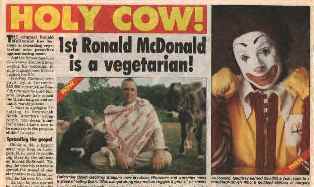
"The clown who starred as Ronald McDonald in McDonald's telly ads has
quit to lead a crusade against burgers. Actor Geoffrey Giuliano - famous
world-wide as the burger-loving clown - revealed he is a vegetarian!
He has pledged to rescue animals from the slaughterhouse "as my way
of saying sorry for selling out to concerns who make millions out of murdering
them." Giuliano, 38, has bought ten calves who wander free on his "Cow
Protection Estate" in New York State."
This is not exactly breaking news, but interesting nevertheless.
Meatless Like Me
http://www.slate.com/id/2190872
UNITED STATES, July 7, 2008: Every vegetarian remembers his first time.
Not the unremarkable event of his first meal without meat, mind you. No,
I mean the first time he casually lets slip that he’s turned herbivore,
prompting everyone in earshot to stare at him as if he just revealed plans
to sail his carrot-powered plasma yacht to Neptune. For me, this first
time came at an Elks scholarship luncheon in rural Oregon when I was 18.
All day, I’d succeeded at seeming a promising and responsible young man,
until that fateful moment when someone asked why I hadn’t taken any meat
from the buffet. After I offered my reluctant explanation–and the guy announced
it to the entire room–30 people went eerily quiet, undoubtedly expecting
me to launch into a speech on the virtues of hemp. In the corner, an elderly,
suited man glared at me as he slowly raised a slice of bologna and executed
the most menacing bite of cold cut in recorded history. I didn’t get the
scholarship.
I tell this story not to win your pity but to illustrate a point: I’ve
been vegetarian for a decade, and when it comes up, I still get a look
of confused horror that says, “But you seemed so … normal.” The U.S. boasts
more than 10 million herbivores today, yet most Americans assume that every
last one is a loopy, self-satisfied health fanatic, hell-bent on draining
all the joy out of life. To demonstrate what a vegetarian really is, let’s
begin with a simple thought experiment. Imagine a completely normal person
with completely normal food cravings, someone who has a broad range of
friends, enjoys a good time, is carbon-based, and so on. Now remove from
this person’s diet anything that once had eyes, and, wham!, you have yourself
a vegetarian.
To read this very humorous and lengthy article on the joys of vegetarianism
in America, please go to source above.
hinduism today
Meatless Like Me
http://www.slate.com/id/2190872
I may be a vegetarian, but I still love the smell of bacon.
By Taylor Clark
Every vegetarian remembers his first time. Not the unremarkable event
of his first meal without meat, mind you. No, I mean the first time he
casually lets slip that he's turned herbivore, prompting everyone in earshot
to stare at him as if he just revealed plans to sail his carrot-powered
plasma yacht to Neptune. For me, this first time came at an Elks scholarship
luncheon in rural Oregon when I was 18. All day, I'd succeeded at seeming
a promising and responsible young man, until that fateful moment when someone
asked why I hadn't taken any meat from the buffet. After I offered my reluctant
explanation—and the guy announced it to the entire room—30 people went
eerily quiet, undoubtedly expecting me to launch into a speech on the virtues
of hemp. In the corner, an elderly, suited man glared at me as he slowly
raised a slice of bologna and executed the most menacing bite of cold cut
in recorded history. I didn't get the scholarship.
I tell this story not to win your pity but to illustrate a point: I've
been vegetarian for a decade, and when it comes up, I still get a look
of confused horror that says, "But you seemed so … normal." The U.S. boasts
more than 10 million herbivores today, yet most Americans assume that every
last one is a loopy, self-satisfied health fanatic, hellbent on draining
all the joy out of life. Those of us who want to avoid the social nightmare
have to hide our vegetarianism like an Oxycontin addiction, because admit
it, omnivores: You know nothing about us. Do we eat fish? Will we panic
if confronted with a hamburger? Are we dying of malnutrition? You have
no clue. So read on, my flesh-eating friends—I believe it's high time we
cleared a few things up.
To demonstrate what a vegetarian really is, let's begin with a simple
thought experiment. Imagine a completely normal person with completely
normal food cravings, someone who has a broad range of friends, enjoys
a good time, is carbon-based, and so on. Now remove from this person's
diet anything that once had eyes, and, wham!, you have yourself a vegetarian.
Normal person, no previously ocular food, end of story. Some people call
themselves vegetarians and still eat chicken or fish, but unless we're
talking about the kind of salmon that comes freshly plucked from the vine,
this makes you an omnivore. A select few herbivores go one step further
and avoid all animal products—milk, eggs, honey, leather—and they call
themselves vegan, which rhymes with "tree men." These people are intense.
Vegetarians give up meat for a variety of ethical, environmental, and
health reasons that are secondary to this essay's goal of increasing brotherly
understanding, so I'll mostly set them aside. Suffice it to say that one
day, I suddenly realized that I could never look a cow in the eyes, press
a knocking gun to her temple, and pull the trigger without feeling I'd
done something cruel and unnecessary. (Sure, if it's kill the cow or starve,
then say your prayers, my bovine friend—but for now, it's not quite a mortal
struggle to subsist on the other five food groups.) I am well-aware that
even telling you this makes me seem like the kind of person who wants to
break into your house and liberate your pet hamster—that is, like a PETA
activist. Most vegetarians, though, would tell you that they appreciate
the intentions of groups like PETA but not the obnoxious tactics. It's
like this: We're all rooting for the same team, but they're the ones in
face paint, bellowing obscenities at the umpire and flipping over every
car with a Yankees bumper sticker. I have no designs on your Camry or your
hamster.
Now, when I say that vegetarians are normal people with normal food
cravings, many omnivores will hoist a lamb shank in triumph and point out
that you can hardly call yourself normal if the aroma of, say, sizzling
bacon doesn't fill you with deepest yearning. To which I reply: We're not
insane. We know meat tastes good; it's why there's a freezer case at your
supermarket full of woefully inadequate meat substitutes. Believe me, if
obtaining bacon didn't require slaughtering a pig, I'd have a BLT in each
hand right now with a bacon layer cake waiting in the fridge for dessert.
But, that said, I can also tell you that with some time away from the butcher's
section, many meat products start to seem gross. Ground beef in particular
now strikes me as absolutely revolting; I have a vague memory that hamburgers
taste good, but the idea of taking a cow's leg, mulching it into a fatty
pulp, and forming it into a pancake makes me gag. And hot dogs … I mean,
hot dogs? You do know what that is, right?
As a consolation prize we get tofu, a treasure most omnivores are more
than happy to do without. Well, this may stun you, but I'm not any more
excited about a steaming heap of unseasoned tofu blobs than you are. Tofu
is like fugu blowfish sushi: Prepared correctly, it's delicious; prepared
incorrectly, it's lethal. Very early in my vegetarian career, I found myself
famished and stuck in a mall, so I wandered over to the food court's Asian
counter. When I asked the teenage chief culinary artisan what was in the
tofu stir-fry, he snorted and replied, "Shit." Desperation made me order
it anyway, and I can tell you that promises have rarely been more loyally
kept than this guy's pledge that the tofu would taste like shit. So here's
a tip: Unless you know you're in expert hands (Thai restaurants are a good
bet), don't even try tofu. Otherwise, it's your funeral.
As long as we're discussing restaurants, allow me a quick word with
the hardworking chefs at America's dining establishments. We really appreciate
that you included a vegetarian option on your menu (and if you didn't,
is our money not green?), but it may interest you to know that most of
us are not salad freaks on a grim slog for nourishment. We actually enjoy
food, especially the kind that tastes good. So enough with the bland vegetable
dishes, and, for God's sake, please make the Gardenburgers stop; it's stunning
how many restaurants lavish unending care on their meat dishes yet are
content to throw a flavorless hockey puck from Costco into the microwave
and call it cuisine. Every vegetarian is used to slim pickings when dining
out, so we're not asking for much—just for something you'd like to eat.
I'll even offer a handy trick. Pretend you're trapped in a kitchen stocked
with every ingredient imaginable, from asiago to zucchini, but with zero
meat. With no flesh available, picture what you'd make for yourself; this
is what we want, too.
to day spas are often unfazed that an equally smart pig suffered
and died to become their McMuffin? Yes, I do. (Or, to use a more pressing
example, how many Americans will bemoan Eight Belles' fatal Kentucky Derby
injury tonight at the dinner table between bites of beef?) Would I prefer
it if we at least raised these animals humanely? Yes, I would.
Let's be honest, though: I'm not exactly St. Francis of Assisi over
here, tenderly ministering to every chipmunk that crosses my path. I try
to represent for the animal kingdom, but take a look at my shoes—they're
made of leather, which, I am told by those with expert knowledge of the
tanning process, comes from dead cows. This is the sort of revelation that
prompts meat boosters to pick up the triumphant lamb shank once again and
accuse us of hypocrisy. Well, sort of. (Hey, you try to find a pair of
nonleather dress shoes.) My dedication to the cause might be incomplete,
but I'd still say that doing something beats doing nothing. It's kind of
like driving a hybrid: not a solution to the global-warming dilemma but
a decent start. Let's just say that at the dinner table, I roll in a Prius.
Finally, grant me one more cordial request: Please don't try to convince
us that being vegetarian is somehow wrong. If you're concerned for my health,
that's very nice, though you can rest assured that I'm in shipshape. If
you want to have an amiable tête-à-tête about vegetarianism,
that's great. But if you insist on being the aggressive blowhard who takes
meatlessness as a personal insult and rails about what fools we all are,
you're only going to persuade me that you're a dickhead. When someone says
he's Catholic, you probably don't start the stump speech about how God
is a lie created to enslave the ignorant masses, and it's equally offensive
to berate an herbivore. I know you think we're crazy. That's neat. But
seeing as I've endured the hassle of being a vegetarian for several years
now, perhaps I've given this a little thought. So let's just agree to disagree
and get on with making fun of Hillary Clinton's inability to operate a
coffee machine.
Because, really, peace and understanding are what it's all about: your
porterhouse and my portobello coexisting in perfect harmony—though preferably
not touching. We're actually not so different, after all, my omnivorous
chums. In fact, I like to think that when an omnivore looks in the mirror,
he just sees a vegetarian who happens to eat meat. Or, no, wait, maybe
the mirror sees the omnivore through the prism of flesh and realizes we
all have a crystalline animal soul, you know?
This is excellent weed, by the way, if you want a hit. Hey, while you're
here: Have I ever told you about hemp?
Hare Krishna Cuisine in Gourmet Magazine’s Top 100
http://news.iskcon.com/hare_krishna_cuisine_gourmet_magazine’s_top_100
By Vyenkata Bhatta Dasa on 19 Jan 2008
New York City The folks at Saveur, an award-winning international
dining magazine, are self-proclaimed fanatics when it comes to helping
readers “savor a world of authentic cuisine.” Like a trusted friend who
can’t resist sharing a good recipe with you, they pride themselves on preaching
the glories of the best food and drink wherever they find it. And they
pack their most zealous and fervent recommendations into their popular
Saveur 100 issue an annual list of “favorite restaurants, food, drink,
people, places and things.” This year that list included the cuisine of
the International Society for Krishna Consciousness (ISKCON) under
the heading “A Faith that Nourishes,” the magazine deemed Hare Krishna
temple dining halls “one of the best restaurant chains in the world.”
The entire entry, reproduced below, has much praise for the Krishna
consciousness movement’s kitchen skills. “We always seek out the nearest
[Hare Krishna temple] for a satisfying, meatless meal,” the magazine reports,
adding that the “Hare Krishna brand of Westernized Indian food renews our
spirits every time.” The magazine especially recommends attending the Sunday
Feast program held at ISKCON temples worldwide.
The culinary kudos came after a Saveur reporter who had apparently
been introduced to ISKCON in his youth through “Krishna-core” bands like
Shelter and 108, and had eaten prasadam (sanctified vegetarian food) at
temples and Govinda’s restaurants contacted the ISKCON temple in Brooklyn,
New York. He stopped by, sampled the regular menu, and was so impressed
that he decided to use the New York temple as the model for Hare Krishna
dining halls around the world. He set up a photographer to visit as well.
The Saveur’s piece includes a color picture of Satya Devi Dasi, Vice
President of the temple and resident catering mastermind, in traditional
devotional attire and holding a bowl of cabbage subji.
For the devotees at the temple, home to Sri Sri Radha Govinda deities,
the media attention confirmed the need to re-focus on prasadam distribution.
After a six-year hiatus, the devotees have resumed their successful Govinda’s
lunch club program, serving a full menu from 11:30 am to 3:00pm daily.
In addition, the devotees provide a wide array of catering services.
Temple president Ramabhadra Dasa feels that the Saveur article has already
started to make a positive impact. “Catering orders have increased,” he
said, “and the potential success for a [full-scale] restaurant is apparent….
The food must be good, and the atmosphere and customer relations must be
good. If those elements are there then lack of the best location is less
likely to make or break you.”
ISKCON Founder-Acarya A.C. Bhaktivedanta Swami Prabhupada placed great
emphasis on prasadam as a part of spiritual life so much so that
he is believed to have light-heartedly referred to the Hare Krishna movement
as “the kitchen religion.” Prabhupada also famously prophesized that New
York City could be “conquered by prasadam distribution.”
An interesting post-script: the Saveur magazine which includes the Hare
Krishna write-up is, appropriately enough, issue number 108.
With reporting from Caitanyananda Dasa
22. A Faith That Nourishes
Dressed in saffron saris and sporting their signature ponytails, Hare
Krishna devotees—who subscribe to a spiritual system, based on Hindu practices,
that was imported to the United States from India in the 1960s—strike many
Americans as relics of our country's counterculture past. The truth is,
the International Society of Krishna Consciousness, as the religious group
is officially known, is still going strong, operating more than 400 temples
worldwide. Here's another little-known fact: Hare Krishna adherents run
one of the best restaurant chains in the world. Called Govinda’s, these
Hare Krishna TEMPLE DINING HALLS serve inexpensive, freshly prepared Indian-style
vegetarian food to believers and nonbelievers alike. Whether we're in Dallas
or Dublin, Brooklyn or Budapest, we always seek out the nearest one for
a satisfying, meatless meal. Sundays are the best time to go; the buffet-style
meal on that day, still referred to by some old-timers as the Sunday love
feast, is free. From potato-stuffed samosas and paneer subji (soft cheese
with peas and potatoes) to spiced cabbage with peas and tofu, the Hare
Krishna brand of Westernized Indian food renews our spirits every time.
Source: Saveur magazine http://www.saveur.com/back-issue/miscellaneous/2008-saveur-100-21046800.html#temple
Global Wheat Shortage Due to Meat Consumption?
http://business.timesonline.co.uk/tol/business/industry_sectors/natural_resources/article3423734.ece
Date: Thu Feb 28, 2008 10:26 am ((PST))
'Booming populations and a switch to a meat-rich diet in the developing
world also mean that about 110m tons of the world€ ¦’²s
annual wheat crop is being diverted to feed livestock.'
THE world is only ten weeks away from running out of wheat supplies
after stocks fell to their lowest levels for 50 years.
The crisis has pushed prices to an all-time high and could lead
to further hikes in the price of bread, beer, biscuits and other basic
foods.
It could also exacerbate serious food shortages in developing
countries especially in Africa.
The crisis comes after two successive years of disastrous wheat
harvests, which saw production fall from 624m to 600m tonnes, according
to the United Nations€ ¦’² Food and Agriculture Organisation
(FAO).
Experts blame climate change as heatwaves caused a slump in harvests
last year in eastern Europe, Canada, Morocco and Australia, all big wheat
producers.
Booming populations and a switch to a meat-rich diet in the developing
world also mean that about 110m tons of the world€ ¦’²s
annual wheat crop is being diverted to feed livestock.
Short term pressures have compounded the problem. Speculative
buying by investors gambling on further price rises has further pushed
up prices.
Though shortages are often blamed on the use of land for biofuel
crops, the main biofuel cereal crop is maize, not wheat. Farmers have brought
millions of acres of fallow land into production and the FAO predicts that
the shortages could be eliminated within 12 months.
Jewish Vegetarians Weigh in Against "Animal-based Agriculture"
http://news.iskcon.com/node/940
By Sam Hodges for Dallas Morning News on 10 Mar 2008
New York - March 6, 2008 -- The Jewish Vegetarians of North America
(JVNA) announced today that it strongly commends the Union of Concerned
Scientists (UCS) for initiating a "Scientists and Economists' Call to Action,"
which urges U.S.-based scientists and economists to sign a letter which
calls for "policies that will ensure swift and deep reductions in U.S.
emissions of heat-trapping gases."
"Since climate change is today's greatest challenge," stated JVNA president
Richard H. Schwartz, "we applaud UCS for their important initiative. But
they, like most scientific groups, are overlooking 'an inconvenient truth'
that even Al Gore has not sufficiently addressed -- A November, 2006 report
from the UN Food and Agriculture Organization (FAO) documented that animal-based
agriculture emits more greenhouse gases (in CO2 equivalents) than all forms
of transportation worldwide combined (18% vs. 13.5%).
Also very significant is that this report projects a doubling of farmed
animals in the next 50 years. If that happens, the increased greenhouse
gas emissions would negate the effects of many positive lifestyle and industrial
changes, making it very difficult to avoid the worse effects of global
climate change. Hence, it is essential that UCS and other environmental
groups make a major societal shift to vegetarianism a societal imperative."
JVNA is eager to engage with rabbis and other Jewish leaders in a respectful
debate on the issue, "Should Jews Be Vegetarians Today?" The group urges
rabbis and other Jewish leaders to consider how a shift toward plant-based
diets would: improve the health of Jews and others; show the relevance
of Judaism's eternal teachings to current societal challenges, thus helping
to revitalize Jewish life; and, most importantly, help move an imperiled
world to a sustainable path.
Further information about the JVNA and its mission to get vegetarianism
onto the Jewish and other agendas may be obtained at the JVNA web site
http://www.JewishVeg.com
or by contacting Dr. Schwartz (president@JewishVeg.com). A complimentary
copy of JVNA's new one-hour documentary "A SACRED DUTY: Applying Jewish
Values to Help Heal the World" will be sent to those who indicate how they
might arrange a screening or promote the movie in some other way. The entire
movie can also be viewed at http://www.ASacredDuty.com,
a site that also has background material re the film, which was produced
by Emmy-award winning producer Lionel Friedberg.
The myth of the rising cost of food
http://www.deltaflow.com/?p=441
The BBC has a feature on “the cost of food“. It shows how almost all
types of food are getting more and more expensive. Drastically so!
What is happening here? Shouldn’t modern high-tech farming with its
nitrogen fertilizers, pesticides and specially breed (and often genetically
modified) high-yield crop varieties allow humanity to easy feed everyone
on the planet? Hasn’t Norman Borlaug’s Green Revolution dramatically increased
the amount of food the world can produce (e.g. doubling wheat yield between
1965 and 1970)? Haven’t exports of food increased by 400% over the last
40 years, promoting the distribution of foods from countries with lots
of farmland to those without the capacity to grow lots of food?
The news reporters give two possible explanations of the rising cost
of food (both bogus):
The world population is increasing. Soon 6 billion people now live
on the planet and the number is expected to rise by 9 billion in 2050.
Feeding more mounts costs more money. Moreover, with the rising wealth
of countries like China and India the people in these countries consume
more food. “To put it bluntly, rich people eat more than poor people”,
says the BBC.
The increasing use of corn for biofuels (ethanol) is decreasing the
amount of the crop that can be used for food. A lower supply coupled with
increasing demand due to an increasing world population naturally leads
to higher costs.
Makes sense, right? Wrong!
Sure, the world population is increasing, but so are yields of crops.
Sure, the use of corn for fuel is increasing, but the increase in the cost
of corn has been comparatively low compared with crops like rice, soya
and wheat.
The real problem is shown, but not commented upon, in the original BBC
feature, as well as in other news sources. It is the increasing consumption
of meat.
The statistics show how producing meat is radically more resource intensive
than producing vegetarian foodstuffs. But take a look back at the original
article: the price of meat (and sugar) is not increasing very much at all.
What is going on here? Why are all foods except meat getting more expensive,
when meat is the single most expensive food to produce?!
One word: subsidies.
The United States spends 35% (the greatest single amount) of its total
$8 billion agricultural subsidies budget on “feed grains” for livestock.
The European Union spends a whooping $76 billion on food subsidies and
18% of it (the greatest single amount) goes to subsidizing beef production.
So, between them, the EU and USA spend at least $16 billion on keeping
the price of meat lower than it should be, given its true cost.
So, what to do?
It’s actually really simple: promote vegetarianism throughout the world
and simultaneously eliminate subsidies on meat. Without subsidies meat
will get so expensive that few people can afford it. Would you buy a Big
Mac if it cost $34 a burger?
If a vegetarian diet is advertised as the logical, cheaper, healthier
alternative, then people will naturally stop eating dead animals. That
lowering of demand will make it more difficult to sell the quantities of
meat which are currently produced. Farmers will be forced to switch from
growing “feed grain” to producing “grain for human consumption”. This,
I estimate, can result in a tenfold increase in the amount of available
food. Enough to easily feed a world population of 60 billion!
(An added side-benefit would be a huge reduction in the number of people
that get cancer, resulting in lower health-care costs and longer life-spans.
Large-scale studies in Europe and the USA have proven without a doubt that
meat eating causes many different types of cancer)
This entry was posted on Saturday, March 22nd, 2008 at 4:27 pmand is
filed under management, news. You can follow any responses to this entry
through the RSS 2.0 feed. You can skip to the end and leave a response.
Pinging is currently not allowed.
Go Vego to Save the World
http://www.atmayoga.com.au/blog/?p=270
April 22, 2008 on 12:08 pm
McCartney urges vegetarianism to fight climate ills
Posted Mon Apr 21, 2008 8:37pm AEST on ABC.net.au
Former Beatle Paul McCartney is urging the world to go vegetarian in
a bid to fight global warming and is surprised more green groups do not
promote it.
In an interview with the animal rights group People for the Ethical
Treatment of Animals (PETA), McCartney said the global meat industry was
a major contributor to global warming.
“The biggest change anyone could make in their own lifestyle would be
to become vegetarian,” McCartney, a long time vegetarian and advocate of
vegetarianism, said.
“I would urge everyone to think about taking this simple step to help
our precious environment and save it for the children of the future.”
McCartney says the amount of land and water used to maintain the meat
industry makes it a major contributor to climate change and complains that
most environmental groups do not list vegetarianism as one of their top
priorities.
“It’s very surprising that most major environmental organisations are
leaving the option of going vegetarian off their lists of top ways to curtail
global warming,” he said.
A 2006 United Nations report found that cattle-rearing generated more
greenhouse gases than transportation.
The planet is “forced” into vegetarianism
http://www.prabhupada.org/rama/?p=4247
There are two kinds of people, those that learn by hearing and those
that learn by their own experience. The second method it takes longer and
is more painful but seems to be necessary for the majority of people in
our age.
When the Hare Krishna movement appeared in the West to teach about a
life in accordance with the lows of God and therefore protection of the
cow and vegetarian diet it was derided and considered religious fanaticism.
Now, as the disastrous consequences of a hedonistic behavior abusing
God’s material resources become more and more evident, humanity is obliged
to reconsider its habits by force and we have much discussion about solutions
and alternatives.
Gandhi said “the world has enough for everyone’s need, but not for everyone’s
greed”.
The following is an article appeared recently in NY times and Digg and
it is interesting to see how people start perceiving glimpses of what the
Vedic sages have been teaching for centuries.
This article is written in the classical materialistic mentality of
continuing gratifying your senses while avoiding the consequences by a
scientific arrangement, so they suggest artificial meat as the solution,
but as there are many comments discussing it and there is a frequent mention
of vegetarianism I found this reading eventually useful for preaching purposes.
Here is the link to the original article entitled: “Can People Have
Meat and a Planet, Too?” with hundreds of comments:
Can People Have Meat and a Planet, Too?
http://dotearth.blogs.nytimes.com/2008/04/11/can-people-have-meat-and-a-planet-too/index.html?ref=science
and the same one commented by the Digg’s community
http://digg.com/environment/Can_People_Have_Meat_and_a_Planet_Too
E-Book Released: "How to Successfully Become a Vegetarian"
http://veggie123.com
USA, March 31, 2008: The above website has published a free e-book called
"How to Successfully Become a Vegetarian." The book describes the basic
forms of vegetarianism, a history, reasons for becoming vegetarian and
then the various issues one faces: nutrition, eating out, cooking, child's
nutrition, etc. A useful resource.
hinduism today
Finding the Best Way to Cook All Those Vegetables
http://news.iskcon.com/node/1033/2008-05-21/finding_best_way_cook_all_those_vegetables
By Tara Parker-Pope for The New York Times on 21 May 2008
By now, most people know they should be eating more vegetables. But
are there ways to get more from the vegetables you already eat?
A growing body of research shows that when it comes to vegetables, it’s
not only how much we eat, but how we prepare them, that influences the
amount of phytochemicals, vitamins and other nutrients that enter our body.
The benefits are significant. Numerous studies show that people who
consume lots of vegetables have lower rates of heart disease, hypertension,
diabetes, eye problems and even cancer. The latest dietary guidelines call
for 5 to 13 servings — that is two and a half to six and a half cups a
day. For a person who maintains her weight on a 2,000-calorie-a-day diet,
this translates into nine servings, or four and a half cups a day, according
to the Harvard School of Public Health. But how should they be served?
Surprisingly, raw and plain vegetables are not always best. In The British
Journal of Nutrition next month, researchers will report a study involving
198 Germans who strictly adhered to a raw food diet, meaning that 95 percent
of their total food intake came from raw food. They had normal levels of
vitamin A and relatively high levels of beta carotene.
But they fell short when it came to lycopene, a carotenoid found in
tomatoes and other red-pigmented vegetables that is one of the most potent
antioxidants. Nearly 80 percent of them had plasma lycopene levels below
average.
“There is a misperception that raw foods are always going to be better,”
says Steven K. Clinton, a nutrition researcher and professor of internal
medicine in the medical oncology division at Ohio State University. “For
fruits and vegetables, a lot of times a little bit of cooking and a little
bit of processing actually can be helpful.”
The amount and type of nutrients that eventually end up in the vegetables
are affected by a number of factors before they reach the plate, including
where and how they were grown, processed and stored before being bought.
Then, it’s up to you. No single cooking or preparation method is best.
Water-soluble nutrients like vitamins C and B and a group of nutrients
called polyphenolics are often lost in processing. For instance, studies
show that after six months, frozen cherries have lost as much as 50 percent
of anthocyanins, the healthful compounds found in the pigment of red and
blue fruits and vegetables. Fresh spinach loses 64 percent of its vitamin
C after cooking. Canned peas and carrots lose 85 percent to 95 percent
of their vitamin C, according to data compiled by the University of California,
Davis.
Fat-soluble compounds like vitamins A, D, E and K and the antioxidant
compounds called carotenoids are less likely to leach out in water. Cooking
also breaks down the thick cell walls of plants, releasing the contents
for the body to use. That is why processed tomato products have higher
lycopene content than fresh tomatoes.
In January, a report in The Journal of Agriculture and Food Chemistry
concluded that over all, boiling was better for carrots, zucchini and broccoli
than steaming, frying or serving them raw. Frying was by far the worst..
Still, there were tradeoffs. Boiling carrots, for instance, significantly
increased measurable carotenoid levels, but resulted in the complete loss
of polyphenols compared with raw carrots.
That report did not look at the effects of microwaving, but a March
2007 study in The Journal of Food Science looked at the effects of boiling,
steaming, microwaving and pressure cooking on the nutrients in broccoli.
Steaming and boiling caused a 22 percent to 34 percent loss of vitamin
C. Microwaved and pressure-cooked vegetables retained 90 percent of their
vitamin C.
What accompanies the vegetables can also be important. Studies at Ohio
State measured blood levels of subjects who ate servings of salsa and salads.
When the salsa or salad was served with fat-rich avocados or full-fat salad
dressing, the diners absorbed as much as 4 times more lycopene, 7 times
more lutein and 18 times the beta carotene than those who had their vegetables
plain or with low-fat dressing.
Fat can also improve the taste of vegetables, meaning that people will
eat more of them. This month, The American Journal of Preventive Medicine
reported on 1,500 teenagers interviewed in high school and about four years
later on their eating habits. In the teenage years, many factors influenced
the intake of fruits and vegetables. By the time the study subjects were
20, the sole factor that influenced fruit and vegetable consumption was
taste. Young adults were not eating vegetables simply because they didn’t
like the taste.
“Putting on things that make it taste better — spices, a little salt
— can enhance your eating experience and make the food taste better, so
you’re more likely to eat vegetables more often,” Dr. Clinton said.
Because nutrient content and taste can vary so widely depending on the
cooking method and how a vegetable is prepared, the main lesson is to eat
a variety of vegetables prepared in a variety of ways.
As Susan B. Roberts, director of the energy metabolism laboratory at
the Tufts University Friedman School of Nutrition, put it, “Eating a variety
of veggies is especially important so you like them enough to eat more.”
The Home Front Diet
During World War II the UK underwent rationing, but the key wasn't the
restriction of food but that the aim was to get the country healthy.
However one source of food was not rationed Vegetables.
It is noted that during the war years although there was less of everything
the country was at it's healthiest something that is little noted or appreciated,
even today with our access to many food products we are considered not
to be as healthy as during these years of austerity.
The aim of the government to make the citizens healthy was summed up
by Woolton Pie a simple vegetable dish
The Recipe:
1Ib each of diced potatoes, cauliflower, Swedes and carrots; Three or
Four spring onions;
One teaspoonful of vegetable extract
One teaspoonful of oatmeal.
METHOD
Cook all together for ten minutes with just enough water to cover.
Stir occasionally to prevent the mixture from sticking.
Allow to cool; put into a pie dish, sprinkle with chopped parsley and
cover with a crust of potatoes or whole meal pastry.
Bake in a moderate oven until the pastry is nicely brown
Taking out the onions it actually makes a tasty meal.
Another interesting fact is this that during the war it was illegal
to throw away or waste food, this was punishable by a prison term, now
look at the unhealthy and wasteful diet we have today. Interesting historical
fact that we could learn from.
Proud Vegetarians, in Costume, Take to the Streets
http://news.iskcon.com/node/1034/2008-05-21/proud_vegetarians_costume_take_streets
By Cara Buckley for The New York Times on 21 May 2008
There was a parade on Sunday that brought all manner of people who love
flora and defend fauna to the city’s streets. It took place in downtown
Manhattan and organizers called it Veggie Pride.
The festivities began at noon in the meatpacking district — get it?
— and drew about 600 people and at least one vegan dog — Simba, a tofu-fed
black Labrador retriever. Some people dressed up as bananas, or heads of
broccoli, or pigs or bloodied cows. A police officer, Jim Alberici, who
was helping with crowd control, said he did not expect any violence. “Not
unless someone shows up dressed as a meat processor,” he said.
No one did.
The parade’s participants wended their way peacefully through Greenwich
Village to Washington Square Park, led by a seven-foot-tall pea pod and
an outsize carrot, who would later marry onstage in a faux ceremony. A
giant pink replica of a human colon, replete with polyps and a sullied
colostomy bag, brought up the rear.
“The worst part was Googling images of colons on the Internet,” said
the colon’s maker, Dan Piraro, who is also a nationally syndicated cartoonist.
He made the colon out of pink netting, plastic ties, bamboo sticks, cardboard,
packing material, paint and hot glue, and three people were needed to hold
it aloft. Mr. Piraro’s point, of course, was that meat can be harsh on
the large intestine.
The parade was the brainchild of Pamela Rice, the author of a widely
distributed pamphlet, “101 Reasons Why I’m a Vegetarian.” She was inspired
by a similar parade held annually in Paris, and was also driven by the
sense that the time for vegetarian pride was nigh. After all, she said,
awareness about animal cruelty and the environmental perils of factory
farming is spreading, as is the widening realization of the health hazards
of meat.
Too often, Ms. Rice said, vegetarianism had been overshadowed by other
causes.
“Today’s our day; we wanted to stand apart,” Ms. Rice said. “Apart from
the yoga people. Apart from the New Age people. It’s just us today. We
usually get the short shrift.”
The parade drew advocates from the United Poultry Concerns (“Dedicated
to the Compassionate and Respectful Treatment Of Domestic Fowl”) and the
Jewish Vegetarians of North America and members of the Supreme Master Ching
Hai International Organization, a spiritual and avowedly vegetarian group.
It drew Roni Shapiro, who runs a vegan meal delivery service in Woodstock,
N.Y. Ms. Shapiro dressed up as a pig and carried a sign that read, “No
I don’t have any spare ribs.” And it drew Rick Panson, who grows “sprouted
foods” and showed up wearing a large thatch of wheat grass on his head.
“I’ll juice it later,” Mr. Panson said.
Also in attendance was Bernard Goetz, who embraced vegetarianism around
20 years ago, after he became known as a vigilante for shooting four youths
he believed were intent on robbing him on a Seventh Avenue express train
in 1984.
Mr. Goetz said he lamented people’s “distant, shallow and bad” attitudes
toward animals. “The world is a deader place because of mankind’s relationship
with animals,” he said.
Though it was a parade for vegetarians and vegans, some meat eaters
quietly joined the ranks. Victoria and Edward Feltz of Hamilton, N.J.,
walked in the parade with their children, Noah, 1, and Autumn, 3, who were
in a double stroller that was strewn with pro-vegetarian signs. “Be kind
to little critters,” read one. But while Ms. Feltz is a devout vegetarian,
Mr. Feltz is not, and the children eat meat, too. “We fight about it every
day,” Ms. Feltz said sadly. Mr. Feltz conceded that he struggled with the
animal cruelty issues involved in eating meat. “I’ve given it up for Lent,”
he said, a hangdog expression on his face.
Another couple, Lisa Melian and Matt Belluardo, dressed up as bloodied
cows, and carried signs that read, “We all bleed red.” Secretly, however,
Mr. Belluardo is an omnivore.
“I’m vegan,” said Ms. Melian. “He’s here for support.”
The parade arrived at Washington Square Park about 1 p.m. Vegan jerky
sticks were passed about, and a costume competition was held. One of the
winners was Bex Vargas, an artist who lives in Queens and was dressed as
a head of broccoli. Ms. Vargas, 26, had brought the costume in a bag. Once
offstage, she admitted that she was exhausted and yearned to go home, but
feared that her costume would invite harassment on the subway. “I don’t
know if I’ll even fit through the turnstile,” she said.
Rain began to fall and the crowd started to disperse, yet through the
drizzle a long line stretched from Thiru Kumar’s dosa cart, a vegetarian
stand that won an award for best street food last year.
Perhaps unsurprisingly, business was decidedly thin at Salem Atwah’s
hot-dog stand, on the southwest corner or Washington Square South and LaGuardia
Place. Rarely, Mr. Atwah said, had he sold so few hot dogs.
“It’s because of the vegetarians,” he said. “It’s one of my worst days
in four years.”
Faux Meat Fake Out on 'Hell's Kitchen'
http://blog.vegcooking.com/2008/05/faux_meat_fake_out_on_hells_ki.php
I don't know how I missed this, but on the last episode of Hell's Kitchen,
Chef Ramsay asked the remaining contestants to identify the missing ingredient
in three dishes: chicken parmesan, beef stew, and sausage ravioli. Not
one of the chefs could identify the missing ingredient in any of the dishes—meat.
That's right, Chef Ramsay replaced the chicken and beef with vegetarian
Gardein "meats" (available at Whole Foods deli counters and in California
and Arizona as the brand It's All Good), and the sausage with Lightlife's
soy sausage. Even Ben, who claims that he has "the best palate in the world,"
couldn't tell that they were faux meats.
Similar products are available here in NZ http://www.blissfulvege.com/
in Auckland)
If you're a fan of these products or Morningstar Farms Meal Starter
Strips, this probably isn't very surprising to you either, since these
products taste great and have a convincing texture. As always, I was amused
by the show, but definitely not surprised. You can watch the clip here:
KFCs in Canada to Offer Vegan Chicken!
http://blog.vegcooking.com/2008/06/kfcs_in_canada_to_offer_vegan.php
No joke. You read that title right. As a part of the deal that KFC Canada
has just signed with PETA (a.k.a. a huge campaign victory), the chain has
agreed to start offering a vegetarian chicken sandwich at 461 of its 711
stores.
The Classic Vegetarian Sandwich, which can easily be made vegan by asking
for it in a wrap and with no mayo, should be available sometime in July.
I don't have any more details at the moment about which company will be
making the vegan chicken or if KFC Canada will do that itself, but stay
tuned for updates. Also, I hope that all of you Canadian readers will try
it out as soon as it's available and let us know how it is. I personally
have never found a vegan chicken I don't like, and I suspect this one will
be yummy too.
Read more about PETA's KFC Canada victory here http://getactive.peta.org/campaign/canada_kfc_victory
BBC Newsnight vegetarianism
http://www.dandavats.com/?p=5901
Radha Mohan das: Please visit this blog and make comments. Last night
Nightnight on the BBC discussed the issue of vegetarianism because the
issue came up in the UN Conference.
http://www.bbc.co.uk/blogs/newsnight/2008/06/is_it_time_to_turn_vegetarian.html
ys
Radha Mohan das
Bhaktivedanta Manor Communications Secretary
07818 815 978 (m)
01923 851 003 (w)
Talk about Newsnight
http://www.bbc.co.uk/blogs/newsnight/2008/06/is_it_time_to_turn_vegetarian.html
Is it time to turn vegetarian?
Newsnight
3 June 08, 12:30 PM
"The best solution would be for us all to become vegetarians".
So suggested the head of the UN climate agency, Yvo de Boer, who is
attending UN-led climate talks in Germany this week. He was responding
to criticism that measures to tackle climate change are partly to blame
for the rise in food and energy costs. Carbon-cutting biofuels, for example,
use food crops to make alternatives to gasoline.
Meanwhile, Patrick Wall, chairman of the European Food Safety Authority,
has questioned whether it is "morally or ethically correct" to be feeding
grain to animals while people starve. Speaking to the Times, he argued
that it's time to end the EU ban on the use of animal remains to feed pigs
and chickens. Lifting the ban would allow grain to be diverted to millions
of starving people.
And the UN's Food and Agriculture Organisation, hosting a much publicised
summit in Rome this week, has warned of global catastrophe unless food
reaches parts of the world where it is needed most.
So, does the global food crisis demand a radical rethink of how we distribute
food? Should we worry less about feeding our animals and prioritise getting
grain to people suffering food shortages - even if that affects the availability
of meat?
Is it time for us all to become vegetarian? Leave your comments below.
And remember when Ethical Man went vegan for a month to reduce his carbon
footprint?
Watch again here: http://www.bbc.co.uk/blogs/newsnight/2008/06/is_it_time_to_turn_vegetarian.html
